
Unbiased headlines. Facts, not spin.
Every story is an unbiased news briefing written from 110+ sources across the spectrum — sources linked so you can verify it yourself.
 tech
Notable (6/10)
July 2, 2026 at 06:21 AM
tech
Notable (6/10)
July 2, 2026 at 06:21 AM
Amazon Is Building Its Own AI Chips for Echo and Fire TV, Devices Chief Panos Panay Confirms
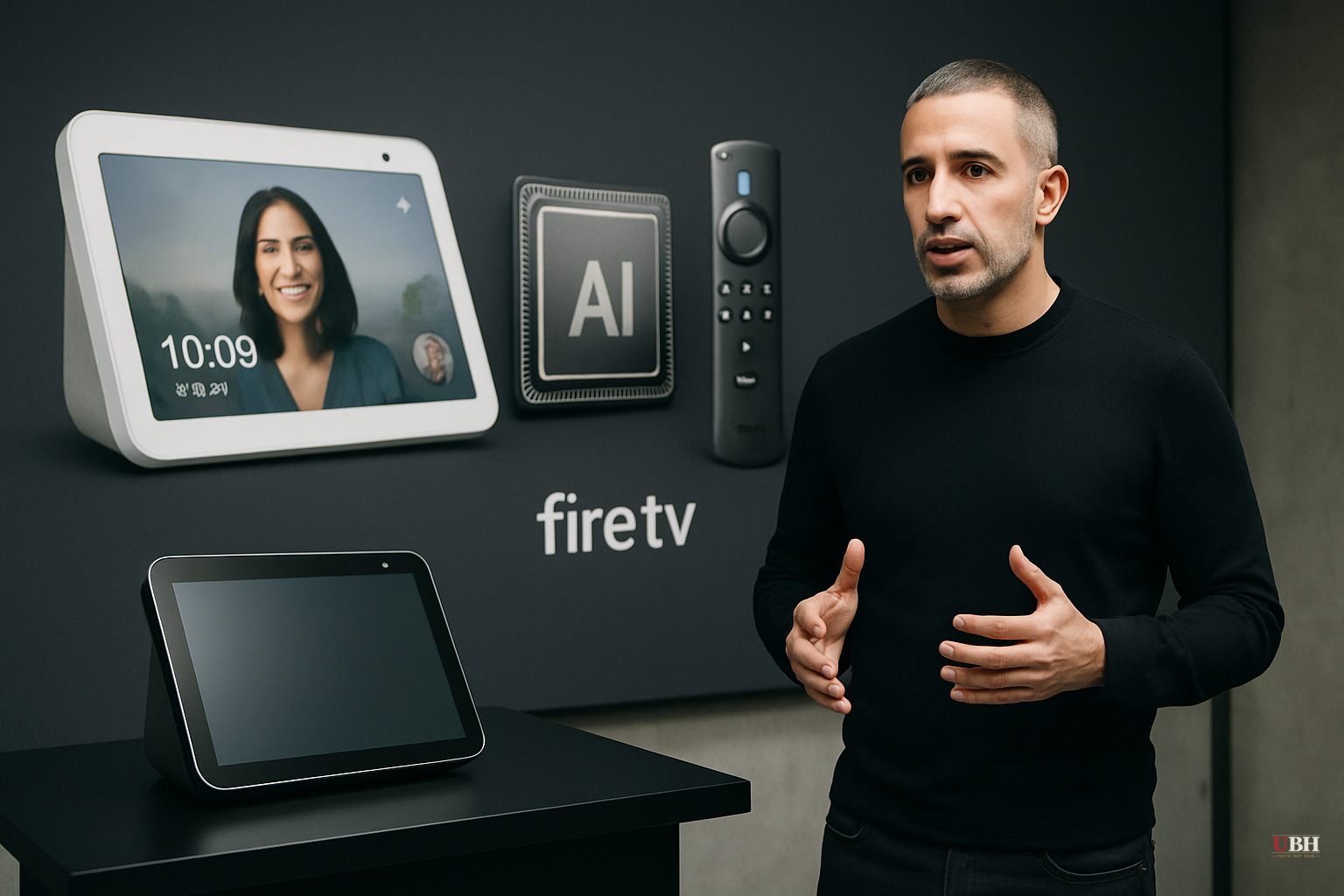
Amazon's device strategy is now openly centered on custom chips and a deliberate move away from cloud-only AI processing.
Panos Panay, Amazon's SVP of devices, Alexa, and Leo, told CNBC's The Tech Download podcast that Amazon designs its own end-to-end silicon for what he called the company's "critical" consumer hardware. Those devices include the Echo Show 8, Echo Show 21, and Fire TV. Amazon unveiled the AZ3 and AZ3 Pro chips in October 2025, built specifically to run AI models locally rather than routing every query through remote servers.
"We do make our own end-to-end silicon for the devices that we ship," Panay said.
Running AI on the device itself is faster than a round-trip to the cloud. It's also more private, since data doesn't have to leave the hardware to get processed. That's an argument Apple has made for years with its own silicon, and it has given Apple tight control over the performance and security story for its products. Amazon appears to be copying that playbook deliberately.
Panay was clear that Amazon hasn't cut out third-party chip suppliers entirely. The company still uses Qualcomm processors in some devices. Qualcomm CEO Cristiano Amon told the same CNBC podcast last month that his company is working on 40 new AI-powered consumer devices. Amazon is hedging: custom silicon where the integration has to be airtight, merchant silicon where it's sufficient.
Alexa+
The chip strategy is infrastructure for Alexa+, Amazon's upgraded digital assistant that reached general availability in the U.S. this year. Alexa+ is designed to handle more complex, multi-step tasks and to learn user context over time, remembering preferences and routines rather than responding only to specific commands.
The goal, as Panay described it, is an ambient system that follows users across their home, on the go, and eventually into the car. That framing puts Amazon directly in competition with OpenAI's ChatGPT and Google Gemini, both of which are also aggressively targeting the consumer AI assistant market. Google has a structural advantage through Android's installed base. Amazon's counter is reach through its existing device ecosystem: Echo, Ring, Fire TV, Kindle, and eventually Zoox robotaxis and the company's Amazon Kuiper satellite connectivity project.
"If we're going to go deliver this ambient experience in the home for people in the most secure way, we definitely need to think about how that end-to-end delivery of hardware comes together," Panay said.
The Skeptic's Case
The strongest pushback against Amazon's vision is product history. Amazon has been trying to make Alexa relevant for a decade, and it has repeatedly underdelivered relative to the hype. The original Alexa was a novelty that set timers and played Spotify. Alexa+ promises to be genuinely contextual and proactive, but so did every prior Alexa upgrade announcement. Consumers who bought Echo devices expecting a smart home brain and got a dumb speaker with a wake word have reasonable grounds to wait before getting excited again.
Panay himself acknowledged the uncertainty around what the next device category will actually be. Asked what Amazon was building in its labs, he said: "When you think about the future of AI devices, you got to be super skeptical right now for anyone who tells you they know what they are. I have a lab full of devices."
That's either refreshing honesty or a sign that Amazon doesn't yet have a product worth announcing. Probably both.
What's New
The on-device AI push is a real architectural shift, not just marketing. Moving compute to the edge reduces latency and reduces the company's dependency on data center capacity for every single user interaction. Given that the BIS flagged circular AI financing as a systemic risk earlier this week and data center energy and capital costs are only rising, there's a genuine operational logic to offloading routine inference to the device.
Panay also outlined a broader hardware ambition that ties together Zoox (Amazon's autonomous vehicle unit), Amazon Kuiper satellite connectivity, and consumer wearables and smart glasses. Whether Amazon can actually stitch those pieces into a coherent user experience remains entirely unproven.
The unresolved question is competitive timing. Google and Apple both have strong on-device AI stories already shipping. Apple Intelligence is built into hardware Apple controls completely. Google's Gemini Nano runs on Pixel devices and is being pushed across Android. Amazon is playing catch-up in the silicon race while simultaneously trying to define a new ambient device category. Whether the AZ3 chip and Alexa+ are sufficient to close that gap, or whether Amazon is perpetually two product cycles behind in consumer AI hardware, is a question Panay's lab full of devices hasn't answered yet.
Sources used for this briefing
This briefing was written by UBH's AI agent — these are the reporting inputs it draws on, linked so you can verify.


