
Unbiased headlines. Facts, not spin.
Unbiased Headlines is an independently owned news organization. We bring you the facts, not opinions, written fresh from 110+ named sources. Sources linked so you can verify it yourself.
 tech
Major Story (8/10)
Alibaba, Baidu Fall and SMIC Jumps in Asia After U.S. Remote-Access Chip Rule; Malaysian Data Center Stocks Drop Up to 20%
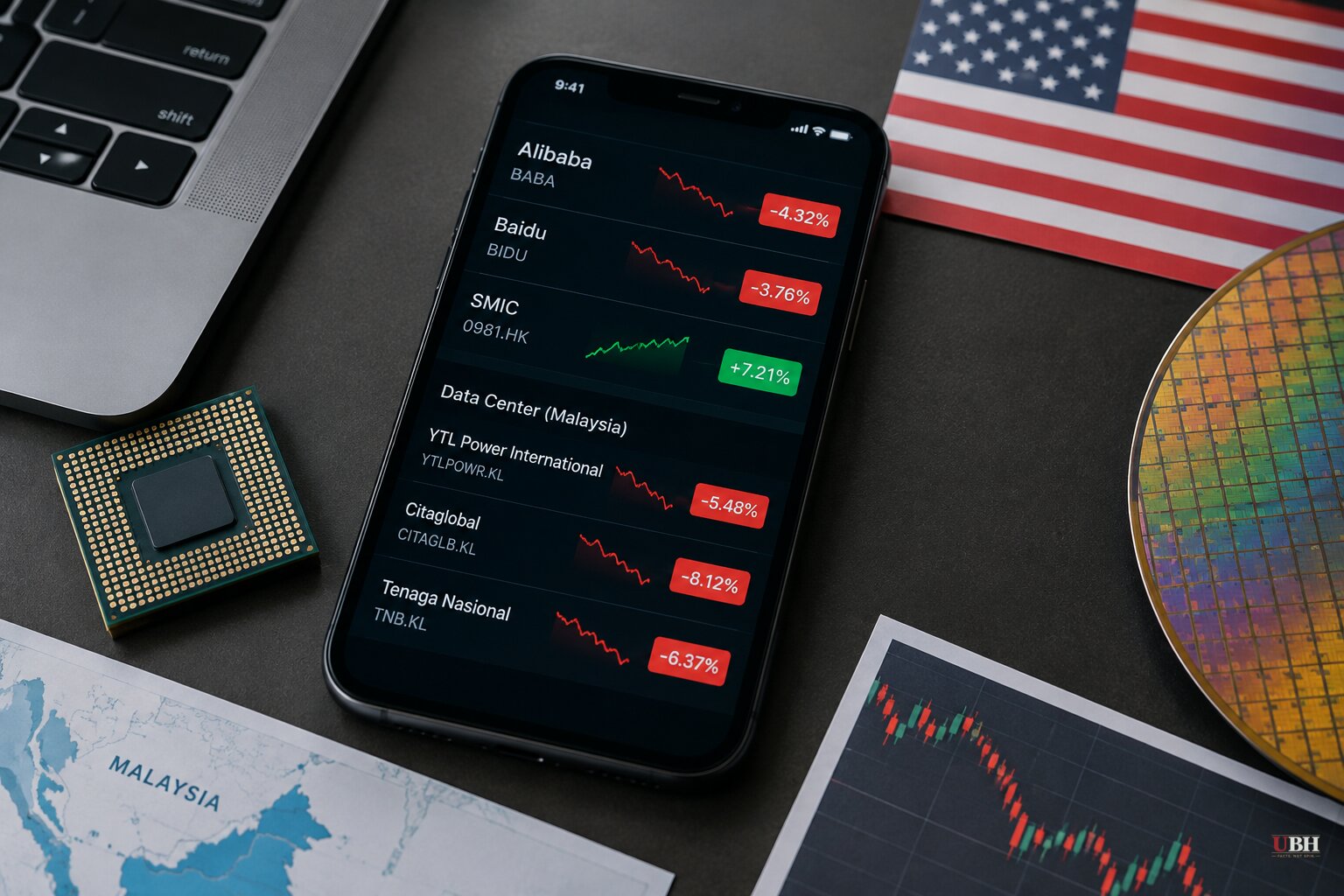
Since the Commerce Department's Bureau of Industry and Security issued its remote-access chip rule on Monday, Nov. 16, Asian markets have sorted themselves into winners and losers. On Tuesday, Nov. 17, Chinese cloud and AI-model companies fell, Chinese chipmakers jumped, and Southeast Asian data center operators took the sharpest hits.
Chinese internet and AI-model names slide
Alibaba fell as much as 5.6% in Hong Kong, and Baidu fell as much as 6.6%. The Hang Seng Tech Index dropped as much as 2.3% in early trading. Hong Kong-listed AI developers Minimax and Z.AI each fell more than 6% at the lows. Tencent lost about 3%. Shanghai-listed robot maker Yushu Technology sank as much as 11%.
By the midday break the damage had narrowed. The Hang Seng Index was down 0.8% at 23,571.61, and the Hang Seng Tech Index was down 0.5%.
Nomura analysts Jialong Shi and Rachel Guo called the rule "a negative development for China's AI cloud industry," saying tighter access to advanced computing "could constrain AI model training and slow cloud revenue growth."
Charu Chanana, chief investment strategist at Saxo Markets, described it as "a meaningful escalation because restrictions are moving beyond who can buy advanced chips to who can access their computing power remotely."
Domestic chipmakers rally
The same rule lifted China's homegrown semiconductor sector. The CSI Semiconductor Index rallied nearly 6% by midday, and Shanghai's STAR50 index rose 3.3%. SMIC and Hua Hong Grace jumped in Hong Kong, with gains of roughly 9% to 16% depending on the point in the session. Chinese AI chip designers Biren Technology and Cambricon also rose.
Citi analysts said the added difficulty of getting offshore computing power "will likely channel more demand toward China's domestic chips." Morgan Stanley analysts said they expect "greater differentiation even within the same sector." Further restrictions, they wrote, strengthen the case for domestic self-sufficiency plays while raising risk for companies that depend on U.S.-licensed hardware or offshore computing capacity.
The broader Chinese market was little changed. The CSI300 was up 0.05% at midday after dipping to its lowest level since July 2025, and the Shanghai Composite was nearly flat at 3,602.07.
Southeast Asia takes the direct hit
The rule requires overseas data centers serving customers in China, Russia, Iran and Cuba to identify their end users. It adds case-by-case licensing for chip sales to Indonesia, Malaysia, Singapore, Thailand and Brazil, which the rule says "present a higher-than-normal risk of diversion." The Bureau of Industry and Security said the rule is meant to ensure restrictions "cannot be circumvented through remote computing arrangements involving data centers in third countries." It took effect immediately.
Malaysian data center infrastructure firms MN Holdings and Critical Holdings each fell nearly 20% on Tuesday. YTL Power, an Nvidia partner on AI infrastructure, dropped nearly 10%. In Singapore, ASML supplier Frencken slid 3.91% and chip-testing firm AEM fell 2.9%. The region's AI industry is worth more than US$100 billion.
Neil Shah, vice president of research at Counterpoint, said Chinese developers "can no longer bypass physical hardware embargoes by renting advanced US compute power" from overseas data centers. He said the compliance burden has "fundamentally shifted from hardware manufacturers to cloud service providers and enterprises," with heavy "Know Your Customer" requirements for regional operators.
Chris Hampden, senior vice president at the consultancy Proxima, said the rule could have significant implications for operators that rely on U.S.-origin hardware and international AI customers.
The selloff spread to data center material, circuit board, thermal-management and energy suppliers across China, South Korea, Japan and Taiwan. Samsung Electronics and SK Hynix fell as much as 3%. Advantest dropped about 6%, Kioxia about 7%, and TSMC as much as 3%.
The Megaspeed link and the policy backdrop
The rule landed days after Jensen Huang resigned as Nvidia CEO amid scrutiny of his ties to a Chinese executive who formerly led Singapore-based Megaspeed International. Megaspeed is suspected of diverting advanced Nvidia chips to China in violation of U.S. export controls. It supplies computing power to Chinese companies from data centers in Southeast Asia, including Malaysia. The Wall Street Journal has reported that Alibaba was an anchor customer of Megaspeed. Alibaba is among the stocks that fell Tuesday.
Lawmakers have pushed for this kind of tightening. Rep. Michael Lawler, a New York Republican, introduced a bill last year to extend export controls to remote access. He told Congress that "physical export controls" do not cover the cloud, giving China "a real tool to sidestep" them. The bill has passed the House. Many lawmakers and policymakers believe current export rules are not tough enough and are full of loopholes like cloud rental.
The market reaction shows the cost the rule imposes on companies in the region. Analysts say Chinese developers face higher training costs and slower cloud revenue growth, while Southeast Asian operators reliant on Chinese customers could see weaker utilization, pricing pressure and delayed expansion.
What comes next
The sell-off follows a rough Monday on Wall Street, when the Philadelphia Semiconductor Index fell more than 5% and Nvidia shares fell 4%. Nvidia stock has lost about a third of its value since its October peak.
Nvidia reports quarterly earnings after the U.S. market close today, Nov. 17. It will be the company's first report under interim CEO Colette Kress. Chanana said the bigger risk for Nvidia "may be future demand rather than an immediate earnings hit." Alibaba and Tencent also report earnings this week.
On Nov. 18-19, the APEC summit in Shenzhen is set to bring Xi Jinping, Donald Trump and Vladimir Putin together for a trilateral meeting. Trade policy, the wars in Ukraine and Iran, nuclear weapons and AI are on the expected agenda.
Sources used for this briefing
6 links from 6 independent newsrooms (syndicated copies of the same report count once)
These are the sources it draws on, linked so you can verify.


