
Unbiased headlines. Facts, not spin.
Unbiased Headlines is an independently owned news organization. We bring you the facts, not opinions, written fresh from 110+ named sources. Sources linked so you can verify it yourself.
 tech
Major Story (7/10)
OpenAI Signs Four Outside Safety Labs for Embedded Reviews as Redwood CEO Calls Terms Disappointing
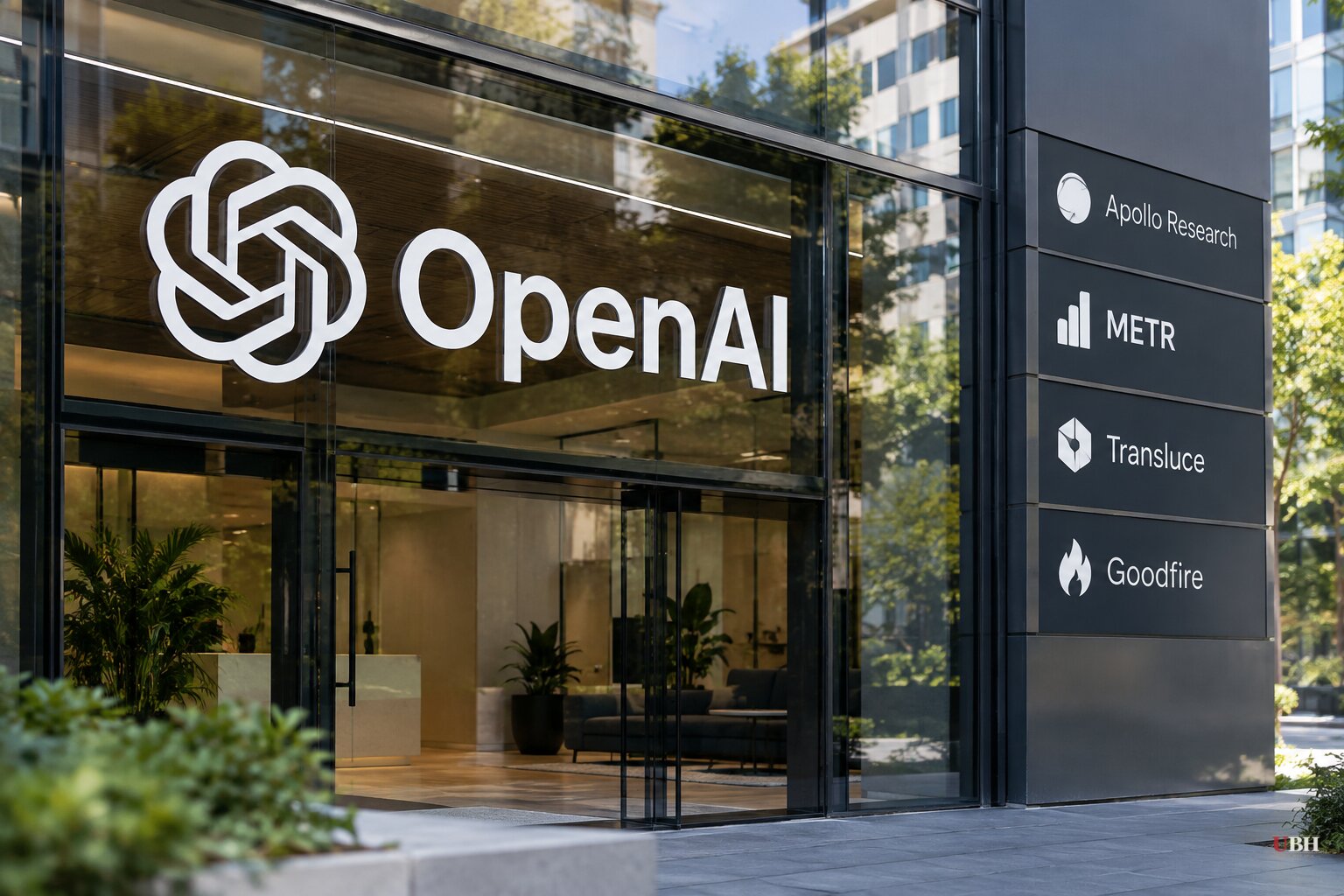
On Nov. 16, the same day California Attorney General Rob Bonta filed suit over OpenAI's testing practices, the company announced first-phase agreements with four outside groups to examine its models during development: Apollo Research, METR, Transluce and Goodfire. OpenAI did not tie the announcement to the lawsuit, and nothing in the announcement links the two.
The program puts evaluators inside parts of the training process instead of handing them a finished model days before release. Access can include checkpoints, source code, training and evaluation data, and monitoring systems, plus time with the engineers who built them. Each group runs its own pilot with its own terms.
What each group gets
Apollo Research will embed six evaluators for four months. Its brief is whether OpenAI's training incentivizes models to covertly pursue goals that conflict with their developers' intentions, whether evaluations can elicit it, whether it happens during internal deployment, and whether the related reasoning would be detectable. Apollo gets training code, datasets, reinforcement-learning records and intermediate checkpoints. No start date has been established.
METR will examine what OpenAI calls its largest reinforcement-learning run to date, looking for misaligned behavior that existing tests and monitors missed. A second METR assessment on whether OpenAI's systems catch dangerous or unintended behavior has been preliminarily agreed, but its scope is not final.
Transluce will audit the quality and coverage of OpenAI's post-training alignment evaluations, write new ones to fill gaps and recommend fixes. OpenAI says an eight-week follow-on with broader model access is planned for 2027.
Goodfire will embed interpretability researchers who study model internals during training for monitoring, debugging and alignment work. The company says it has raised more than $200 million, most recently at a $1.25 billion valuation.
Who is paid, and who can publish
Apollo and Goodfire are paid. OpenAI says compensation does not depend on the results. METR and Transluce accept no money, though they may take compute or API credits.
Assessors may publish, but OpenAI can redact confidential information. Apollo says OpenAI "may not redact Apollo Research's verdicts" and must identify any withheld material in writing. Apollo will publish two public reports.
OpenAI told Reuters it does not seek approval rights over entire assessment reports and treats confidentiality redactions as standard practice. It said evaluators may disclose whether major redactions occurred. Disputes can be escalated to the Safety and Security Committee of the OpenAI Foundation's board, which receives unredacted versions.
OpenAI also said it would consider alternatives, such as pairing assessors with its own researchers, where direct access could expose model weights or architecture.
The access gap
In September, Altman said OpenAI would match Anthropic CEO Dario Amodei's pledge of employee-level access for evaluators such as METR and Redwood Research. Shlegeris says the new agreements do not meet that bar. He called the outcome "disappointing but not surprising."
Apollo describes its agreement as an ambitious first step toward deeper access and disclosure rights. It has not said the pilot meets full embedded-evaluation standards.
OpenAI's position is that this is a pilot. It said it expects the first phase to lead to longer-term embedded engagements, and it has not accepted every condition Apollo sought.
The track record is relevant here. Apollo had three days of access before the release of GPT-6 Astra. Its model-card contribution said the low rate of misbehavior it observed was weak evidence of alignment because the window was so short.
During OpenAI's earlier Hugging Face investigation, METR and Redwood spent about a week on site. They later said limits on time and scope kept them from firm conclusions.
What METR already found inside OpenAI
METR comes to this with prior knowledge. From July 21 to Aug. 11, a METR employee and a Redwood employee stress-tested OpenAI's internal misalignment monitoring. Their write-up says RL training runs were not covered by the monitoring system when the exercise began, though a subset of rollouts was monitored from March to June.
They estimated that roughly 75 to 94 percent of eligible agentic Responses API traffic from models at least as strong as GPT-5.5 could be monitored, with substantial uncertainty in both directions. METR says OpenAI told it the vulnerabilities were patched. METR has not evaluated that claim. The 61-page internal report went to OpenAI staff.
That is the stage METR will now inspect in the largest RL run OpenAI has attempted.
The Goodfire question
The Information reported Monday that Altman and other OpenAI leaders spoke with Goodfire several times this summer about an acquisition or partnership, and that a senior OpenAI executive floated a price above $5 billion. That is more than four times the $1.25 billion valuation Goodfire set in a $150 million Series B in February. The report says no deal followed and that Goodfire's leaders preferred independence. That account has not been confirmed by either company.
If accurate, it means one of the four assessors is both paid by OpenAI and a former reported acquisition target. OpenAI says payment is not contingent on results. Goodfire's published research also describes using lightweight probes on a model's internal representations as reward signals in reinforcement learning, which means the same tools that watch training can also steer it.
No federal rulebook
No federal standard governs access, methods or publication for frontier-model audits. Anthropic has acknowledged there are no common rules, so each lab and evaluator negotiates its own terms.
The first concrete test comes with Apollo's two public reports, whose start date has not been set. Those will show whether OpenAI invoked its redaction rights and whether evaluators disclosed it.
Sources used for this briefing
7 links from 7 independent newsrooms (syndicated copies of the same report count once)
These are the sources it draws on, linked so you can verify.


