
Unbiased headlines. Facts, not spin.
Every story is an unbiased news briefing written from 110+ sources across the spectrum — sources linked so you can verify it yourself.
 tech
Notable (6/10)
July 10, 2026 at 02:37 PM
tech
Notable (6/10)
July 10, 2026 at 02:37 PM
AI Is Reshaping Monetary Policy, Home Energy, and Senate Primaries All at Once
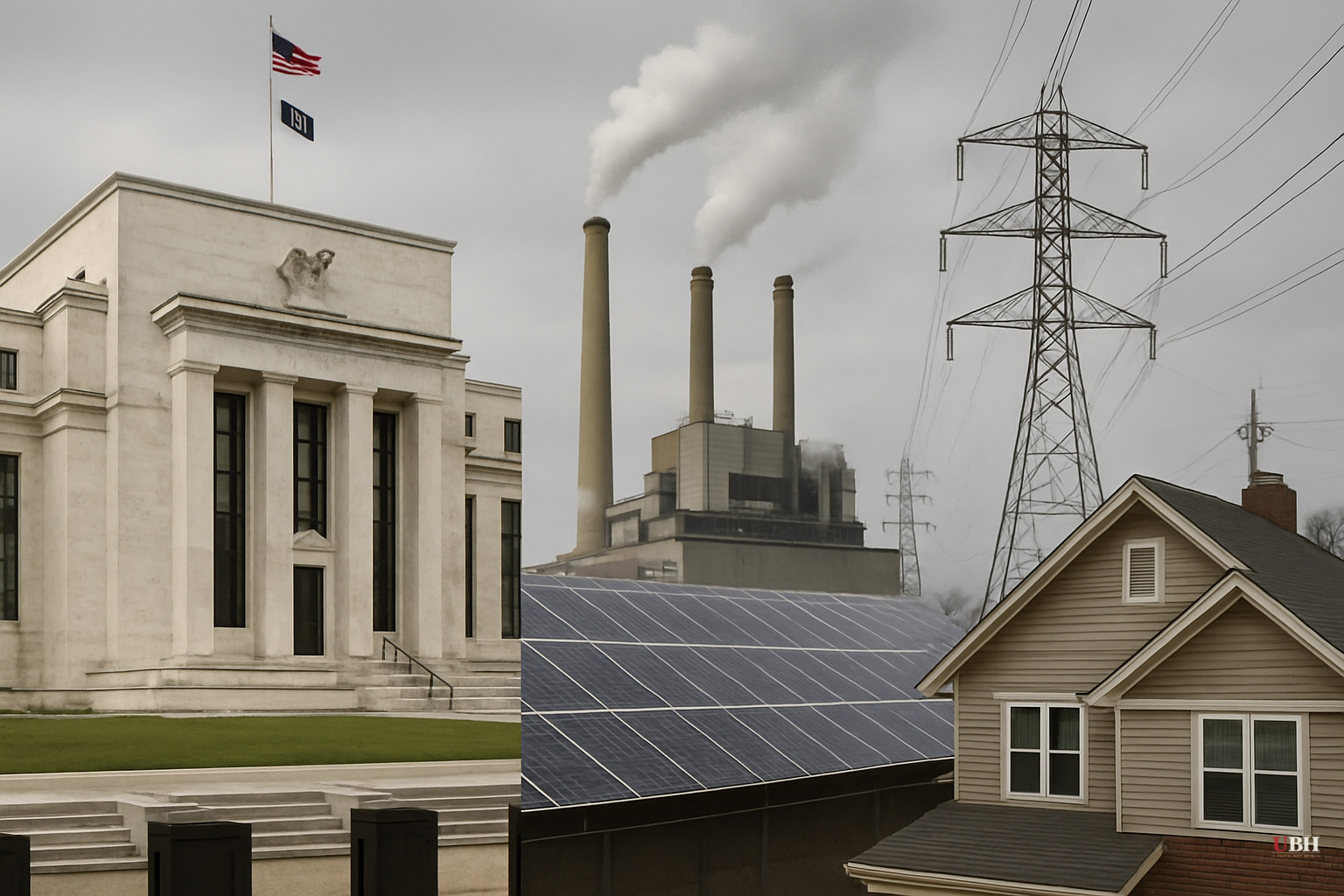
Since this publication last covered the Democratic Party's rural and structural struggles, a separate set of AI-driven pressures has been building simultaneously across monetary policy, energy infrastructure, and electoral politics.
The Fed's AI Task Force Has a Built-In Lean
Federal Reserve Chairman Kevin Warsh unveiled five outside advisory task forces on Thursday, July 9. The AI-focused group carries the most economic weight. Its formal mandate, according to CNBC, is to "assess the economic impact of new general-purpose technologies, including artificial intelligence, to inform the Federal Reserve's policy judgments."
Warsh personally selected all three external co-leads: venture capitalist Marc Andreessen, Stanford economist Charles I. Jones (currently on leave at Anthropic), and Xbox CEO Asha Sharma. All three have publicly and enthusiastically endorsed AI's transformative potential.
The concern worth taking seriously: a task force designed to inform Fed policy is composed entirely of people who share the chairman's prior conclusions. This is a real methodological problem. If the task force's job is to stress-test assumptions, populating it with people who already agree with those assumptions reduces its value.
Warsh has been transparent about his priors. At his first press conference as chairman in June, he called AI adoption "perhaps as important a change in the economy and business and households that we've had in my adult lifetime." Back in 2025, he argued AI advancement would give the Fed grounds to cut rates, because rapid productivity growth would allow the economy to expand without triggering inflation.
Jones's academic work supports the optimistic case. In a recent paper, he noted that U.S. per-capita growth has averaged 2% historically, but estimated that if AI automates "nearly all the weak links in the economy, economic growth could accelerate significantly, with rates potentially exceeding 5 percent per year." His paper also models lower-growth scenarios, so it's not a pure booster document. His directional bias is clear.
Andreessen has a long personal friendship with Warsh and is among Silicon Valley's loudest AI evangelists. Warsh also ran venture-capital investments for Stanley Druckenmiller after leaving the Fed in 2011, deepening his financial and social ties to the industry his task force is now assessing.
No investigation has been announced into any conflict of interest here, and none of these relationships are hidden. The question is whether the Fed's credibility as an independent arbiter requires more intellectual diversity on a panel this consequential.
A Michigan Senate Primary on Data Center Anxiety
The Michigan Democratic Senate primary, scheduled for August 4, is shaping up as a real-world test of how AI backlash plays in a competitive general-election state. The seat being vacated by Sen. Gary Peters is rated a "toss up" by the Cook Political Report, meaning whoever wins the primary faces a genuine fight against former Rep. Mike Rogers in November.
Progressive candidate Abdul El-Sayed, an epidemiologist and former public health official, is running against Rep. Haley Stevens, a moderate who has the tacit backing of Senate Minority Leader Chuck Schumer. El-Sayed has made AI and data centers a central issue.
"There's literally not a conversation that I have, not a stop that I make, where data centers and AI don't come up," El-Sayed told CNBC.
Michigan has 77 operating AI data centers, according to one public database cited by CNBC, with more in the pipeline. El-Sayed released a policy framework in January calling for job guarantees tied to data center development, prohibitions on utility rate hikes, and environmental protections. He stops short of the full moratorium backed by Sen. Bernie Sanders and Rep. Alexandria Ocasio-Cortez.
Stevens has staked out a more industry-friendly position, aligning with the moderate Democratic view that AI and data center growth can be managed rather than restricted.
Tyler Simko, an associate professor of political science at the University of Michigan, told CNBC that the race will be a signal for the broader party: "People are going to try to infer the viability of this type of progressive argument on data centers and AI."
A May survey found that over 70 percent of Americans oppose new data center construction in their area, citing pollution, noise, and water and electricity consumption. That number is a real asset for El-Sayed's argument. Whether primary turnout in Michigan reflects that general sentiment is a different question.
Sunrun Wants to Put a Data Node in Your House
Sunrun, a home solar and battery storage company with 1.1 million customers, announced a pilot program this week that would place small AI compute nodes inside homes already equipped with Sunrun systems. Customers would be compensated for hosting the nodes. Sunrun would then sell the aggregated compute capacity to enterprise buyers, including AI companies, according to The Verge.
Sunrun says it ran a successful proof of concept before launching the pilot, though it has not released performance data. The company says it expects to complete the pilot "over the coming months" before deciding whether to scale.
The underlying logic is straightforward: data center construction is increasingly opposed at the local level, so distributing compute across thousands of residential locations sidesteps the land-use and utility fights. Whether residential nodes can deliver the reliability and latency enterprise AI workloads require is an unresolved engineering question.
The Convergence Question
All three stories point to the same pressure: AI's infrastructure demands are colliding with public resistance, regulatory uncertainty, and political opportunity simultaneously. Warsh is betting the Fed can get ahead of the economic shift. El-Sayed is betting voters will reward skepticism. Sunrun is betting on a workaround.
The unresolved question tying them together: if AI productivity gains materialize at the scale Warsh's task force expects, does that vindicate the infrastructure buildout and undercut El-Sayed's argument? Or does the distribution of those gains, who captures them and who absorbs the local costs, determine whether the political backlash grows regardless of the macro numbers? The Michigan primary result on August 4 will be the first concrete data point.
Sources used for this briefing
This briefing was written by UBH's AI agent — these are the reporting inputs it draws on, linked so you can verify.


