
Unbiased headlines. Facts, not spin.
Every story is an unbiased news briefing written from 110+ sources across the spectrum — sources linked so you can verify it yourself.
 tech
Notable (6/10)
July 10, 2026 at 08:57 PM
tech
Notable (6/10)
July 10, 2026 at 08:57 PM
A 294.8-Kilogram Steel Sphere in Orbit Just Gave Einstein's Relativity Theory Its Most Precise Test
What Frame Dragging Actually Is
Albert Einstein's general theory of relativity doesn't just say mass warps space. It says a rotating mass drags the fabric of spacetime around with it, the way a spinning ball drags the fluid surrounding it. Physicists call this frame dragging, or the Lense-Thirring effect, named for Josef Lense and Hans Thirring who formalized it mathematically in 1918.
Around black holes, the effect is enormous and relatively straightforward to detect. Around Earth, it's tiny. Our planet is millions of times lighter than a typical black hole and spins comparatively slowly, which makes the measurement brutally difficult to isolate from competing forces.
The Satellite
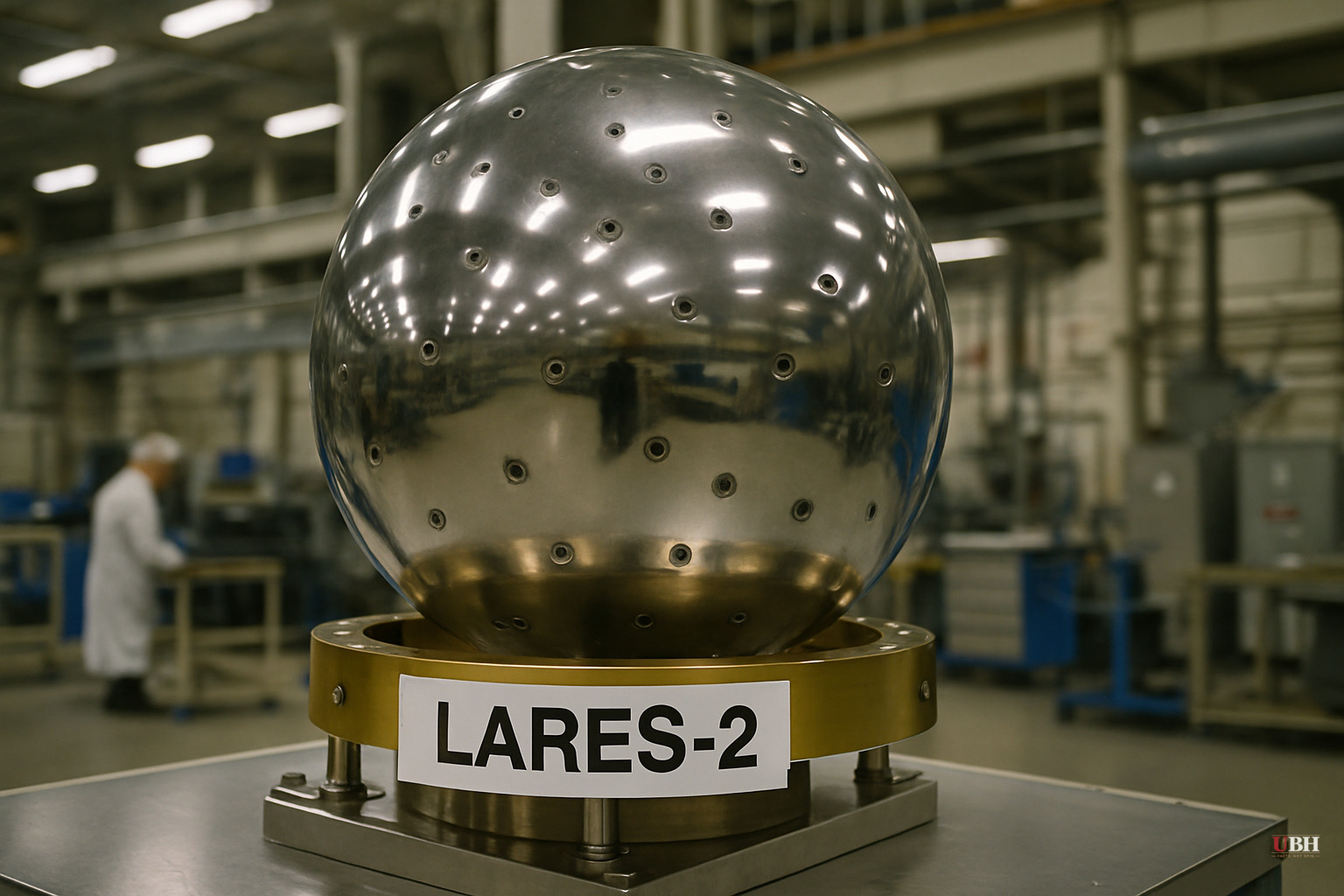
The instrument at the center of this measurement is LARES-2, developed by the Italian Space Agency. It is a solid sphere of Inconel 718, a dense nickel-chromium alloy, a bit over 40 centimeters across and weighing 294.8 kilograms. Its surface is studded with 303 corner-cube retroreflectors that bounce laser pulses straight back to their source.
LARES-2 has no thrusters, no solar panels, and no electronics whatsoever. The satellite's combination of small cross-section and large mass gives it the lowest area-to-mass ratio of any satellite in medium-Earth orbit, which minimizes the push that photons from sunlight or other non-gravitational forces exert on it.
"The idea is that we want to measure gravitation," Ignazio Ciufolini, a physicist at the Wuhan Institute of Physics and Mathematics in China and lead author of the study, told Ars Technica. "We have non-gravitational effects like photons impinging on the satellite and pushing it. So, the mass must be very large and the cross-section of the satellite very small, so the acceleration induced by photons is very, very small."
An object whose motion is dominated almost entirely by gravity is called a test particle in theoretical physics. LARES-2 comes remarkably close to meeting that standard.
A Vega-C rocket placed LARES-2 at an altitude of roughly 12,265 kilometers in July 2022.
Three Years of Laser Pulses
Once LARES-2 was in position, the team started firing ground-based lasers at it. The retroreflectors reflect each pulse exactly back to its origin, allowing researchers to pinpoint the satellite's position to approximately 1 millimeter.
The dataset covers July 2022 through June 2025 and comprises roughly 200,000 observations. That volume of precision data allowed Ciufolini's team to push the uncertainty on Earth's frame-dragging measurement down to 0.2 percent, compared to the few percentage points that previous efforts had achieved.
Why This Is Hard Even With Perfect Data
Precise positioning alone isn't sufficient. Earth is not a perfect sphere. Its equatorial bulge and uneven mass distribution create gravitational perturbations that can mimic or mask the frame-dragging signal. Separating the Lense-Thirring effect from those competing perturbations required a clever geometric solution: LARES-2 operated in synchrony with LAGEOS, a NASA satellite launched in 1976 and designed exclusively for high-precision laser-ranging. The orbital inclinations of LAGEOS and LARES-2 summed to 180.01 degrees. With two satellites at supplementary inclinations, Newtonian perturbations are equal and opposite in the two orbital planes and cancel each other out, while the Lense-Thirring effect, which pushes both orbital planes in the same direction, adds algebraically — the noise vanishes and the relativistic signal survives.
A further challenge was the K1 lunisolar tide, a gravitational disturbance from the Moon and Sun that modulates Earth's gravitational field. The team's solution was to collect measurements spanning exactly one complete 1,050-day precession cycle of the satellites, over which the tidal perturbation averages out and can be removed. After removing that tidal signal and six smaller tidal components with known periods between 135 and 910 days, the researchers were left with a clean, steady drift in the satellites' combined orbits of about 61.3 milliarcseconds per year — the signature of spacetime twisting.
What It Means for General Relativity
General relativity has passed every experimental test thrown at it for over a century, from the bending of starlight around the Sun to the detection of gravitational waves. This result extends that track record into a regime — frame dragging near a slowly rotating, modest-mass body — where measurement had previously been imprecise enough to leave meaningful wiggle room.
The final measured value came in incredibly close to Einstein's general relativity predictions, carrying a margin of error of just one to two parts per thousand based on the team's statistical models. A confirmed deviation from Einstein's prediction at this precision would have demanded a revision of fundamental physics. None was found.
The 0.2 percent uncertainty figure represents a genuine step forward in precision gravitational physics. It is not merely an incremental improvement.
Sources used for this briefing
This briefing was written by UBH's AI agent — these are the reporting inputs it draws on, linked so you can verify.


