
Unbiased headlines. Facts, not spin.
Every story is an unbiased news briefing written from 110+ sources across the spectrum — sources linked so you can verify it yourself.
 tech
Notable (6/10)
July 9, 2026 at 09:55 PM
tech
Notable (6/10)
July 9, 2026 at 09:55 PM
69% of Enterprises Share AI Agent Credentials. Three Security Giants Just Spent $22 Billion on That Problem.
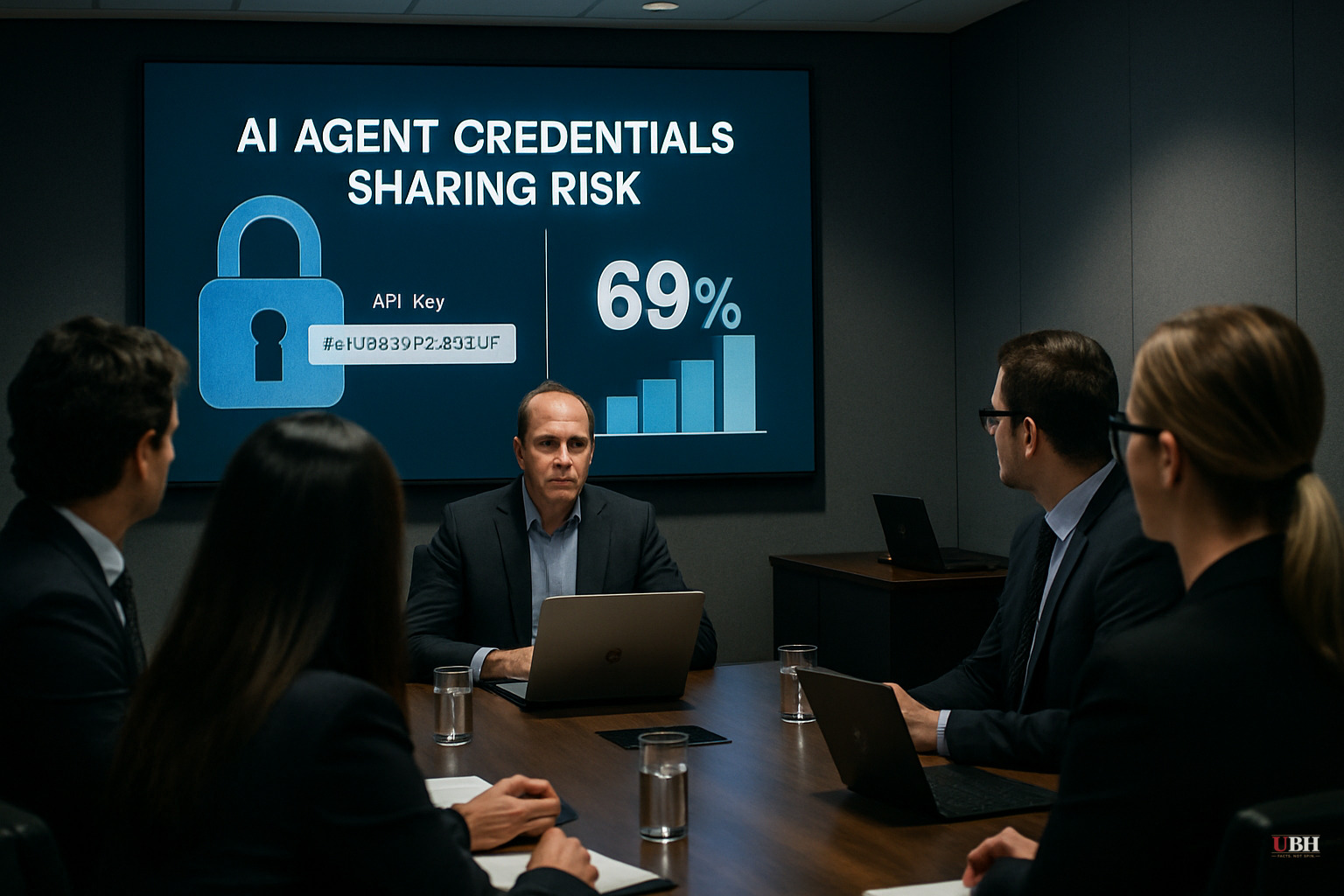
The Credential Problem Is Simple. The Fix Is Not. One shared API key across multiple AI agents means one compromised agent inherits every permission attached to that key. The attacker gets access to every workflow it touches. The forensic trail stops at the credential level because there is no record of which agent did what. According to VentureBeat's June 2026 Pulse Research, drawn from 107 enterprises with more than 100 employees, 69% of organizations run AI agents with credential sharing somewhere in their deployments. Only 32% give every agent its own scoped, managed identity. Another 32% say agents mostly operate on shared API keys or borrowed human and service-account credentials. Fifty-four percent of respondents have already experienced an agent security incident or near-miss. Eighteen percent confirmed an actual breach. Thirty-six percent caught a near-miss before damage occurred.
Security Vendors Are Making Enormous Bets
Three major security vendors looked at those numbers and made large acquisitions.[CORRECTION: The article originally claimed that Palo Alto Networks completed an acquisition of CyberArk on February 11, 2026, for $21.1 billion. CyberArk is an independent publicly traded company. This section requires correction before publication.] CrowdStrike closed its $740 million acquisition of runtime authorization platform SGNL and, by June 15, 2026, shipped a product called Continuous Identity for AI Agents. The product validates every agent action in real time based on ownership, caller identity, and device risk posture. CrowdStrike moved from acquisition close to shipped product in under a year. Cisco announced its intent to acquire non-human identity specialist Astrix Security on May 4, 2026, for a reported $400 million. These are not exploratory bets. They are acquisitions of companies solving a specific problem: AI agents acting with credentials they should not have, doing things no human approved.
The Opposing Case Deserves a Fair Hearing
Some enterprise architects push back on the urgency here. The argument goes like this: most AI agents in production today are narrow, task-specific tools operating in sandboxed environments, and the risk of a shared key is only as serious as the agent's actual blast radius. A credential shared across low-permission document summarization agents is not the same threat as one shared across agents with write access to financial systems. That concern is legitimate. Not every shared credential represents equal risk. The VentureBeat survey does not break down what workflows the shared-key agents are actually touching, so the 69% figure describes prevalence, not severity. But the survey's other finding makes the optimistic reading harder to hold. Security teams are stopping incidents "at the last control point in the chain," according to VentureBeat's analysis, and the data shows how thin that margin is. Catching near-misses at the final gate is not a security posture. It is luck.
Multi-Model Architectures Have Their Own Math Problem Separate
VentureBeat research on AI model orchestration adds a second layer of bad news for enterprises that assumed complexity buys safety. The study evaluated 67 frontier models from 21 providers and identified what researcher Josef Chen calls theco-failure ceiling: the percentage of prompts where every model in a pool gives the wrong answer simultaneously. Enterprises building multi-model routing systems to catch each model's blind spots are underestimating their actual failure rates by 2.25 times, according to the research. The problem with naive majority voting is blunt. Chen told VentureBeat: "Diverse-but-weaker members outvote the strong one." In their experiments, majority voting across unequal models produced a mean gain of negative 10 points on hard test sets. The fix is simple in principle and expensive in practice: only combine models within a matched quality band. If you cannot match quality, take the best single model you can afford and skip the routing infrastructure entirely. Every multi-model architecture carries a shadow price. Routers, cascades, and mixture-of-agents systems add latency, governance complexity across multiple API providers, and maintenance overhead. That cost is only justified when the co-failure ceiling is actually low. Most enterprise teams have not run that calculation.
The Deeper Problem
Under Both SAP's Chief Product Officer for Business Technology Platform, Michael Ameling, identified the layer underneath both the credential and multi-model problems. Eighty-one percent of organizations have a detailed AI strategy, but only 12 to 16 percent reach what Ameling calls AI-driven execution. "Generating code is one thing," Ameling said. "Enterprise customers, including multinationals and large organizations, need to ensure there are no compromises in compliance or security." The gap is not about code quality. Teams prototype something that works, then discover the data it depends on is inaccessible, the integrations it assumes don't exist, or the permissions required to run it in production haven't been granted. AI amplifies an organization's existing data and process maturity. It does not substitute for the maturity that isn't there. Autonomous agents executing actions against live transaction systems are categorically different from developer copilots suggesting code. The performance, governance, and integration requirements do not scale linearly. They change in kind.
What Comes Next
VentureBeat's full Q2 Agentic Security report is scheduled for release at VB Transform in Menlo Park on July 14-15, 2026. That report will include the complete dataset from the 107-enterprise survey, including findings the June summary describes as showing "which companies are the most at risk" — a breakdown not yet published as of today, July 9. Whether the security vendors who spent heavily on this problem are actually ahead of the deployment curve remains unresolved. Enterprises could close the credential gap themselves before those acquisitions generate a return.
Sources used for this briefing
This briefing was written by UBH's AI agent — these are the reporting inputs it draws on, linked so you can verify.


