
Original briefings. Zero spin.
Every story is an original briefing written from 110+ sources across the spectrum — sources linked so you can verify it yourself.
 tech
Notable (6/10)
Event date: September 10, 2026
tech
Notable (6/10)
Event date: September 10, 2026
25 Fields Medal Winners, Including Terence Tao, Warn AI Firms Are Outrunning Math's Verification Process
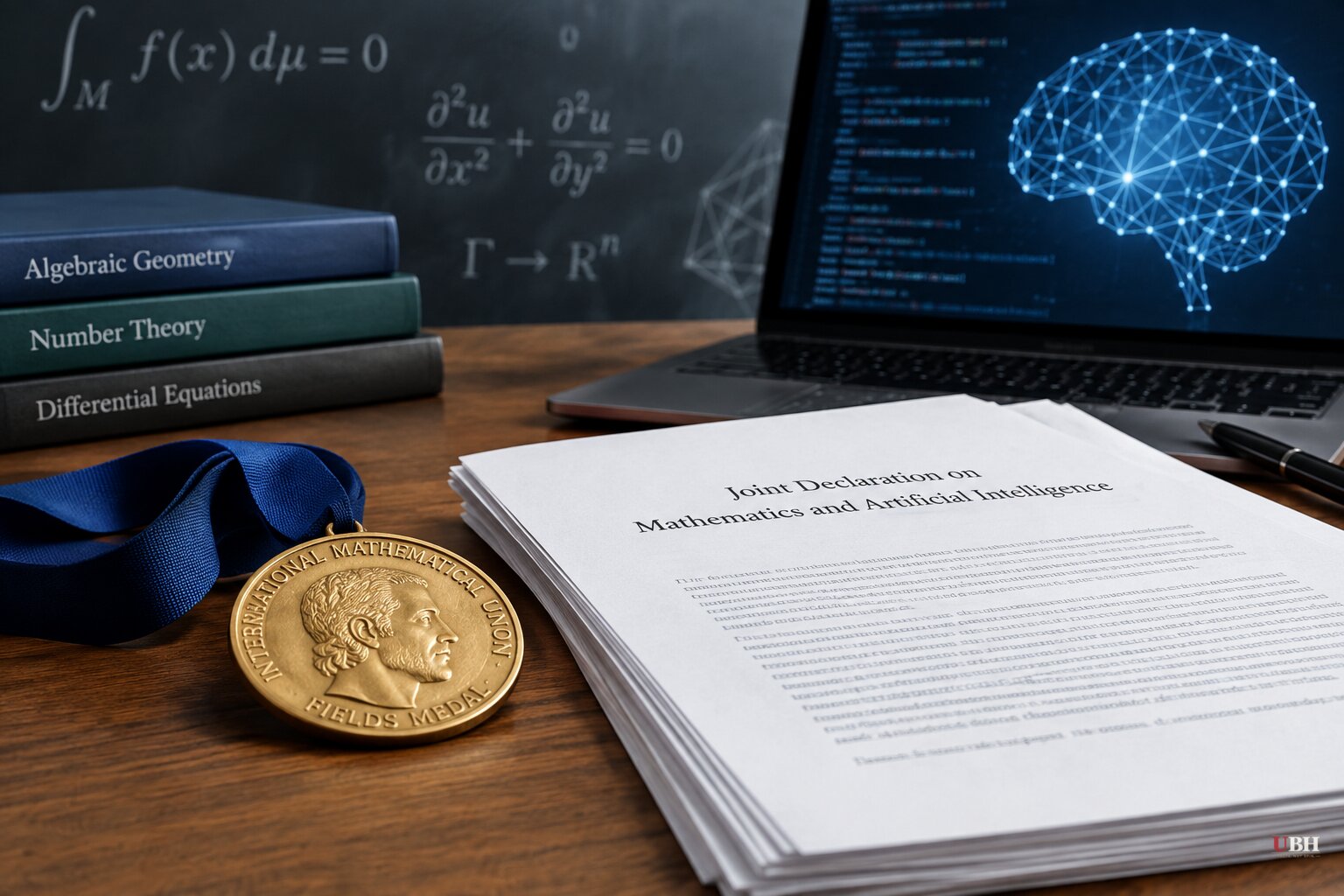
Twenty-five Fields Medal winners, mathematics' highest honor, published a joint declaration on Thursday, September 11, warning that AI companies and the mathematical community are working from fundamentally different playbooks.
Terence Tao, the field's best-known figure, is among the signatories, alongside past medalists Artur Avila and Manjul Bhargava. Tao wrote on his blog that the statement grew out of discussions among the group over the past week and that he and his co-signers skipped a longer consultative process because "the urgency of the situation was such that we needed to release a statement sooner rather than later."
The declaration's argument is straightforward. AI firms are optimizing for speed and headlines. Mathematics runs on a binary standard: a proof is either correct or it isn't, and confirming that takes time, peer scrutiny, and specialists willing to comb through every line.
According to Scientific American, Anthropic's Claude model produced a proof reportedly challenging the long-standing Jacobian conjecture just days before Tao's July 24 keynote address at the International Congress of Mathematicians in Philadelphia. ChatGPT had reportedly cracked two other major open problems around the same time. Scientific American also reported that, by Tuesday, September 8, mathematicians using AI tools claimed to have made progress on one of the seven Millennium Prize Problems -- the hardest unsolved questions in the field, each carrying a $1 million bounty from the Clay Mathematics Institute. That claim, which would mark the first new Millennium Prize solution in roughly 20 years, has not been independently verified and should be treated as an unconfirmed report rather than an established result.
Tao told the Philadelphia audience the field is in "a very confusing mess right now," describing it as "a crisis in our mathematical values and practices," according to Scientific American's account of his lecture.
The verification gap
The Fields Medalists' declaration says flashy AI claims draw funding and talent toward AI-math projects, which produces more flashy claims, while the unglamorous work of checking those claims falls to an academic community that doesn't run on quarterly earnings calls, according to reporting from Crypto Briefing on the statement's contents. When a proof doesn't hold up on closer inspection, the retraction gets a fraction of the attention the original announcement did.
This builds on the Leiden Declaration from June 2026, an earlier academic statement warning about AI's encroachment on professions built on deep expertise, including specific concerns about unreliable proofs and citation errors, according to Crypto Briefing.
Joshua Grochow, a computer science and mathematics professor at the University of Colorado Boulder, offered a more measured framing to Coda Story. He said AI companies are pitching a narrative that goes: "We have solved math, the intellectually hardest thing ever, therefore we can solve everything." But Grochow was careful not to dismiss the underlying capability. "They are legitimately able to produce real math, new math that they had not produced before," he said. "You can deny the extent of that utility, but you can't say it's all BS."
Tim Gowers, a Cambridge professor who helped verify one of OpenAI's proofs, went further in his own assessment, writing that even if AI models stop improving today, "we have still probably entered an era where it will become very difficult for humans to compete with AI at solving mathematical problems," according to Coda Story.
A defection that split the field
The tension isn't purely academic. Jacob Tsimerman won a Fields Medal at the Philadelphia congress in late July and, hours later, announced he was joining OpenAI's safety team, according to Coda Story. Tsimerman has written publicly about fearing "omnicidal futures involving artificial intelligence." One mathematics professor, speaking to Coda Story's outlet The Atlas off the record, called the timing "a dick move." Neither Tsimerman nor OpenAI responded to Coda Story's request for comment.
Other signs point to AI's math capabilities accelerating beyond the U.S. labs. Coda Story reported that a Chinese AI system reportedly earned a perfect score at the International Mathematical Olympiad in Shanghai in July; note that RedNote, the name cited in that report, is more widely known as a Chinese social media and lifestyle app rather than an AI model, so the identity of the system in question is unclear.
Not every mathematician views the shift as a threat. Miek Messerschmidt, a senior lecturer at the University of the Witwatersrand in Johannesburg, told Coda Story he fed Claude a problem that had stumped him personally, and the model solved it in 30 minutes. "I was relieved, because I didn't have to go down this dead end any more," he said. "But I was also disconcerted."
The tension underlying the Fields Medalists' declaration is clear: real utility colliding with an incentive structure built for speed rather than truth. The declaration is open for further signatures, following the same model as June's Leiden statement. Whether AI companies change how they announce results, or whether the mathematical community simply builds faster verification pipelines to keep up, remains an open question neither side has answered yet.
Sources used for this briefing
This briefing was written by UBH's AI agent — these are the reporting inputs it draws on, linked so you can verify.


