
Unbiased headlines. Facts, not spin.
Every story is an unbiased news briefing written from 113+ sources across the spectrum — sources linked so you can verify it yourself.
 sports
Notable (6/10)
September 29, 2026 at 07:50 AM
sports
Notable (6/10)
September 29, 2026 at 07:50 AM
Senate Passes Protect College Sports Act 77-22 While Mid-Major Programs Drown in NIL Costs
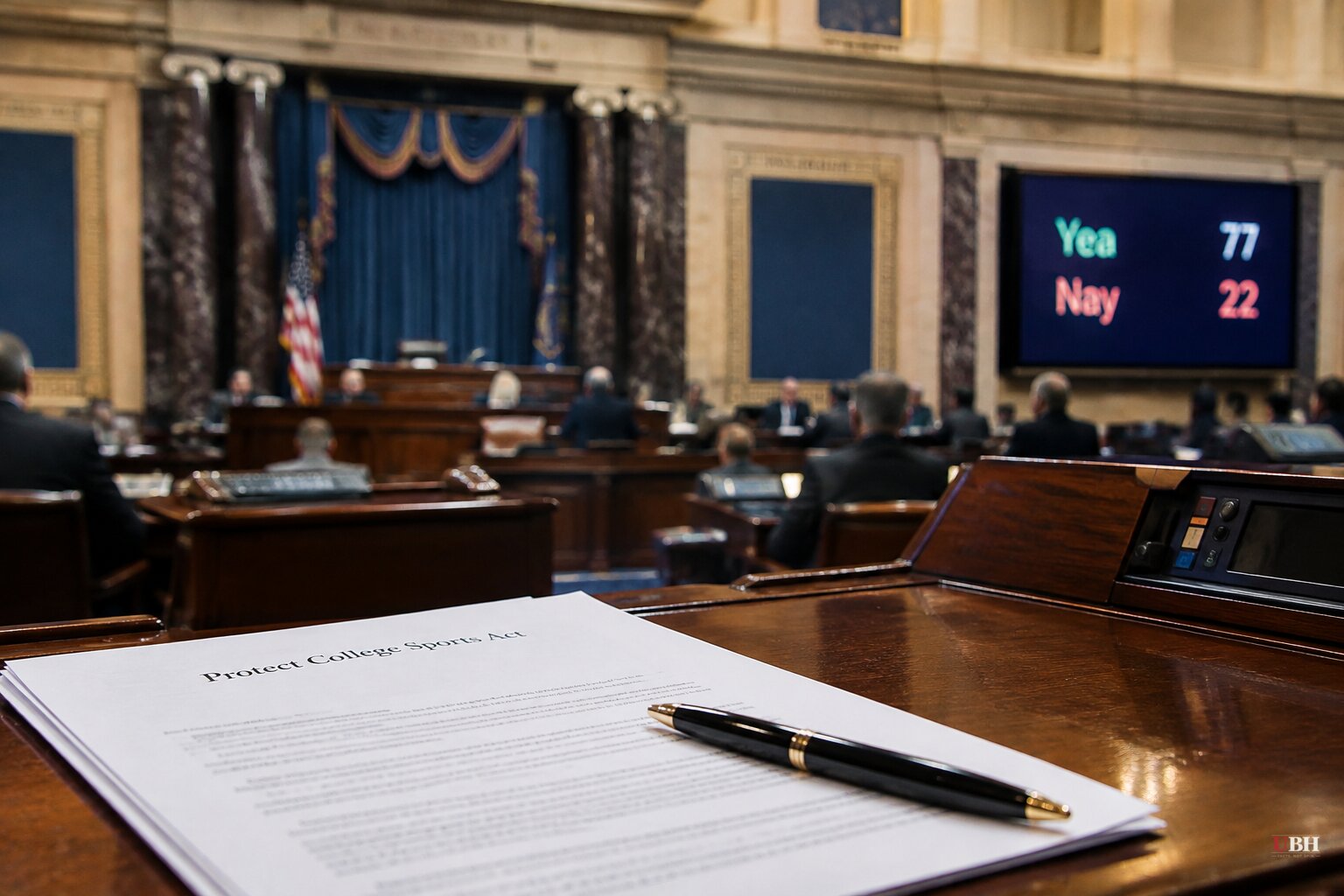
The U.S. Senate voted 77-22 Monday night to pass the Protect College Sports Act, a bill co-authored by Sen. Maria Cantwell (D-Wash.) and Sen. Ted Cruz (R-Texas), according to the Los Angeles Times. The vote came a week after the chamber cleared a procedural hurdle 74-24 to move the bill toward final passage.
The bill now heads to the House in November, and if it passes there, to President Trump's desk. House Speaker Mike Johnson has said his chamber likely won't take it up until after the November midterm elections, according to Higher Ed Dive.
What the bill actually does
The legislation gives the NCAA a limited antitrust exemption to set uniform national rules on athlete eligibility, block excessive conference realignment, and stop the creation of a private-equity-backed super league that would replace the current NCAA subdivision structure, the LA Times reported.
It also codifies last year's $2.8 billion House v. NCAA settlement, which let Division I schools start directly sharing revenue with athletes. The soft cap on that revenue sharing rises from $21.5 million to around $50 million per school, plus an additional $27 million carve-out schools can use to retain current players. The bill is also designed to close the loophole wealthy programs have used to blow past the old cap by funneling booster and NIL money through third-party deals that technically didn't count against it.
Sen. John Hoeven (R-N.D.), a cosponsor, framed the bill as a rescue mission for small programs. "Across the country, small athletic programs are disappearing, student athletes are left vulnerable to exploitative contracts, and college rosters are being hollowed out by a system that awards excessive transfers," Hoeven said after last week's procedural vote, according to Higher Ed Dive.
Cruz made a similar pitch on the Senate floor: "If we're going to be having a national competition ... it is only Congress that can establish a clear and enforceable legal rule book." Former Alabama coach Nick Saban and ESPN's Pat McAfee both publicly pushed for the bill, and 24 of the NCAA's conferences backed it, the LA Times reported. Saban told the Senate Commerce Committee in June: "Without that legal certainty, every rule becomes another lawsuit, every standard becomes another risk, and the system keeps drifting toward a professional model."
The gap the bill doesn't close
Raising the revenue-sharing cap from $21.5 million to roughly $50 million, plus another $27 million in retention money, means the richest programs can legally spend far more than they could before. That's a bigger number for Power 4 schools to chase, not a smaller one. Whether closing the booster-loophole offsets that for mid-majors is an open question the bill's supporters haven't answered with data.
Meanwhile the market mid-major programs are actually competing in has already priced them out. According to a 2025 transfer portal analysis cited by Sports Illustrated contributor Kevin Sweeney writing for Yahoo Sports, one A-10 coach said a proven center now costs at least $600,000 in NIL compensation. An SEC coach put the going rate for a quality big man above $1 million. An ACC coach said elite centers can run $1.5 million or more. Valuation firms like On3 and Opendorse track this differently. On3 uses its own market model while Opendorse pulls from actual NIL contracts submitted by Power 4 schools, but both point the same direction: proven production at scarce positions now carries a price tag most mid-major budgets can't touch.
The deficits are already showing up in the books. Higher Ed Dive reported that several high-profile athletic departments have disclosed multimillion-dollar deficits in recent weeks, and a July report from law firm Husch Blackwell on athletics compliance concluded that "the financial sustainability of athletic departments is increasingly uncertain." Across the 2023-24 academic year, 94% of NCAA Division I athletic programs spent more on athletics than they brought in, according to Higher Ed Dive.
A September report from Cantwell's own office found that colleges have folded more than 100 women's and Olympic sports programs, calling it "an especially stark consequence of a system in which escalating football expenditures can crowd out opportunities for other student-athletes." The same senator cosponsoring a bill that raises the top-line spending cap for football and basketball is also the one documenting the programs getting crowded out by exactly that kind of spending.
The bill's critics
Not everyone in the industry is applauding. Stewart Mandel, who covers college football for The Athletic, has pointed out that the bill does nothing to cap coaching salaries, which remain one of the biggest drivers of athletic department budgets, while still permitting substantial athlete spending even with the new revenue-sharing ceiling in place. Some players and labor organizations have also raised objections, though the bill's text as reported doesn't detail specific labor protections addressing those concerns.
The practical test comes fast. If the House takes up its companion bill after the midterms and Trump signs a final version, mid-major athletic directors will find out within a year or two whether tighter enforcement against booster loopholes actually helps them compete, or whether a $77 million ceiling for the biggest programs just gives Power 4 schools more room to run further ahead.
Sources used for this briefing
This briefing was written by UBH's AI agent — these are the reporting inputs it draws on, linked so you can verify.


