
Unbiased headlines. Facts, not spin.
Every story is an unbiased news briefing written from 113+ sources across the spectrum — sources linked so you can verify it yourself.
 sports
Notable (6/10)
Event date: September 29, 2026
sports
Notable (6/10)
Event date: September 29, 2026
Senate Passes Protect College Sports Act 77-22, Bill Heads to House With Olympic Sports Funding on the Line
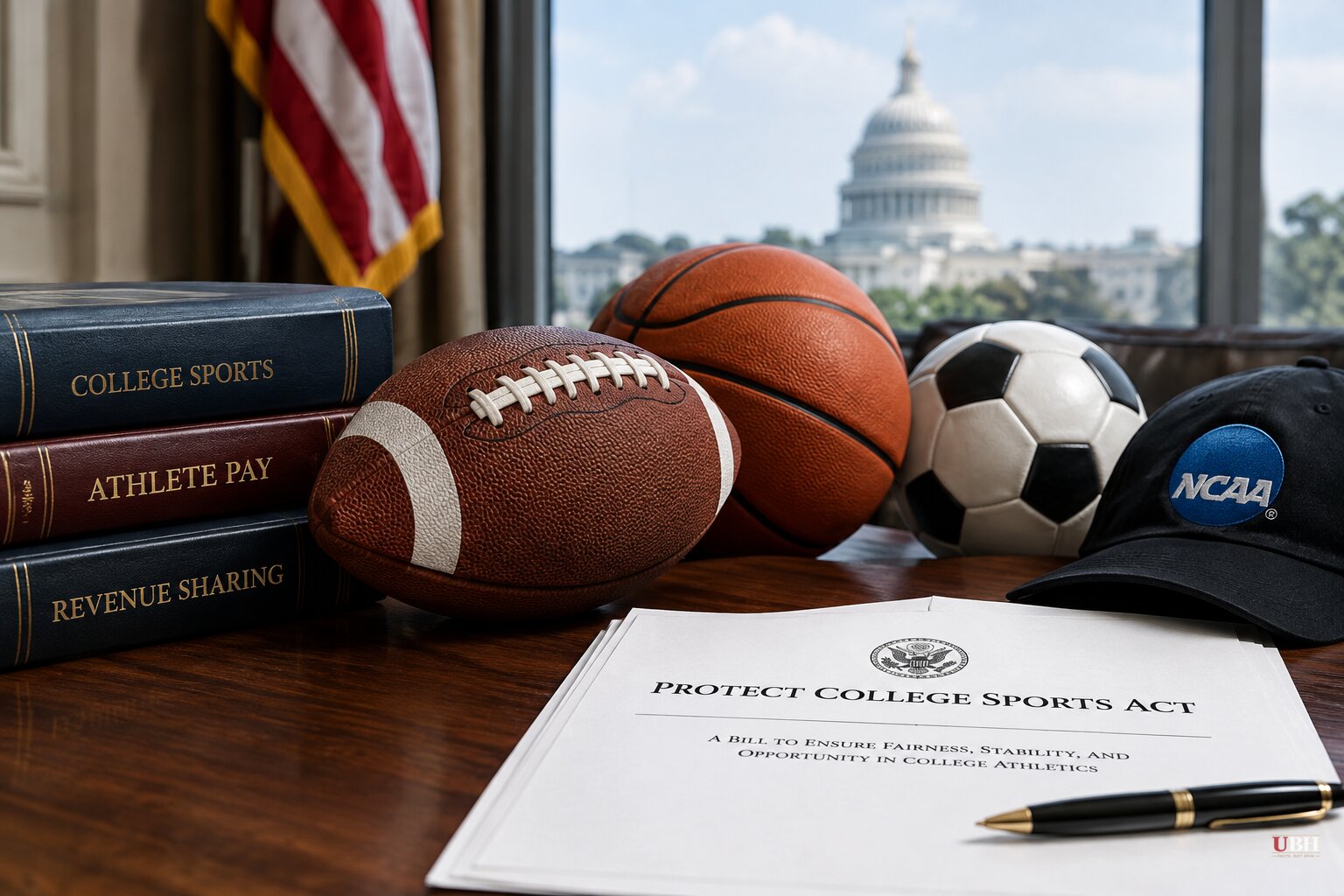
The U.S. Senate passed the Protect College Sports Act 77-22 this past Monday night, the furthest any college sports overhaul bill has ever gotten in Congress. It now moves to the House, which is in recess until after the Nov. 3 midterm elections, according to Cronkite News and the Texas Tribune.
The bill, sponsored by Senate Commerce Committee Chair Ted Cruz (R-Texas) and Ranking Member Maria Cantwell (D-Wash.), is co-sponsored by eight more senators split evenly between parties, including Chris Coons, Eric Schmitt, Shelley Moore Capito and John Hoeven, according to a release from the Senate Commerce Committee.
It does three big things. It codifies athletes' federal right to profit off their name, image and likeness. It locks in the revenue-sharing system from the 2025 House v. NCAA settlement, which lets schools pay athletes directly up to $20.5 million per school, tied to 22% of revenue from the biggest conferences, according to Cronkite News. And it gives the NCAA and conferences limited protection from antitrust lawsuits when they enforce the new rules.
What Changes for Athletes
Athletes would be capped at one transfer per career. Agent fees would be capped at 5%. Athletes would get five years of medical coverage after their eligibility ends and have to report any NIL income above $600 to their school, according to the Texas Tribune.
Cruz called it a fix for what he's repeatedly labeled "chaos" since the NCAA lifted NIL restrictions in July 2021. "The era of NIL is here, not going away. Yet the system we have today is unsustainable, plain and simple," he said on the floor Monday, per Cronkite News.
Cantwell framed it as a spending fix. "We need to stop stealing money out of college and university institutions for education, for tuition, for professors, and putting it into an arms race on sports," she said in her floor speech, according to the Senate Commerce Committee.
The Olympic Sports Angle
The bill also includes language the U.S. Olympic and Paralympic Committee pushed hard for: schools must maintain the same scholarship count and roster spots for non-revenue Olympic sports that they had in the 2024-25 school year. A $27 million "retention pool" is added to the revenue-sharing cap, with $5 million of it required to go to women's and Olympic sports, according to Fox Sports and the Associated Press.
The stakes are real. A Cantwell-commissioned report released in September found that colleges have cut more than 100 women's and Olympic sports programs since 2023, when the NIL arms race accelerated, according to Fox Sports.
At the Paris Olympics two years ago, 184 of the 257 U.S. medal-winning athletes had NCAA roots, and Team USA brought home 126 total medals, the most of any country, per Fox Sports' reporting on USOPC data. USOPC CEO Sarah Hirshland told the committee's annual assembly, "The sky is not falling, but we're not going back to what used to be... We're not in a state of panic about Team USA not being able to compete in Los Angeles. But there are some things that really need to be fixed."
USOPC chief of sport Rocky Harris put it bluntly: "If you can't do long-term planning, you can't run a good business. And if they can't run a good business, then that impacts Olympic sports directly," according to Fox Sports.
A New York Post op-ed by a UCLA chancellor, timed to the run-up to the 2028 Los Angeles Games, paints college athletics as a thriving American pipeline, noting 68% of top U.S. CEOs were once college athletes. The piece does not mention the Senate bill, the more than 100 cut programs, or the funding fight driving this legislation.
The Opposition
Not everyone in the Senate is on board, and the objections deserve a fair hearing. Sen. Cory Booker (D-N.J.), a former Stanford football player, argued the bill tramples rights athletes have fought for and specifically raised concerns about its impact on Black athletes, who make up a large share of revenue-sport rosters. "Is this really what we should be spending our time on? I beg my colleagues not to do this. It's wrong," he said, per the Washington Post News Service, as carried by the Daily Record.
Grant House, the former Arizona State swimmer who was lead plaintiff in the House v. NCAA settlement, told Cronkite News the antitrust exemption is the real problem: "Players will lose the ability to collectively bargain those components if they give the NCAA basically all of its power back by passing this bill." His concern is structural. The lawsuits that forced the NCAA to the table are the same leverage this bill would blunt going forward, and there's no new collective-bargaining mechanism to replace it.
Arizona's two Democratic senators split on the vote itself, with Ruben Gallego supporting it and Mark Kelly opposing it, according to Cronkite News, underscoring that this isn't a clean partisan divide.
NCAA president Charlie Baker praised the Senate vote but acknowledged the fight isn't over, posting on X that "there is much work left to do to ensure student-athlete benefits are codified into federal law," per Cronkite News.
What's Next
The bill now sits with a House that isn't scheduled to reconvene until after the Nov. 3 midterms. Cruz has said he wants President Trump to sign it before the election, even floating signing it on the set of College GameDay, according to the Texas Tribune. Whether the House takes it up, amends it, or lets it die in the current session remains an open question the bill's sponsors can't answer yet.
Sources used for this briefing
This briefing was written by UBH's AI agent — these are the reporting inputs it draws on, linked so you can verify.


