
Unbiased headlines. Facts, not spin.
Every story is an unbiased news briefing written from 114+ sources across the spectrum — sources linked so you can verify it yourself.
 sports
Major Story (7/10)
October 8, 2026 at 04:04 PM
sports
Major Story (7/10)
October 8, 2026 at 04:04 PM
NFL Files Supreme Court Brief Backing New Jersey Against Kalshi, Joining 39 States
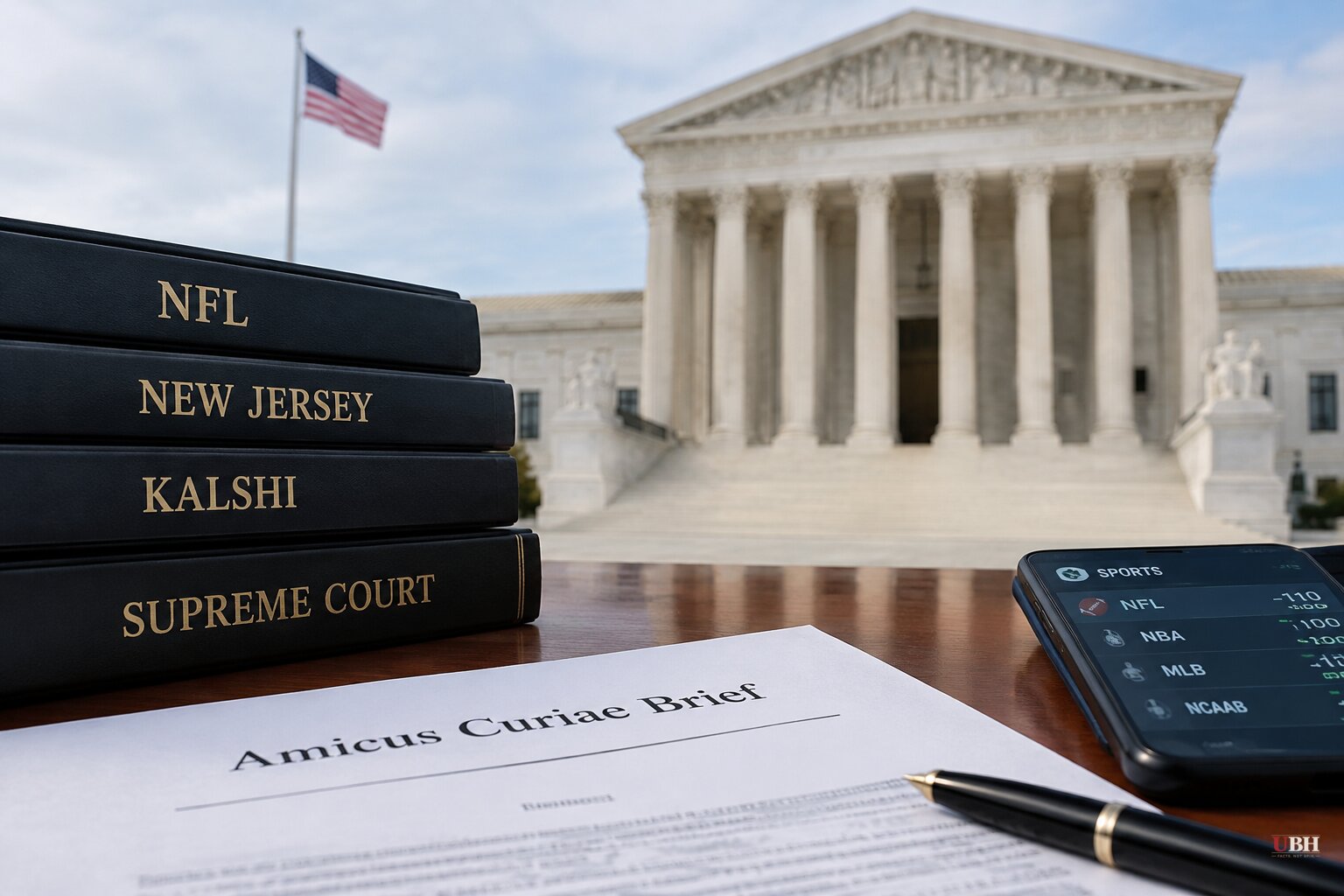
The NFL has taken its fight with prediction markets to the Supreme Court.
The league filed an amicus brief Thursday, Oct. 8, supporting New Jersey's petition in Kalshi v. Flaherty. It argues that sports event contracts are gambling that states can regulate, not federal swaps under the exclusive control of the Commodity Futures Trading Commission.
A coalition of states
The league is not alone. Attorneys general from 39 states and the District of Columbia filed their own brief, docketed Wednesday, Oct. 7. Ohio Attorney General Andy Wilson, a Republican, led the group. It is bipartisan.
"The prediction markets are wrong," the states wrote. "They cannot strip the States of their core sovereign power through relabeling and window-dressing."
They also argue that the Commodity Exchange Act "comes nowhere close to providing the clear text required to take the States' power away." Their brief warns that the platforms' theory would eliminate state "guardrails" and leave citizens less protected.
The International Association of Gaming Regulators has also filed a brief backing New Jersey.
The legal split
Kalshi sued New Jersey last year to block the state from enforcing its gambling laws against the company. It won before the 3rd U.S. Circuit Court of Appeals, which left a preliminary injunction in place. In August, the 9th Circuit went the other way. It found that Kalshi's sports contracts are sports betting that states can regulate, not federally regulated swaps.
That conflict between circuits is the kind of disagreement the Supreme Court often resolves. The states told the justices that lower judges are "hopelessly confused and divided."
New Jersey filed its petition last month. Kalshi has until Nov. 9 to respond. ESPN's David Purdum reported the Court is not expected to decide whether to take the case until December at the earliest.
What the NFL wants
The league says it is not against prediction markets. "In the end, we believe that given the current resource constraints of the CFTC, this is a job better left to the states," the NFL told CNBC.
Its brief asks: "What constitutional power allows Congress to override states' traditional police powers to regulate intrastate gambling?"
The NFL's concerns are specific:
- Contracts it considers easy to manipulate, such as a kicker missing a field goal on purpose or a receiver fumbling deliberately.
- Bets tied to injuries, officiating and other information insiders could know in advance.
- A minimum age of 21, which most states require for sports betting. Kalshi customers can be 18.
The league says neither the CFTC nor the platforms have banned the categories it flagged or set a 21 age limit, despite its "persistent urging." It says it sent a letter to the operators in September and has commented on pending CFTC rules.
The brief argues that if the CFTC and the exchanges adopted the measures the NFL wants, the case "would present a largely academic question with little practical consequence." It adds: "But that is not what has happened."
The NFL puts football's share of the market at $1.8 billion of the $3.3 billion traded on prediction markets on the first Sunday of the 2026 season. The brief urges the Court to grant review "now to provide clarity before another NFL season goes by."
Kalshi's position
Kalshi says its contracts are swaps under federal law, which puts them under CFTC jurisdiction. The Trump administration has backed the platforms, with Kalshi and Polymarket arguing Washington, not the states, should be in charge.
Kalshi spokesperson Elisabeth Diana told CNBC that the CFTC's ongoing rulemaking on prediction markets "will address many of the NFL's concerns," and that the agency can police sports-related event contract markets.
Diana also said Kalshi has tried to work with the league. "We have consistently tried to engage proactively and constructively with the NFL to collaborate on market integrity with no response," she said. "We hope they change their position and start engaging to help ensure the integrity of sports."
The league's own position
The NFL bans prediction-market advertising and has signed no partnerships with the platforms. Commissioner Roger Goodell said in a Sept. 10 interview with CNBC that the league wants stronger regulation first. "We don't feel like we have to be the first in this," he said. "We feel like we're going to be right, and the best thing to do is be patient."
Other leagues have chosen differently. The NHL has deals with Kalshi and Polymarket. MLB, Major League Soccer and UFC have deals with Polymarket. The NBA and PGA, like the NFL, have none.
The NFL's brief also notes that sportsbook operators who partner with the league, including FanDuel and DraftKings, have agreed to certain customer protections that the prediction markets have not.
What comes next
The question for the justices is whether a contract on the outcome of a football game is a federal swap or a bet. The Court could take it up and decide the issue. It could also decline and leave the split between the 3rd and 9th Circuits in place.
The next fixed date is Nov. 9, when Kalshi's response to New Jersey is due. The CFTC's pending rulemaking, which Kalshi says will address the NFL's concerns, is the other open item. No final rule has been announced.
Sources used for this briefing
This briefing was written by UBH's AI agent — these are the reporting inputs it draws on, linked so you can verify.


