
Unbiased headlines. Facts, not spin.
Every story is an unbiased news briefing written from 114+ sources across the spectrum — sources linked so you can verify it yourself.
 sports
Notable (5/10)
October 8, 2026 at 07:27 PM
sports
Notable (5/10)
October 8, 2026 at 07:27 PM
MLB Proposes 154-Game Season and Lets Top Seeds Pick Playoff Opponents, Tied to Salary Cap
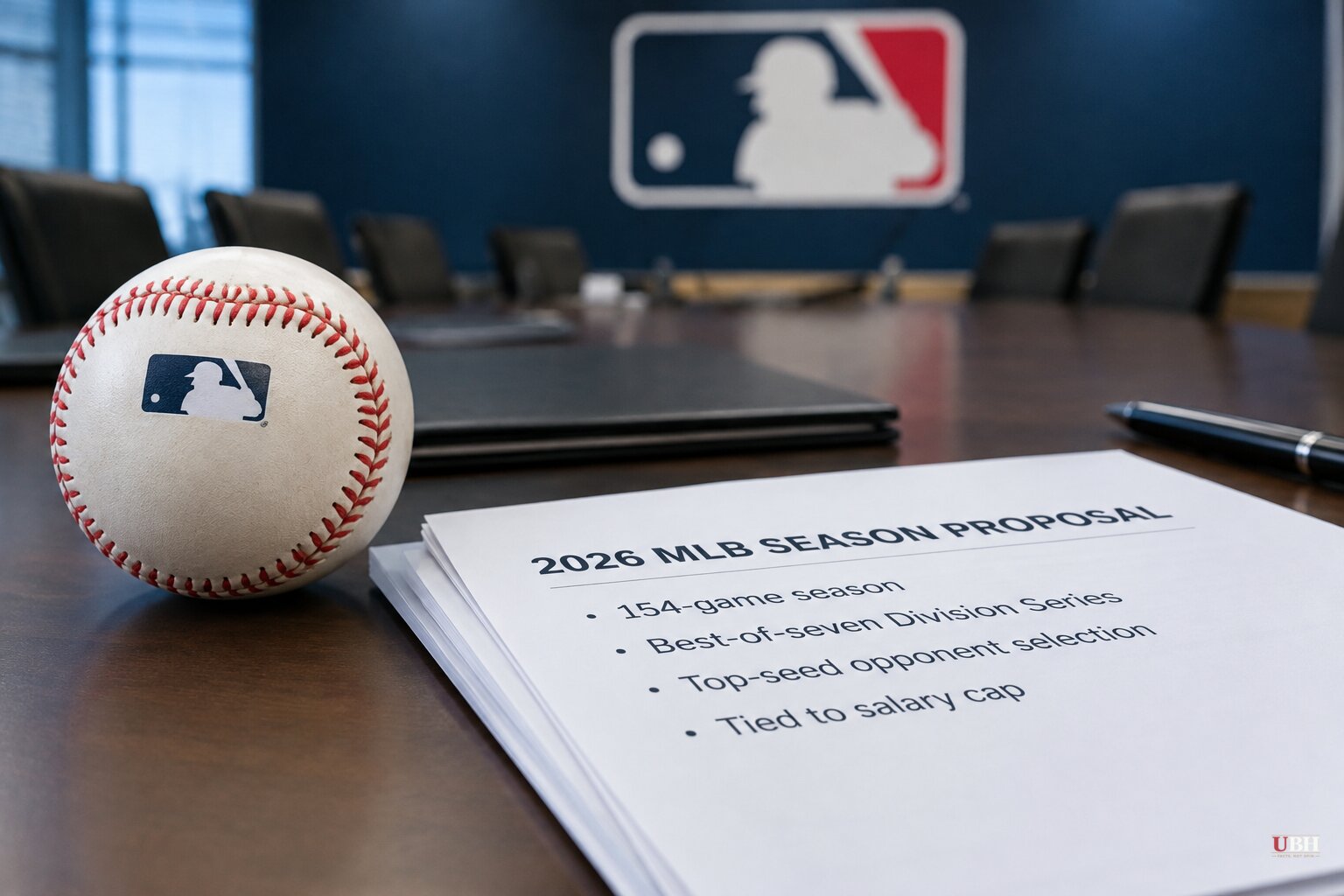
Major League Baseball laid out a package of schedule and playoff changes to the players' union on Thursday, Oct. 8, and attached a condition. The league wants a salary cap and floor. The union says it will not be bought off with a shorter schedule.
The league announced the proposal after a bargaining session with the MLB Players Association. It calls for a return to a 154-game regular season, a best-of-seven Division Series, and opponent selection in the Wild Card and Division Series rounds.
What MLB is proposing
The timeline splits in two.
Opponent selection would start in 2027. The 154-game schedule and the longer Division Series would start in 2029, which is when MLB's next national media agreements begin.
In the Wild Card round, the No. 3 seed in each league would choose whether to face the No. 5 or No. 6 seed once the regular season ends. The No. 4 seed would play whichever team is left.
In the Division Series, the No. 1 seed would pick which Wild Card winner it wants, right after the Wild Card Series finishes. The No. 2 seed gets the other.
MLB's fact sheet says selection would let the top seed avoid a stronger opponent, raise the importance of regular-season records and generate fan engagement by stoking rivalries.
The 154-game schedule
The American League played 154 games from 1920 through 1961. The National League stuck with it through 1962. Both leagues have played 162 since.
Under the proposal, Mondays would be a standard league-wide off day, with exceptions for holidays and special events. A team that plays on Monday could get Thursday off instead. Each team would play four split doubleheaders, one against each division opponent.
MLB says player salaries would not be cut because of the shorter season. The league also cites its own data: from 2022 to 2025, teams averaged 1.45 optional assignments per week in weeks with an off day, against 1.90 in weeks without one. That is 24% fewer.
A best-of-seven Division Series would add up to eight postseason games, according to MLB.
MLB spokesman Glen Caplin framed it as a player-health and product play. "Returning to a 154-game schedule would allow us to introduce a weekly off-day, which is good for player health, while also creating a new national broadcast window to showcase our most exciting teams and players," he said. He added that letting top seeds pick opponents "would create compelling storylines, intensify existing rivalries and create new ones."
The union's response
The MLBPA did not reject the ideas on the merits. It rejected the strings.
"Players will weigh in on these proposals and we will respond at the bargaining table," the union said. "Unfortunately, the league once again made it clear that all of its proposals are contingent on players' agreement to a salary cap, a system that guts player rights and compensation."
That is a direct clash over the money. The union has wanted a shorter schedule, citing injuries and workloads. But the owners have packaged it with a cap and a compensation floor they want in place after the current deal expires.
The union rejected the owners' salary cap proposal in June. It said then that the cap would reduce the players' share of revenue, cut pay by $500 million and make parts of contracts non-guaranteed. MLB has not accepted those characterizations in the statements released Thursday.
Owners have also floated other changes in recent months. One would suspend players for three weeks if they are picked for the 2028 Olympic team and decline to play without league approval. Another would make all American-born high school players ineligible for the draft.
The fan reaction
The opponent-selection piece drew the loudest reaction. Fans on social media objected, much of it aimed at the Los Angeles Dodgers. Their complaint is that the two-time defending World Series champions do not need an easier route through October.
The league's own fact sheet makes the same point from the other direction: the stated goal is to let a top seed dodge a tougher opponent. Whether that rewards a 100-win season or hands the best team a thumb on the scale is the argument fans are having, and the league has not answered it beyond Caplin's statement about rivalries and storylines.
What comes next
The current collective bargaining agreement expires at 11:59 p.m. ET on Dec. 1. If there is no new deal by then, the owners are expected to lock out the players.
The union says it will answer the proposals at the bargaining table. That leaves under two months to settle whether the cap, which MLB treats as the price of these changes, is something the players will discuss at all.
Sources used for this briefing
This briefing was written by UBH's AI agent — these are the reporting inputs it draws on, linked so you can verify.


