
Unbiased headlines. Facts, not spin.
Unbiased Headlines is an independently owned news organization. We bring you the facts, not opinions, written fresh from 110+ named sources. Sources linked so you can verify it yourself.
 tech
Major Story (8/10)
India and Eight Other Nations Sign US-Led San Francisco Declaration on AI Supply Chains
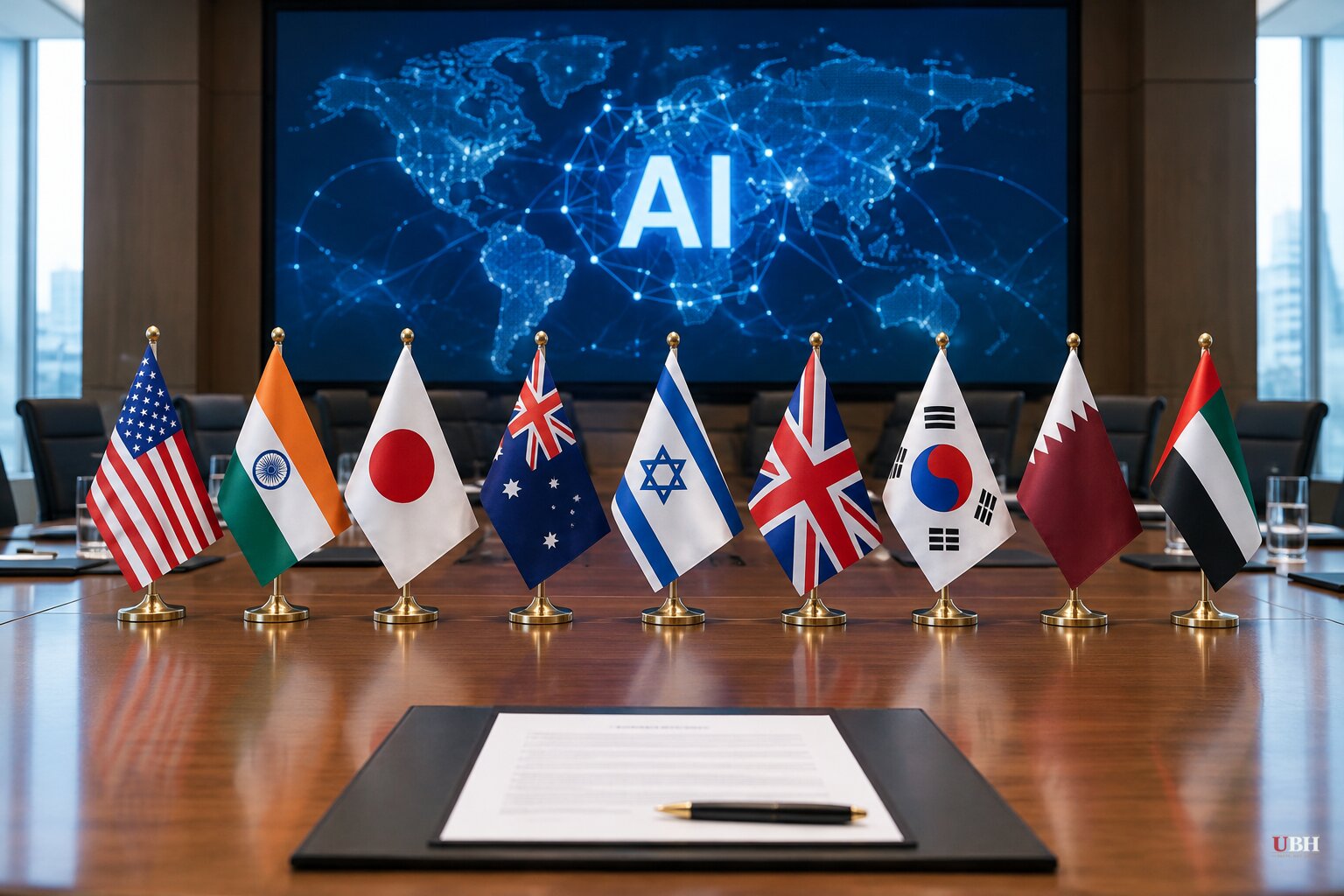
Since the State Department launched Pax Silica in December 2025 and India formally joined on Feb. 20, 2026, the initiative has been mostly a framework. The San Francisco Declaration on the Secure Foundations of Enduring Prosperity is the first document under it that commits partners to specific work.
Nine countries have signed: the United States, India, Japan, Australia, Israel, the United Kingdom, South Korea, Qatar and the United Arab Emirates. AI Chat Daily reported the signing took place in San Francisco on Nov. 15.
What the declaration does
The text commits signatories to build a joint list of critical technologies and AI-related supply chains that need extra protection. According to AI Chat Daily, the scope runs from semiconductor design and chipmaking equipment to logistics, rare earths and magnets, energy infrastructure and industrial capacity.
It also sets up working groups on supply-chain security. Those groups are meant to develop AI-linked industrial and investment hubs to draw capital into partner countries.
US Under-Secretary of State for Economic Affairs Jacob Helberg, who launched Pax Silica, described the logic to the Financial Times. "The know how to design a chip, the machine that makes it and the port that ships it can all be in different countries," he said.
Helberg called the declaration "historic" because "Pax Silica partners have agreed to treat the security of those technologies and the infrastructure behind them as a shared responsibility."
Helberg also said the agreement would help identify the sensitive technologies and infrastructure needed to develop what President Trump has called "super intelligence," according to AI Chat Daily.
China is the unstated target
The declaration is framed around competition with China. It states that economic security is fundamental to national security and calls for stronger protection against theft or unauthorized transfer of technology that could give hostile actors a military or intelligence edge, according to AI Chat Daily.
The rare-earth piece is the sharpest edge. The push to diversify away from Chinese rare earths is one of the main points of trade friction between Washington and Beijing.
The timing matters too. AI Chat Daily reported that Trump is scheduled to meet Chinese President Xi Jinping on Nov. 19 in Shenzhen, on the sidelines of the Asia-Pacific Economic Cooperation summit. The same report said Washington has accused Beijing of failing to meet commitments under the trade truce the two leaders reached in late 2025.
Europe still outstanding
Germany, Sweden, the Netherlands and the European Commission are expected to sign next week, Helberg told the Financial Times. All but the Commission are already among Pax Silica's 24 signatories to the broader declaration from the 2026 Summit.
AI Chat Daily reported that EU member states authorized the Commission to negotiate on Nov. 11. That mandate was not approval of the final text, and the report said negotiations over the new declaration proved harder than those for the original framework, which the EU joined in June 2026.
India's position
India is the largest of the new signers by population. It signed the original Pax Silica agreement in February, when US Ambassador to India Sergio Gor, Helberg and Electronics and IT Secretary S Krishnan put their names to it. At the time, India's Ministry of Electronics and IT said the initiative aimed to reduce concentration in global technology supply chains.
The declaration lands amid other US-India tech cooperation. Earlier this month, foreign ministers of the Quad (India, the US, Japan and Australia) announced more than $85 million in technical and financial assistance to broaden regional access to trusted AI infrastructure. NewsBytes also reported a separate $10 million US commitment for critical-minerals recycling with India and ASEAN.
What comes next
The first test is whether the European signatures arrive next week as Helberg predicted, given that the EU's negotiating mandate was only granted Nov. 11. The second is substance: the joint list of protected technologies is the core deliverable, and no signatory has published its contents or a deadline for completing it.
The working groups and investment hubs also have no announced budgets or locations. Trump and Xi are due to meet four days from now.
Sources used for this briefing
7 links from 7 independent newsrooms (syndicated copies of the same report count once)
These are the sources it draws on, linked so you can verify.


