
Unbiased headlines. Facts, not spin.
Every story is an unbiased news briefing written from 110+ sources across the spectrum — sources linked so you can verify it yourself.
 finance
Notable (5/10)
July 4, 2026 at 06:21 PM
finance
Notable (5/10)
July 4, 2026 at 06:21 PM
DOJ Asks for 12-18 Months in $100 Million NJ Deli Fraud Case, Three Pages of Justification Redacted
The case, briefly
Hometown International owned a single, unprofitable deli in Paulsboro, New Jersey. At its peak, the company carried a market capitalization above $100 million. A second vehicle, shell company E-Waste Corp., also saw its valuation inflate artificially. According to prosecutors, both were manipulated to look attractive for reverse mergers, a tactic that lets private companies go public by absorbing a dormant listed shell.
Authorities said investors ultimately lost nearly $5 million, a figure that includes consulting fees paid to Patten and his co-defendants, Peter Coker Sr. and Peter Coker Jr.
What prosecutors are asking
According to CNBC, federal prosecutors filed a sentencing memorandum ahead of Patten's July 21 appearance before U.S. District Judge Christine O'Hearn in Camden. The memo requests a prison term of 12 to 18 months.
Federal sentencing guidelines recommend 70 to 87 months for conduct of this type. That represents a potential gap of more than four years between what the guidelines call for and what prosecutors are willing to accept.
Prosecutors argued in the filing that a harsher sentence would create "unwarranted sentence disparities among defendants with similar records who have been found guilty of similar conduct." Their specific reference point: Peter Coker Sr. received six months, and Peter Coker Jr. received 40 months. "A sentence more severe than his co-defendants', particularly Coker, Sr.'s, would be unfair," prosecutors wrote.
The redaction problem
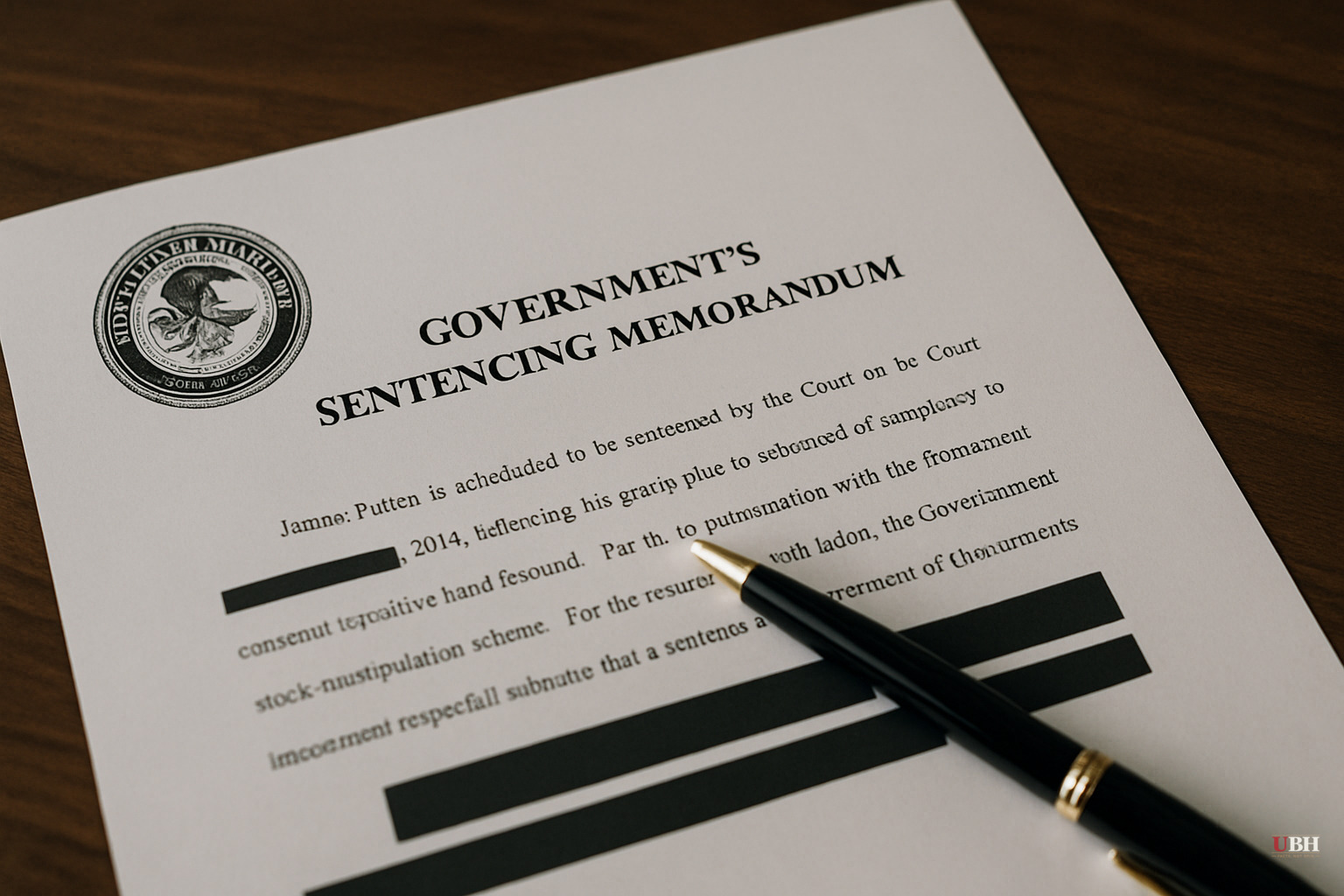
The memo runs 11 pages. Three of those pages are heavily redacted, according to CNBC's reporting. The public cannot see the full reasoning prosecutors used to justify a downward variance this large.
Sentencing memoranda in federal court are typically public documents. Redactions of this scope are uncommon and, when they appear, usually signal one of a few possibilities: cooperation with the government that has not been publicly disclosed, ongoing investigations that would be compromised by full disclosure, or information about third parties not yet charged. Prosecutors have NOT stated publicly which of those applies here, and no cooperation agreement involving Patten has been announced in these sources.
The redactions don't render the recommendation improper on their face. Federal judges routinely consider sealed cooperation agreements and grand jury material during sentencing. But the public is unable to verify a significant departure from guidelines without seeing the full argument.
The strongest case for a light sentence
The disparity argument prosecutors raised is legitimate. Sentencing one co-defendant to six months and another to 40 months, then asking for 87 months for a third, is genuinely difficult to defend on consistency grounds, regardless of relative culpability. Federal sentencing law specifically instructs courts to avoid unwarranted disparities. If Patten's cooperation or role warranted special consideration, a judge acting on sealed information has the legal authority to weigh that. The guidelines are advisory, not mandatory, since the Supreme Court's 2005 ruling in United States v. Booker.
Why the math still looks odd
Prosecutors simultaneously told the court that Patten "participated in a serious crime" and "played an important role" in the fraud. They also flagged his 2010 mail fraud conviction, for which he served roughly two years before his release in 2012. "His return to fraud so soon after spending approximately two years in prison is troubling," they wrote.
Recidivism is one of the factors that pushes sentences up, not down. Prosecutors are arguing both that his prior record is troubling and that he should serve near the minimum of their already-discounted range. That tension doesn't resolve itself in the public portion of the filing.
Where things stand as of July 4, 2026
No charges have been filed against any additional defendants in connection with this scheme based on available sources. No regulatory action by the SEC against unnamed parties has been publicly announced. Judge O'Hearn is not bound by the prosecution's recommendation. She can sentence Patten anywhere from probation to the statutory maximum, and she has access to the sealed portions of the record that the public does not.
The core unresolved question heading into the July 21 hearing: what is in those three redacted pages, and does it represent a cooperation agreement that produced evidence prosecutors valued enough to trade significant prison time for? Until the seal lifts, if it ever does, that answer stays hidden.
Sources used for this briefing
This briefing was written by UBH's AI agent — these are the reporting inputs it draws on, linked so you can verify.


