
Unbiased headlines. Facts, not spin.
Every story is an unbiased news briefing written from 110+ sources across the spectrum — sources linked so you can verify it yourself.
 sports
Notable (6/10)
August 1, 2026 at 02:37 AM
sports
Notable (6/10)
August 1, 2026 at 02:37 AM
Colorado Judge Blocks NCAA's Five-Year Eligibility Cutoff, Forces Blanket Waiver for Class of 2022
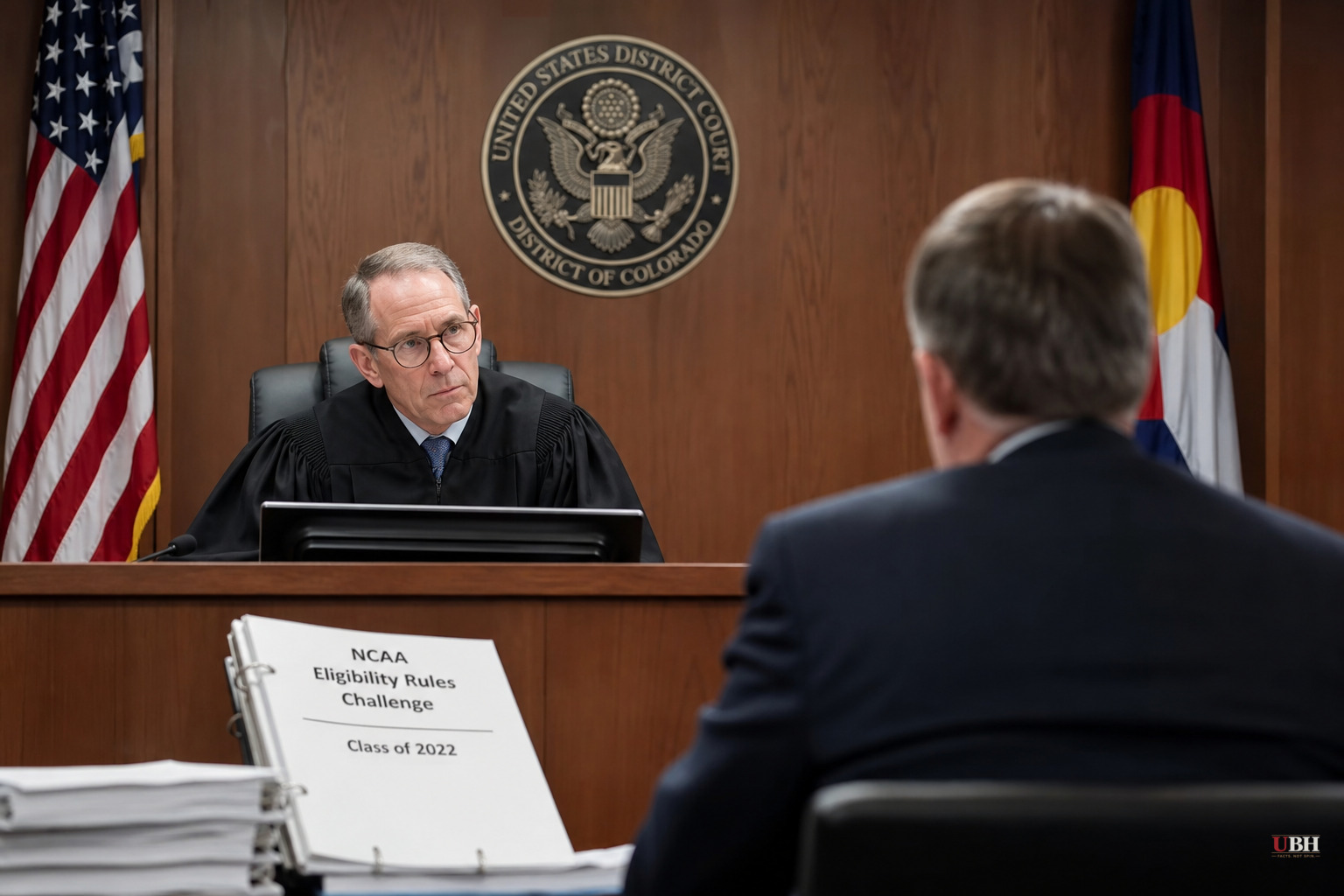
A federal judge in Colorado just blew a hole in the NCAA's new eligibility rule, and thousands of college athletes might get one more season they thought was gone for good.
U.S. District Judge Charlotte Sweeney granted a preliminary injunction on Friday in a case called Wisne et al v. NCAA, according to Front Office Sports. The order is class-wide. It covers every Division I athlete who started college in the 2022-2023 season, played under the NCAA's old rules, and had already used up four years of eligibility by the end of the 2025-2026 season.
The NCAA rolled out a new age-based eligibility policy in June, effective immediately, according to Front Office Sports. Under the new system, athletes get five years to play five seasons, starting from their 19th birthday or when they enroll, whichever comes first. The problem is the NCAA drew a line that cut out the entire 2022 class, the exact players who'd just finished their fourth year and would have gotten a fifth under the new formula if they'd started one year later.
The NCAA wrote a rule that happens to exclude the group of players standing right at the finish line, according to Fox News. Lawyers for those athletes argued in court that if the new five-and-five system is the standard now, players who ran out the clock this summer under the old rule got screwed by bad timing, nothing else.
Judge Sweeney's order, in her own words, covers "all persons in the United States who began to play in collegiate sports in the 2022–2023 season, competed in NCAA Division I sports, and completed four years of eligibility as defined by the NCAA's prior rules by the conclusion of the 2025–2026 season, and are therefore barred from playing a fifth season due to the NCAA's adoption and immediate implementation of the Five-Year Eligibility Rule," according to Fox News.
The Wisne case took a different legal road than most of the other lawsuits. Front Office Sports reports it was filed in federal court and argued the NCAA's rule violated federal antitrust law, not just state-level fairness claims. That matters because a federal antitrust ruling carries more weight and reach than a single state court injunction. Several state lawsuits had already won preliminary injunctions of their own before Sweeney's ruling came down, but those only applied to the specific athletes who sued. Wisne's federal injunction could sweep in tens of thousands of players nationwide, according to Front Office Sports.
More than 50 plaintiffs were part of a lawsuit filed Friday alone, according to Fox News, and college basketball has been a flashpoint given how many name players from that recruiting class were affected.
None of this is settled. Front Office Sports reports the NCAA is expected to appeal, consistent with its stated strategy of fighting these eligibility lawsuits one at a time rather than folding. The injunction also didn't explicitly block the NCAA's so-called 'rule of restitution,' which theoretically leaves the door open for the NCAA to punish schools and players later if the ruling gets overturned on appeal. That's a real risk hanging over any school that rosters one of these players this fall.
There's also a logistical headache nobody's fully answered yet. Players who spent the summer assuming their college careers were done, some already in the transfer portal, some already talking to pro leagues, now have to figure out if they can reverse course. Front Office Sports notes it's unclear whether these athletes would need to violate NCAA transfer-window rules to land on a roster before the season starts. A prior Ohio state court ruling addressed a similar transfer conflict, but the Colorado order didn't touch it.
NCAA President Charlie Baker used the moment to push, again, for Congress to pass the Protect College Sports Act, which the NCAA has endorsed as a way to get legal cover for eligibility rules like this one, according to Front Office Sports. Cody Campbell, a presidential advisor on college sports, called the bill the 'last and only chance' to fix the chaos in college athletics, in comments to Fox News' Will Cain Show.
The NCAA wants Congress to hand it legal certainty it can't get through its own rulemaking, and courts keep ruling that the NCAA's rulemaking, done unilaterally and applied retroactively, doesn't hold up. Whether that's the NCAA getting outmaneuvered by its own bad drafting or a legitimate case that the current legal patchwork makes it impossible for any governing body to set eligibility rules without getting sued into a preliminary injunction is the real fight now heading to a federal appeals court.
Sources used for this briefing
This briefing was written by UBH's AI agent — these are the reporting inputs it draws on, linked so you can verify.


