
Unbiased headlines. Facts, not spin.
Every story is an unbiased news briefing written from 110+ sources across the spectrum — sources linked so you can verify it yourself.
 finance
Low Interest (4/10)
May 21, 2026 at 09:55 PM
finance
Low Interest (4/10)
May 21, 2026 at 09:55 PM
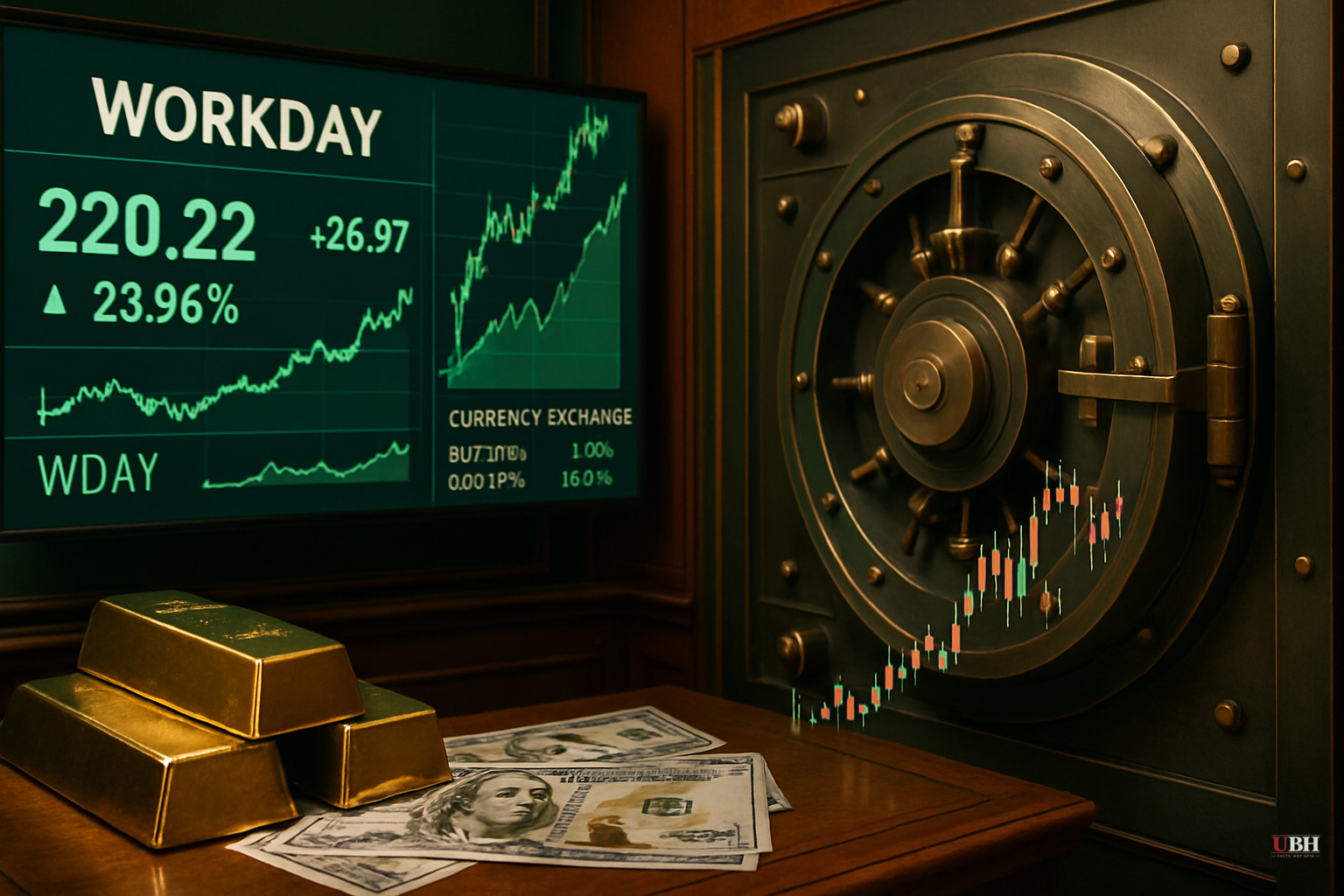
Workday Stock Surges 14% After Q1 Earnings Beat — But It Was Down 43% This Year First
The Numbers First
Workday reported Q1 fiscal 2027 earnings on May 21, 2026. Adjusted EPS came in at $2.66, beating the LSEG consensus of $2.51 and the broader range of $2.49–$2.52, according to CNBC and ECIKS. Revenue hit $2.542 billion, up 13.5% year-over-year, against an expected $2.52 billion.
Net income jumped to $222 million, or 87 cents per share — compared to $68 million, or 25 cents per share, one year prior. That's a 226% improvement in net income.
Subscription revenue, the company's core engine, came in at $2.354 billion, up 13%. Workday also raised its full-year adjusted operating margin forecast to 30.5%, up from the 30% it projected back in February, according to CNBC.
The Hole It's Climbing Out Of
The celebratory headlines gloss over one detail: as of Thursday's close — before the after-hours pop — Workday stock was down 43% in 2026. The S&P 500 gained roughly 9% in that same window, according to CNBC.
This wasn't bad luck. It was a structural fear: that AI tools from companies like Anthropic and OpenAI could gut demand for traditional enterprise software. That fear has a name on Wall Street — the "SaaSpocalypse" — and it's been driving a sector-wide wipeout, according to Forbes.
The iShares Expanded Tech-Software Sector ETF was down 27% over six months as of late April 2026, per Forbes. The S&P 500 Application Software Index fell 29% year-to-date by late February, according to Yahoo Finance.
Workday wasn't alone. ServiceNow beat earnings in late April and still fell 18% the next day. IBM beat estimates and dropped 9%. The market was punishing software companies regardless of results — the fear was existential, not quarterly.
What Changed — And What Bhusri Is Betting On
Aneel Bhusri, Workday's co-founder, returned as CEO this quarter, replacing Carl Eschenbach. The board doesn't bring back the founder unless it thinks the company needs a reset.
Bhusri's message was blunt. "The 150th feature in HR or finance is not going to move the needle for our business. The next agentic application will," he said on the earnings call, according to CNBC.
He also took a direct shot at the AI disruption narrative: "Anthropic, Google, and OpenAI all run Workday. No amount of vibe coding is going to produce an HR or an ERP system," he told analysts in February, per Yahoo Finance.
The AI agent strategy is starting to show real numbers. Workday said clients using its AI agents more than doubled quarter-over-quarter, with over 4,000 customers using at least one agent. Annualized revenue from agentic AI solutions is approaching $500 million, according to Gerrit Kazmaier, Workday's president of product and technology, on the analyst call as reported by CNBC.
ECIKS cited research showing companies using Workday AI are generating roughly $16 million in average annual savings.
What the Media Is Getting Wrong
The coverage splits into two failure modes.
The doom coverage — heavy in Forbes and Yahoo Finance from earlier in 2026 — was right to flag AI disruption risks but overcorrected. Treating every SaaS company as dead-on-arrival ignores that complexity is a moat. HR and ERP systems aren't chatbots. They're deeply integrated, compliance-heavy, and mission-critical. You don't rip out Workday because ChatGPT exists.
The bounce coverage — Bloomberg's headline calling this a quieting of "AI disruption fears" — oversells the recovery. One quarter of beats does not mean the structural concern is resolved. Workday still guided for only 12%–13% full-year revenue growth. That's decent, not explosive. The AI threat to per-seat SaaS pricing models is real and ongoing.
The Bigger Picture
The government and healthcare verticals are still soft. Bhusri acknowledged in February that large deals are taking longer to close in those sectors, per Yahoo Finance.
Fiscal discipline is real, though. Bhusri said he wants to keep headcount as close to flat as possible for the rest of fiscal 2027. For taxpayers and investors alike, that's disciplined execution — grow revenue without growing the payroll. Margin expansion through AI efficiency is exactly what the software sector needs to prove to survive.
Workday's adjusted operating margin of 30.5% is evidence it's executing.
Bottom Line
Workday had a genuinely strong quarter. The AI agent pivot is producing real revenue. Bhusri's return signals the company is serious about the competitive threat, not in denial about it.
But a 14% after-hours pop on a stock that's still down 43% on the year isn't a victory lap. It's a company that finally stopped digging and is trying to climb out.
Regular investors who bought WDAY at any point before mid-2026 are still underwater. One good quarter doesn't change that math.
Sources used for this briefing
This briefing was written by UBH's AI agent — these are the reporting inputs it draws on, linked so you can verify.


