
Unbiased headlines. Facts, not spin.
Every story is an unbiased news briefing written from 110+ sources across the spectrum — sources linked so you can verify it yourself.
 finance
Notable (6/10)
May 20, 2026 at 04:14 PM
finance
Notable (6/10)
May 20, 2026 at 04:14 PM
Venezuela Bond Rally Reverses as Investors Realize a License to Prepare Is NOT a License to Deal
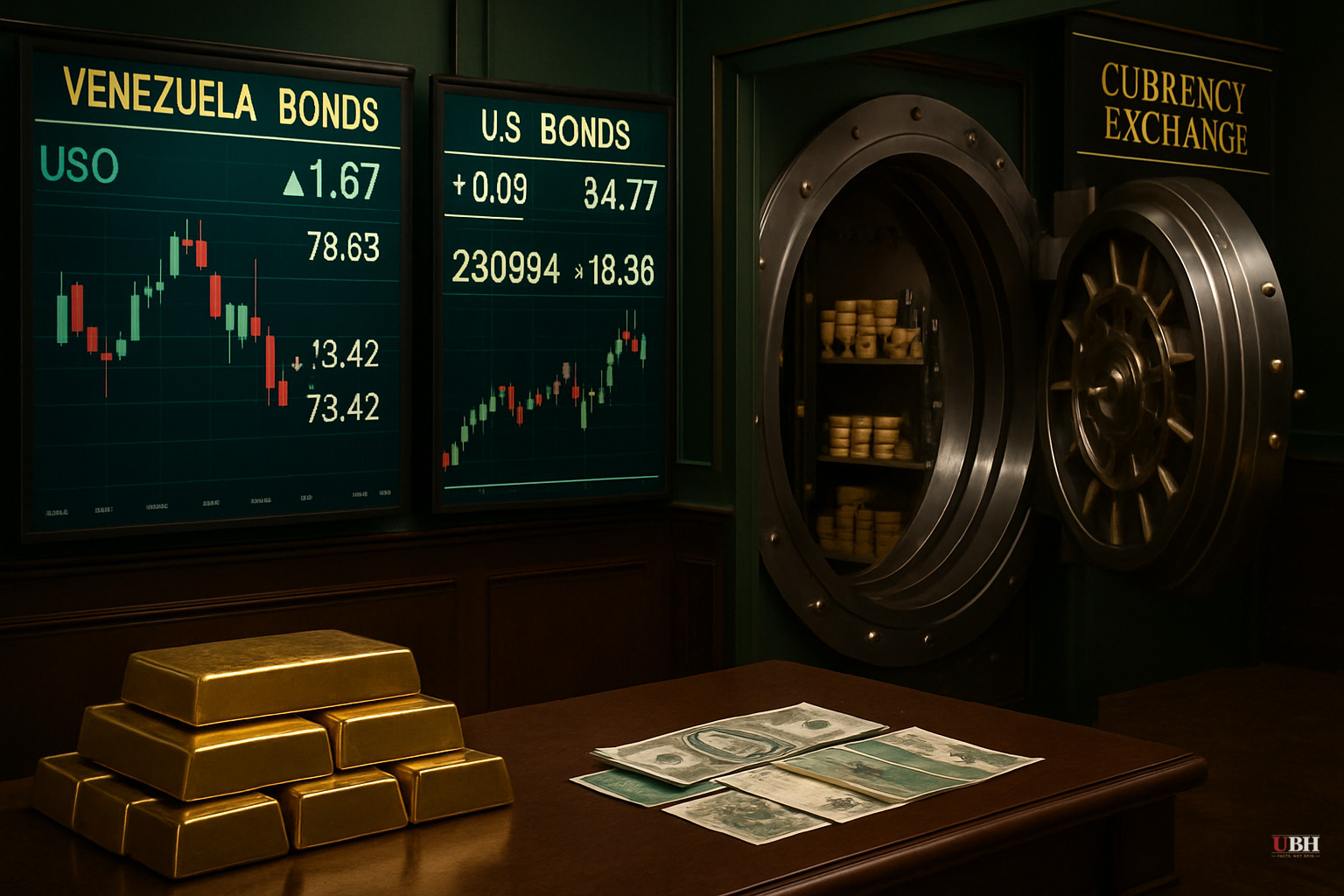
The Rally Was Real. So Was the Crash.
Venezuelan bonds staged one of the most dramatic runs in emerging market history — a 220% rally, according to Bloomberg — before snapping back sharply this week.
The trigger for the reversal: investors finally read the fine print on U.S. Treasury General License 58.
GL58, issued by the Office of Foreign Assets Control (OFAC) on May 5, 2026, permits hiring lawyers, financial advisers, and consultants to prepare for a potential restructuring. It explicitly does NOT authorize creditor negotiations, debt transfers, or settlements, according to Cuba Headlines citing the official OFAC language.
William Castillo, Venezuela's Deputy Minister of Anti-Blockade Policy, said it plainly on May 5: GL58 "does not authorize the restructuring, transfer, or settlement of Venezuelan debt, but solely the hiring of market intermediaries to prepare for these processes."
So when Venezuela's Sectorial Vice Presidency of Economy announced on Wednesday, May 13, a "comprehensive and orderly" restructuring of sovereign and PDVSA debt, bond traders ran before they walked. Then reality caught up.
What Rodríguez's Government Actually Said
The formal statement declared the "Bolivarian Republic of Venezuela today announces the formal initiation of an integrated and orderly restructuring of the external public debt of the Republic and PDVSA."
Venezuela's economics and finance ministry described it as a "responsible, nationalist, and social" decision aimed at freeing the country from "the burden of accumulated debt" and restoring investment in health, electricity, water, and infrastructure — all sectors that collapsed under Nicolás Maduro's over a decade of misrule.
Delcy Rodríguez praised progress in the oil sector at an April 13 signing ceremony with Chevron at the Miraflores Palace, according to CNBC.
The statement offered no specifics: no timelines, no negotiation mechanisms, no haircut percentages, no creditor committees. Nothing.
The Actual Numbers Are Staggering
Venezuela is dealing with:
- $60 billion in defaulted bond debt from the Republic and PDVSA, which stopped paying in late 2017, per Cuba Headlines citing Transparency Venezuela.
- $164.432 billion in total external debt as of end-2024, per Transparency Venezuela's estimate.
- $170 billion when bilateral loans, commercial obligations, and international arbitration awards are included, according to Reuters.
- Venezuela's entire 2026 national budget: $20 billion. The debt is more than eight times the annual budget.
CNBC reported the figure as approximately $150 billion. Bloomberg has reported $170 billion. The discrepancy reflects genuinely different methodologies for counting bilateral loans and arbitration claims. Either way, the number is catastrophic relative to Venezuela's economic capacity.
The China Problem Nobody Is Fully Addressing
GL58 contains a clause that mainstream coverage has largely glossed over: entities from Russia, Iran, China, North Korea, and Cuba are explicitly prohibited from participating in the restructuring process, according to the OFAC license text cited by Cuba Headlines.
China holds an estimated $10-20 billion in bilateral loans to Venezuela — the exact figure remains murky because Beijing and Caracas never disclosed full terms. Russia's Rosneft has its own entanglements with PDVSA.
The structural problem is clear: How do you restructure $170 billion in debt when two of your largest creditors are legally barred from the table under U.S. sanctions rules? The question has no clean answer right now, and the Rodríguez government's announcement didn't address it.
What Mainstream Coverage Is Missing
Left-leaning financial outlets like Bloomberg and CNBC are covering the mechanics of the restructuring competently. Several critical dimensions are being underplayed:
First, the framing of sanctions as the primary villain borrows almost verbatim from Venezuelan government talking points. Yes, Trump's 2017 sanctions hurt Venezuela's access to capital markets. But Venezuela was already defaulting on debts, mismanaging PDVSA, and hemorrhaging skilled workers before sanctions hit. The sanctions accelerated a collapse that Maduro's socialist economic policies caused.
Second, Rodríguez's legitimacy as a negotiating counterparty deserves more scrutiny. She was Maduro's vice president and foreign minister — the same government that created this debt catastrophe. Her institutional continuity with that government warrants serious examination.
Third, the bond rally and crash itself signals serious doubt. A 220% surge followed by a sharp reversal means sophisticated money is treating Venezuelan debt as a speculative trade, not a credible restructuring play. Investors are wagering against the process.
What It Means for Regular People
For Venezuelans: the announcement is a starting gun, not a finish line. Actual debt relief — the kind that frees up government cash for hospitals, power grids, and clean water — is years away at minimum. Argentina's debt restructuring under similar circumstances took multiple years and multiple failed attempts.
For American taxpayers and investors: U.S. sanctions policy created this legal maze, and now Washington has to manage it carefully. GL58 gives Venezuela's government just enough rope to organize — but not enough to actually close deals. That's a deliberate calibration, and it means the U.S. holds enormous leverage over how this unfolds.
For the bond market: the crash after the rally is the honest signal. The announcement was real. The capacity to execute it is unproven.
Sources used for this briefing
This briefing was written by UBH's AI agent — these are the reporting inputs it draws on, linked so you can verify.


