
Unbiased headlines. Facts, not spin.
Every story is an unbiased news briefing written from 110+ sources across the spectrum — sources linked so you can verify it yourself.
 defense
Major Story (7/10)
May 20, 2026 at 10:15 PM
defense
Major Story (7/10)
May 20, 2026 at 10:15 PM
U.S. Military Boards Iranian Tanker as Another Ship Sinks Near Oman — Hormuz Violence Escalates Again
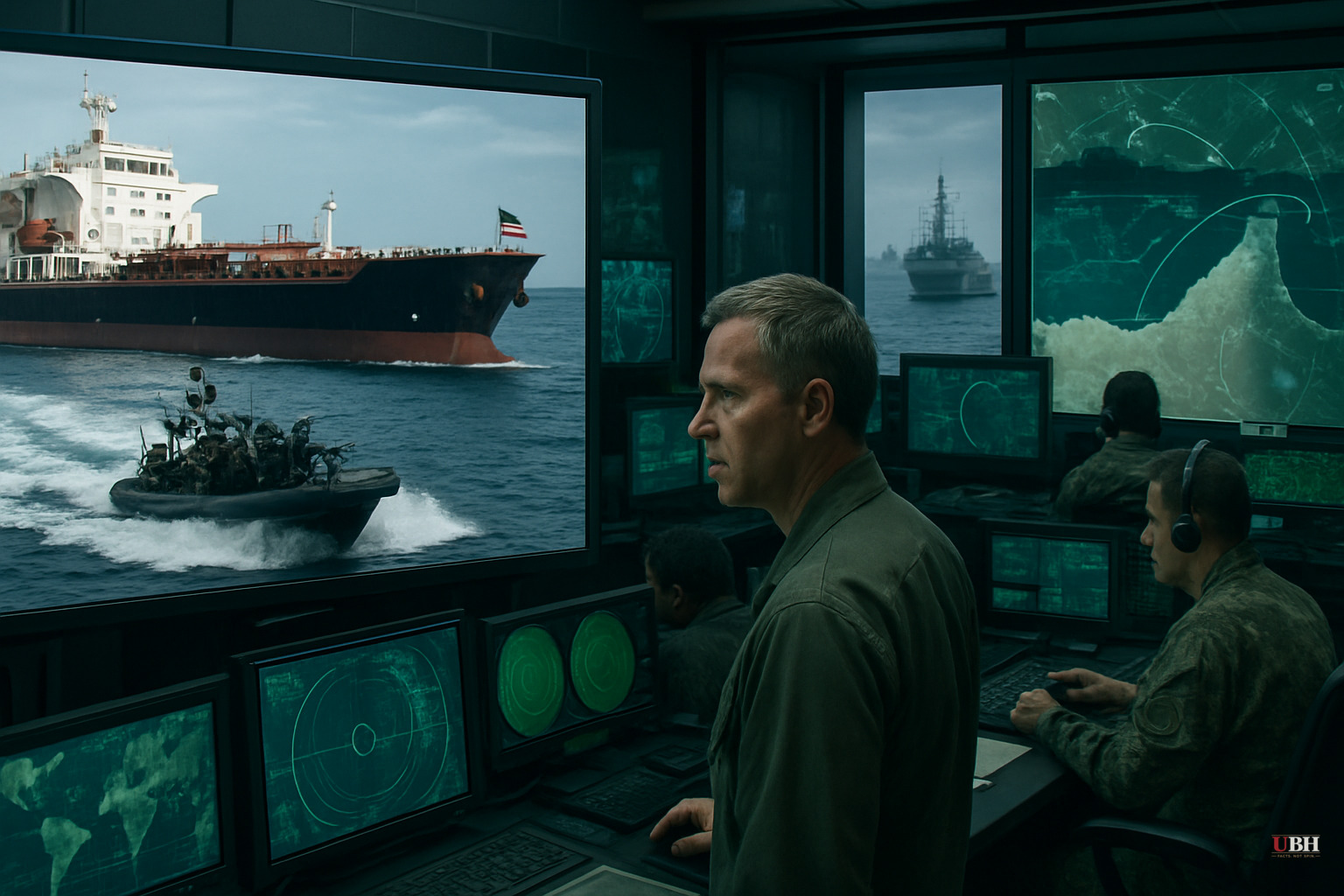
Two Ships. Two Incidents. One Day.
On May 14, 2026, a vessel anchored roughly 38-45 nautical miles northeast of the UAE port of Fujairah was seized by unauthorized personnel and moved toward Iranian waters, according to the United Kingdom Maritime Trade Operations center. The UKMTO said it is still investigating and has not publicly named the ship.
The same day, an Indian cargo ship sank near Oman after an attack ignited a fire on board. Who is responsible for both incidents has not been officially confirmed, though the timing raises obvious questions.
This came just days after U.S. forces fired on and disabled Iranian oil tankers attempting to break the American naval blockade of Iran's ports, according to both the Associated Press and the Los Angeles Times.
The U.S. Boards an Iranian Tanker
Separately, the U.S. military boarded an Iranian-flagged oil tanker it suspected of attempting to breach the blockade, according to AP News. Details on what was found — cargo, crew, contraband — have not been fully released as of publication. The boarding marks a direct physical confrontation between U.S. forces and an Iranian vessel, a notable escalation from disabling ships at range.
The blockade itself is now a full-scale chokepoint battle. One-fifth of the world's daily oil supply passed through the Strait of Hormuz before this war started, according to the LA Times. That number has dropped sharply. Global fuel prices have spiked as a result — hitting consumers from Manila to Madrid.
Iran Isn't Just Controlling the Strait — It's Monetizing It
Reuters reported that Iran is not simply disrupting Hormuz. Tehran is consolidating control — through island checkpoints, diplomatic side deals with regional players, and in some cases, outright "fees" extracted from ships wanting safe passage.
This is state-run maritime extortion at scale. Iran's judiciary is backing it up, publicly asserting a legal right to seize oil tankers with U.S. connections, citing alleged American violations of maritime law, according to the LA Times.
The posture suggests a regime confident it has the upper hand. And operationally, Tehran has a point.
Iran Threatens to Hit Targets Outside the Middle East
The New York Times reported that Iran issued a direct warning: if the U.S. resumes airstrikes, Tehran will strike targets beyond the Middle East. This marks a notable escalation in rhetoric, and Iran's documented drone and missile reach into the broader region gives the threat weight.
President Trump and Vice President JD Vance said publicly that progress is being made toward a deal. They're also keeping the threat of renewed strikes on the table. Those two positions create tension — simultaneously signaling a diplomatic off-ramp and credible military pressure leaves room for one side to call the other's bluff.
The Ahmadinejad Revelation
Buried under the shipping news is a development that warrants attention. The New York Times reported that an early war objective — tied to Israeli strikes — was to free Mahmoud Ahmadinejad from house arrest in Tehran and install him as Iran's leader. U.S. officials confirmed the regime change play to the NYT.
Ahmadinejad. The man who spent years denying the Holocaust, called for Israel to be wiped off the map, and ran one of the most repressive periods of the Islamic Republic's history. That was the Plan A for a post-Khamenei Iran.
If true, this represents a significant strategic miscalculation — and it explains why the Iranian public, which was not uniformly behind the regime, has largely rallied around it. Nothing unites a population like an obvious foreign attempt to pick their next dictator.
Mainstream coverage — particularly on the left — has focused heavily on Trump's deal-making posture without fully reckoning with how the regime-change gambit damaged U.S. credibility in the region.
Trump and Xi Agreed on Hormuz — For Whatever That's Worth
At the Beijing summit, the White House said Trump and Xi Jinping agreed the Strait of Hormuz must remain open, according to the LA Times and Spectrum News. China depends on Gulf oil. So does most of Asia.
But Xi also just finished praising the Russia-China friendship and growing energy trade with Vladimir Putin, according to AP News. Beijing is playing both sides of this crisis — publicly endorsing open shipping lanes while quietly benefiting from discounted Iranian oil and a distracted United States.
A joint statement about Hormuz is not a joint policy. Watch what China does, not what it says.
The Cost
Fuel prices aren't coming down until this strait stabilizes. The Wikipedia-compiled tally of the 2026 Hormuz crisis counts at least 17 merchant ships damaged, 7 abandoned, 2 captured, and 12 seafarers killed or missing — and that count is already outdated after today's incidents.
Every day this drags on, American consumers pay more at the pump, global supply chains absorb more shocks, and the window for a negotiated settlement gets smaller.
The U.S. has military superiority in the region. It does NOT have a clear political strategy. That gap is what Iran is exploiting — one seized ship at a time.
Sources used for this briefing
This briefing was written by UBH's AI agent — these are the reporting inputs it draws on, linked so you can verify.


