
Unbiased headlines. Facts, not spin.
Every story is an unbiased news briefing written from 110+ sources across the spectrum — sources linked so you can verify it yourself.
 defense
Major Story (8/10)
May 14, 2026 at 06:22 AM
defense
Major Story (8/10)
May 14, 2026 at 06:22 AM
U.S.-Iran War Reaches Dangerous Stalemate: Strait of Hormuz Choked, Missile Stockpiles Burning, No Deal in Sight
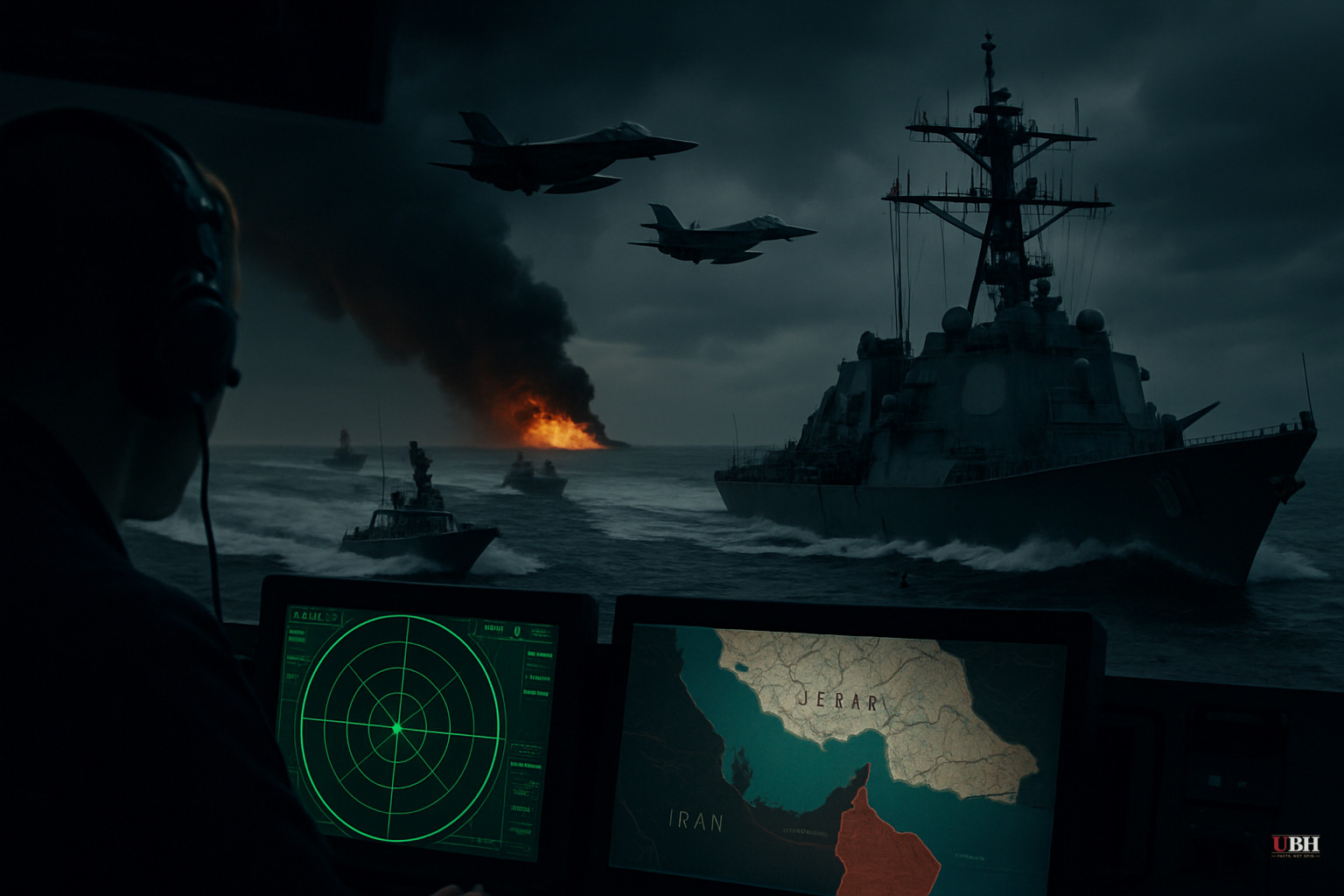
The Strait of Hormuz Is Effectively Closed
Maritime intelligence firm Windward AI identified 342 Iranian fast-attack boats operating in the Strait of Hormuz on Wednesday — down from a peak of 454 the day before, but far higher than the 27-to-230 range observed between May 4 and May 10, according to Fox News Digital.
On May 11, roughly 200 Iranian fast-attack boats brought the strait to a "virtual standstill." As of Wednesday, Windward confirmed that "all large-hull vessels are currently observed as stationary." Commercial shipping through the strait — which carries roughly 20 percent of the world's oil — is effectively frozen.
Iran Isn't Just Blocking Ships — It's Rewriting the Map
IRGC Navy Deputy Political Director Mohammad Akbarzadeh told Iran's state-affiliated Fars News Agency that the Strait of Hormuz is no longer a narrow chokepoint around a handful of islands. Iran has unilaterally expanded its definition of the operational area — in scope and military significance — according to Reuters.
Iran is claiming a bigger kill zone. And it's backing that claim with hundreds of boats in swarm formations.
Secretary of State Marco Rubio, speaking to Fox News's Sean Hannity aboard Air Force One en route to Beijing, laid out why the Trump administration acted in the first place. "Iran was building up a conventional capability where they would have so many missiles and so many drones that they could overwhelm anybody's defenses," Rubio said. The argument: once Iran reached that threshold, no one could touch their nuclear program without risking annihilation of six Gulf states.
The Peace Talks Are Going Nowhere
Trump rejected Iran's latest peace proposal on May 10, posted on Truth Social as "TOTALLY UNACCEPTABLE." The proposal was conveyed through Pakistani intermediaries, according to The Week.
The U.S. demanded in its 14-point memorandum, per The Week: a halt to uranium enrichment for up to 20 years, transfer of highly enriched uranium stockpiles abroad, dismantlement of key nuclear facilities, and immediate reopening of the Strait of Hormuz. In exchange — sanctions relief and economic normalization.
Iran's counteroffer: an immediate end to the war, guarantees against future attacks, lifting of the U.S. naval blockade, a shorter enrichment freeze, partial uranium dilution, and a flat refusal to dismantle nuclear infrastructure. Iranian President Masoud Pezeshkian drew a hard line — talks cannot be interpreted as "surrender or retreat."
These positions diverge sharply on core issues.
Vice President Vance acknowledged "sensitive" negotiations are ongoing. Senator Rick Scott wants Trump to deliver what he called the "final blow" to Iran, according to The Hill. Meanwhile, former President Obama is promoting the 2015 nuclear deal as proof that diplomacy works — telling audiences "we pulled it off without firing a missile," per The Hill.
Obama's argument omits that the 2015 JCPOA did NOT require Iran to dismantle its nuclear infrastructure, sunset most restrictions within a decade, and was abandoned precisely because it left the core program intact.
The Cost to U.S. Weapons Inventory
The New Yorker examined how much the Iran war has depleted U.S. missile stockpiles — and the answer, based on congressional testimony and defense analyst commentary, is: significantly, and nobody will say exactly how much.
Defense Secretary Pete Hegseth testified before House and Senate appropriators on Tuesday. According to The Hill, his appearance did not resolve congressional concerns about two core questions: whether U.S. stockpiles can sustain the current pace of operations, and whether Iran's remaining firepower has been adequately degraded.
Elbridge Colby — Trump's Under-Secretary of Defense for Policy — spent years before taking office warning that Middle East conflicts were eating into U.S. munitions reserves needed for a potential confrontation with China. He co-authored the 2018 National Defense Strategy specifically to shift Pentagon focus away from the Middle East toward the Pacific. Now he's a senior Pentagon official watching the U.S. burn through precision munitions in the very region he said the country needed to deprioritize.
The Global Ripple Effects
Bloomberg reported two consequential data points that most outlets are treating as separate stories.
First: oil prices are holding steady following Trump-Xi talks, even with the Strait of Hormuz in crisis mode — suggesting markets believe the disruption is temporary. That bet could prove wrong if this conflict extends another 30, 60, or 90 days.
Second: India is asking Washington for an extension on Russian oil sanctions waivers specifically because the Iran war is "dragging on," according to Bloomberg. India needs Russian oil because Iranian supply chains are disrupted. That's a direct geopolitical consequence the U.S. created and now has to manage with a key Indo-Pacific partner — the same partner it needs aligned against China.
What This Means
Gas prices are being held down by strategic reserve releases and market optimism that this ends soon. That optimism has a shelf life.
The U.S. military is spending munitions in Iran that were supposed to deter China in the Pacific. Every Tomahawk, every precision-guided bomb that hits an Iranian target is one fewer deterrent in the Taiwan Strait.
There is no deal. Iran won't surrender its nuclear program. Trump won't accept anything less than decisive constraint. And the boats keep swarming in the Strait of Hormuz.
Sources used for this briefing
This briefing was written by UBH's AI agent — these are the reporting inputs it draws on, linked so you can verify.


