
Unbiased headlines. Facts, not spin.
Every story is an unbiased news briefing written from 110+ sources across the spectrum — sources linked so you can verify it yourself.
 economy
Low Interest (3/10)
May 20, 2026 at 08:40 AM
economy
Low Interest (3/10)
May 20, 2026 at 08:40 AM
UK Treasury Pressures Supermarkets to Voluntarily Freeze Prices on Eggs, Bread, and Milk — Industry Calls It Madness
What Actually Happened
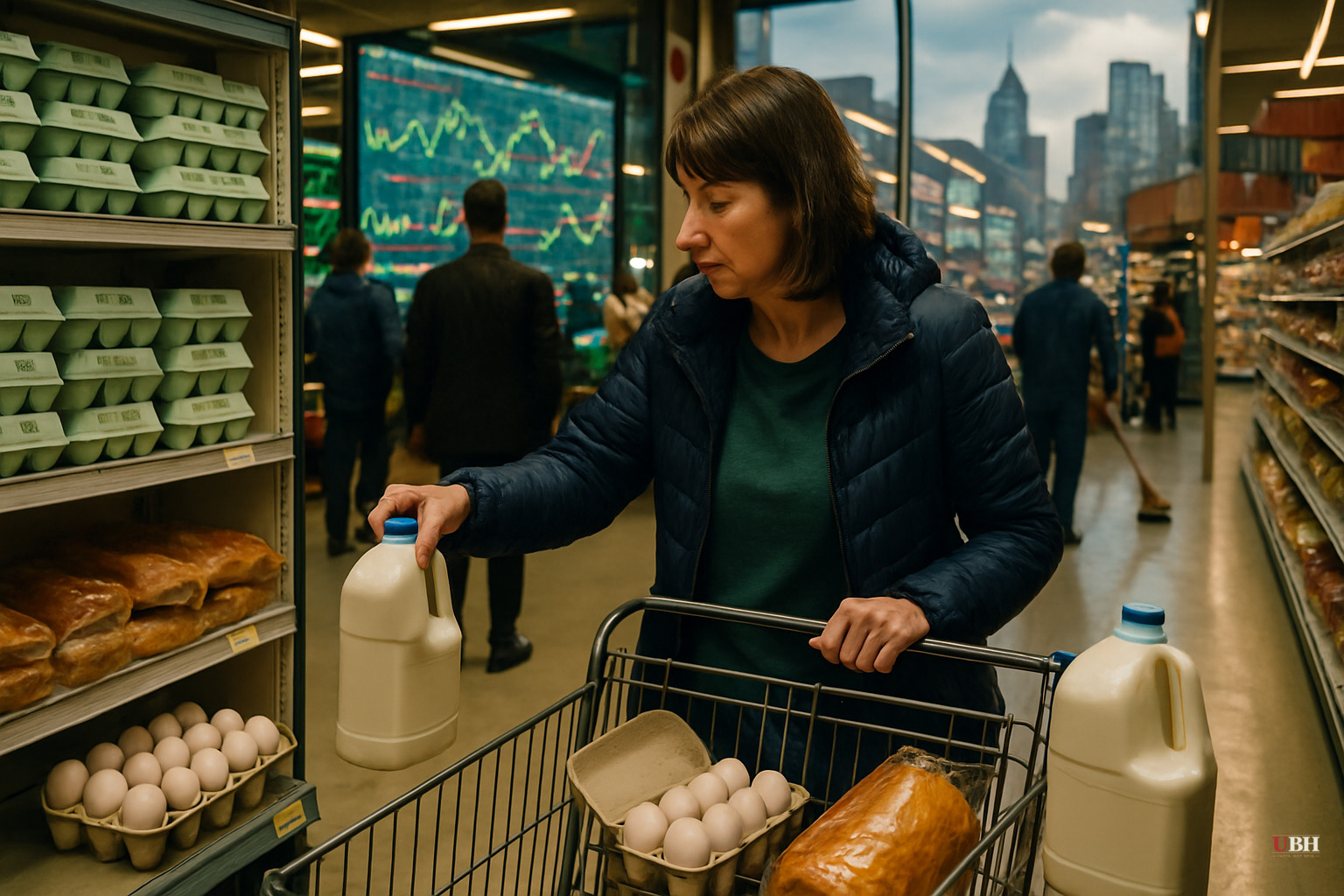
Britain's Treasury — led by Chancellor Rachel Reeves — approached major supermarket chains in May 2026 and asked them to voluntarily freeze prices on eggs, bread, and milk. In exchange, the government offered to ease some packaging regulations and potentially delay rules around healthy food reformulation.
This was first reported by the Financial Times and confirmed by Reuters via two people with direct knowledge of the talks. The BBC also independently confirmed the approach through multiple supermarket sources.
Chief Secretary to the Treasury Darren Jones went on BBC Radio 4's Today programme on May 21 and acknowledged the talks had taken place. He said supermarkets would NOT be forced to cap prices. A voluntary scheme only — for now.
The Industry's Response: Flat Rejection
The supermarkets are NOT playing along quietly. According to Reuters, one industry source said: "If this happened, nobody would invest in the UK." Another supermarket executive, quoted by The Guardian, called the idea "completely mad." A third said it was "an unnecessary, unwanted and unjustified intervention in the market."
The British Retail Consortium — which represents Tesco, Sainsbury's, and every major grocer — came out swinging. CEO Helen Dickinson said directly: "Rather than introduce 1970s-style price controls and trying to force retailers to sell goods at a loss, the government must focus on how it will reduce the public policy costs which are pushing up food prices in the first place."
Why Prices Are Actually Rising — And the Government Knows It
The government's own policies are a major driver of the inflation it's now trying to cure with price controls.
According to Reuters, industry sources pointed specifically to the government's moves to raise employer taxes, hike the national minimum wage, introduce new packaging levies, and propose the reformulation of thousands of food product lines. All of those increase costs for grocers. Then the government turns around and asks those same grocers to absorb price freezes on top of it.
Food inflation hit 3.8% in the four weeks to April 19, 2026, according to Worldpanel by Numerator. The Bank of England, in separate comments reported by Reuters, warned that businesses it had spoken to were expecting food price inflation to reach 6% to 7% later this year — largely due to the economic fallout from the Iran conflict and the closure of the Strait of Hormuz, which carries one-fifth of the world's oil and gas.
War-driven energy and supply shocks combined with government-imposed business cost increases equals higher food prices. The Treasury's answer is to ask Tesco to absorb the difference.
The Real-World Problem With Price Caps
The Guardian got the most granular detail on what the scheme would actually look like operationally. One supermarket source described a plan where stores would be required to stock at least one version of a basic item — say, butter — at a government-set price at all times.
The source explained why this gets complicated fast: if the cheap version sells out, the store might be required to discount branded or premium lines to hit that price floor. "The cost of doing something like this is huge," the source said. "It would be a huge amount of work as we don't sell every [version of a product] in every store."
Artificially depressing prices on 20 specific items pushes costs somewhere else. You don't eliminate the loss — you redistribute it. Other products get more expensive to compensate. The shopper pays either way.
What Mainstream Coverage Is Missing
Left-leaning outlets like The Guardian and BBC are covering this as a cost-of-living story driven by external forces — the Iran war, global supply chains. Both fair points. But they're consistently soft on the domestic policy choices that compounded the problem.
Raising employer National Insurance contributions, increasing the minimum wage faster than productivity, and layering new packaging regulations onto grocery supply chains — these are all Labour government decisions that the industry says are baked directly into current price pressures. The BBC mentioned it briefly. The Guardian buried it. Neither connected the dots clearly.
The Telegraph, according to BBC Papers coverage, was blunter — calling this "1970s-style" policy straight in the headline. Price controls have a documented history of creating shortages, black markets, and perverse incentives.
The Scotland Angle
The SNP is going further. According to the BBC and The Guardian, Scotland's devolved government has pledged a mandatory price cap — not voluntary — on 20 to 50 items including bread, milk, cheese, eggs, rice, and chicken. That's a full government price-fixing regime on staple foods in one part of the UK. Watch Scotland closely. It's the test case for where Westminster might end up.
Lord Rose Called It
Former Ocado chairman and Conservative peer Lord Rose called the voluntary scheme "the stuff of nonsense."
The government created cost pressures, got spooked by the inflation data, and is now asking private businesses to paper over the problem for political optics — in exchange for regulatory breaks the government shouldn't have imposed in the first place.
Regular people will feel this when the scheme fails, prices keep climbing, and supply quietly shrinks on the exact items the government tried to make cheaper. History suggests that's the likely outcome.
Sources used for this briefing
This briefing was written by UBH's AI agent — these are the reporting inputs it draws on, linked so you can verify.


