
Unbiased headlines. Facts, not spin.
Every story is an unbiased news briefing written from 110+ sources across the spectrum — sources linked so you can verify it yourself.
 defense
Low Interest (4/10)
May 17, 2026 at 09:32 PM
defense
Low Interest (4/10)
May 17, 2026 at 09:32 PM
Two Navy EA-18G Growlers Collide Mid-Air at Idaho Air Show — All 4 Crew Members Eject Safely
What Happened
At 12:10 p.m. local time on Sunday, May 17, 2026, two U.S. Navy EA-18G Growler jets collided mid-air approximately two miles northwest of Mountain Home Air Force Base in southwestern Idaho.
The jets belonged to Electronic Attack Squadron (VAQ) 129, based out of Whidbey Island, Washington — the Navy's dedicated Growler demonstration team. This was a performance, not a combat mission. Four personnel were aboard the two aircraft: pilots and electronic warfare officers, two per jet.
All four ejected. All four are alive.
The Crash, On Camera
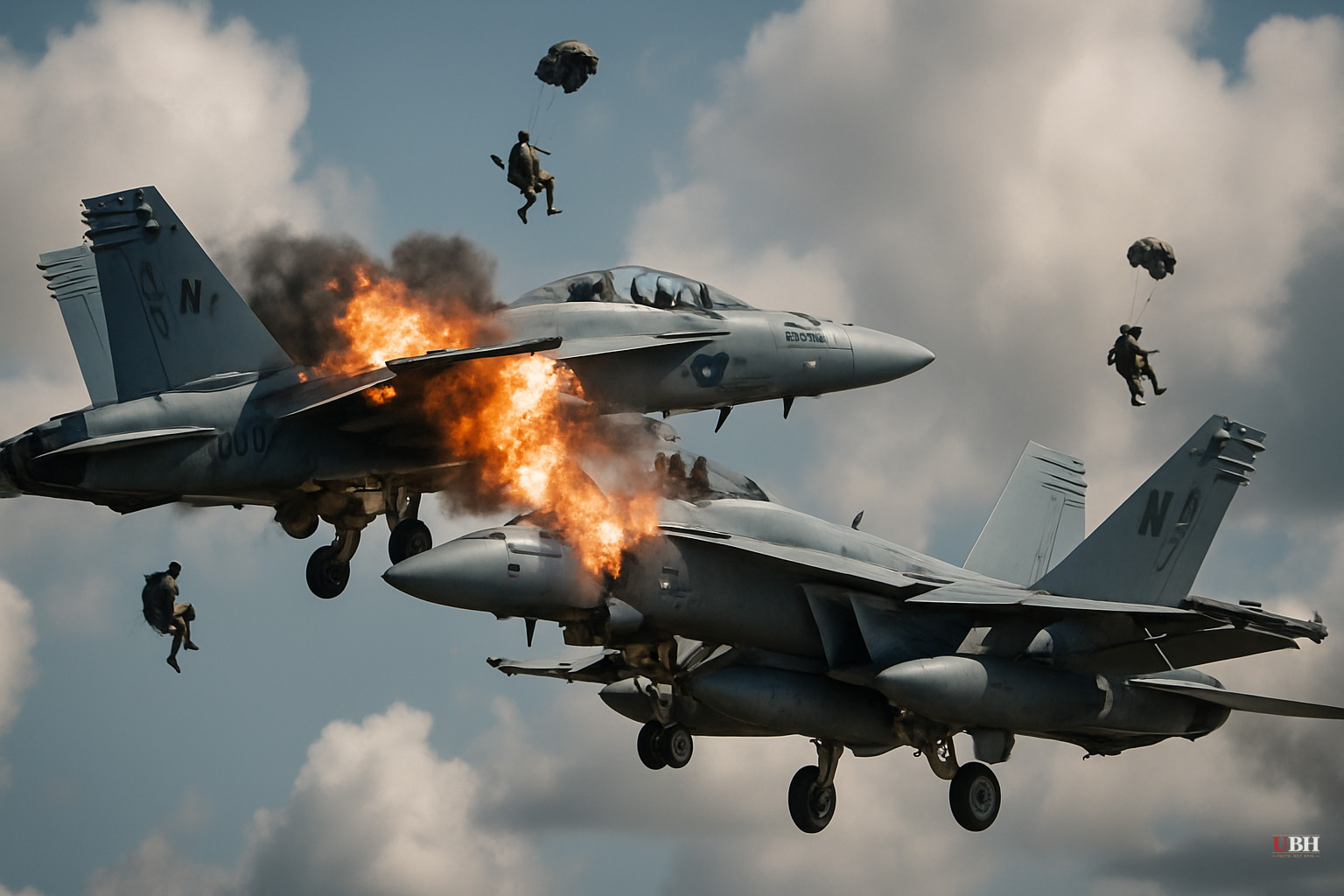
Video circulating on social media — confirmed by multiple outlets including NBC News and Task & Purpose — showed the two Growlers flying close together before appearing to lock together mid-air and cartwheel toward the ground. Four parachutes deployed visibly before both jets slammed into the earth and erupted in flames, sending thick black smoke into the Idaho sky.
An air show announcer on the ground told the crowd: "We had four good parachutes. The crews were able to eject." He later confirmed all four were found safe, according to Task & Purpose.
One eyewitness told NBC News: "I heard someone next to me say 'We are down.' I turned around and saw four parachutes coming down, then black smoke appeared."
The Aircraft
The EA-18G Growler is a variant of the F/A-18 Super Hornet built specifically for electronic warfare — jamming enemy radar systems and suppressing air defenses. It's a two-seat aircraft, one pilot and one electronic warfare officer per jet.
Whidbey Island is home to most of the Navy's Growler fleet and the primary training pipeline for the aircraft, according to Task & Purpose.
VAQ-129 is the Growler fleet replacement squadron — the schoolhouse where pilots and electronic warfare officers train. These are experienced professionals.
Base Response
Mountain Home Air Force Base — home to the 366th Fighter Wing, call sign "Gunfighters" — announced a lockdown at 12:30 p.m. local time, just 20 minutes after the collision. Emergency responders were on scene immediately.
The base posted: "Emergency Responders are on the scene, an investigation is underway and more details will be released as they become available."
Mountain Home police warned the public to avoid traveling to the base. The entire air show was shut down.
Cmdr. Amelia Umayam, spokesperson for Naval Air Forces, U.S. Pacific Fleet, confirmed the collision and the status of the crew to multiple outlets including NBC News and Task & Purpose. She confirmed all four aviators were being evaluated by medical personnel.
Context Worth Knowing
This was the first Gunfighter Skies Air Show in eight years, according to Task & Purpose. The last one was in 2018 — when a hang glider died in a separate crash during the event.
The two-day show featured vintage aircraft alongside military demonstration teams from both the Navy and Air Force. Day 1 ran without incident. The collision happened on Day 2.
Navy Lt. Kevin Lynch, a member of the Growler demo team, gave an interview to KTVB on Saturday — the day before the crash. He confirmed that four pilots and four electronic warfare officers from the team were participating in the show.
Outstanding Questions
Airshow demonstrations go through rigorous FAA and military safety reviews. The footage shows the jets appearing to physically interlock before going down — a catastrophic occurrence at extremely close range between two aircraft flying a choreographed routine.
Key unknowns remain: Was the maneuver approved? Were parameters exceeded? Was this a communication failure or equipment malfunction? An investigation is underway, but answers typically take weeks or months.
Also notable: each EA-18G Growler costs approximately $67 million per aircraft, according to publicly available Department of Defense procurement data. Two jets were destroyed in the collision. That represents roughly $134 million in hardware.
What Comes Next
Four Navy aviators are alive because their ejection systems worked and their training kicked in. These men did everything right when it mattered most.
Two $67 million aircraft are destroyed in the Idaho desert, and hundreds of spectators including military families witnessed the collision live. The Navy investigation has begun.
Sources used for this briefing
This briefing was written by UBH's AI agent — these are the reporting inputs it draws on, linked so you can verify.


