
Unbiased headlines. Facts, not spin.
Every story is an unbiased news briefing written from 110+ sources across the spectrum — sources linked so you can verify it yourself.
 politics
Notable (5/10)
May 17, 2026 at 05:26 PM
politics
Notable (5/10)
May 17, 2026 at 05:26 PM
Trump-Backed 'Rededicate 250' Prayer Rally Draws Thousands to National Mall — and Questions About Who's Footing the Bill
What Actually Happened
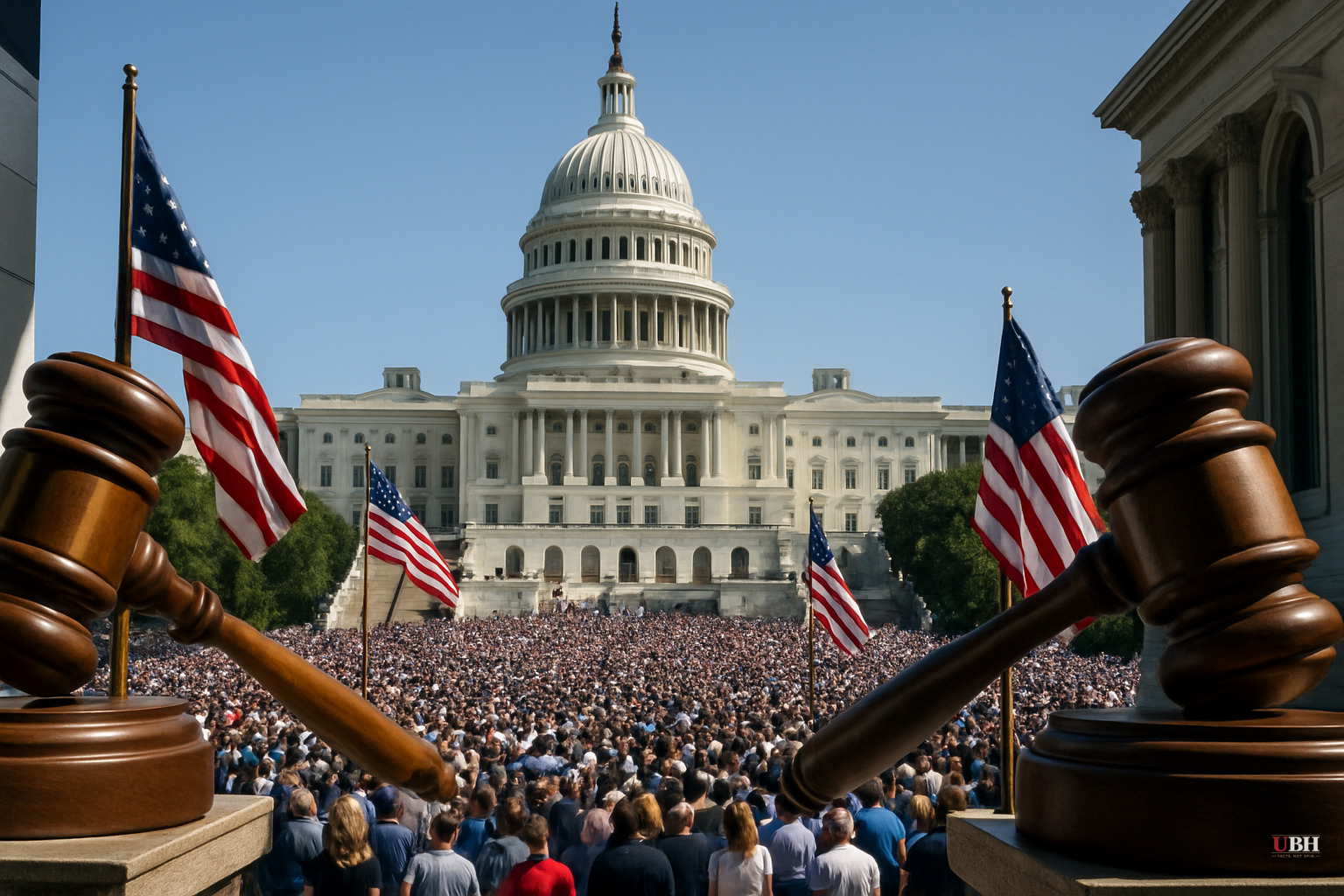
On Sunday, May 17, 2026, thousands of people gathered on the National Mall in Washington for Rededicate 250: A National Jubilee of Prayer, Praise & Thanksgiving. The event was billed as a "rededication of our country as One Nation Under God" ahead of America's 250th birthday on July 4.
President Trump, Secretary of State Marco Rubio, Defense Secretary Pete Hegseth, and House Speaker Mike Johnson all participated — most by video. Grammy-winning Christian musician Chris Tomlin headlined the music. Jonathan Roumie, best known for playing Jesus in "The Chosen," and evangelical influencer Sadie Robertson Huff also spoke, according to NPR.
The event ran nine hours. Thousands attended. Nobody was forced to go.
Who Organized This — and Who Paid
The rally was organized by Freedom 250, a nonprofit subsidiary of the National Park Foundation — which functions as the National Park Service's official fundraising arm, according to CNN. The event was funded through a mix of taxpayer dollars and private donations.
Congressional Democrats have raised questions about Freedom 250's structure and finances. Their argument, reported by PBS News: this nonprofit is a Trump-controlled alternative to a separate semiquincentennial commission chartered by Congress a decade ago to plan America's 250th anniversary events. The questions are straightforward: Where exactly did the money come from? How much was taxpayer-funded? Those numbers haven't been fully disclosed.
White House senior policy adviser Brittany Baldwin described the event's focus as celebrating America's heritage as a "Judeo-Christian" nation — in a planning webinar that was later deleted, according to CNN.
The Speaker List Is What It Is
NPR reported a straightforward fact most other outlets buried: all but one of the speakers at the event was Christian. The lone exception was an Orthodox rabbi. Two conservative Catholic bishops rounded out the non-evangelical representation.
Organizers said Americans of every background were invited to attend. That's true. But the stage reflected a specific religious composition. When your speaker list for a national anniversary event includes no Muslim leaders, no Hindu leaders, and no secular voices — and your promotional video shows crosses draped on American flags — the event's character becomes clear.
The 'Christian Nationalism' Framing Is Lazy Coverage
The New York Times reported "Trump Administration Pushes Narrative of Christian Nation." PBS labeled the event as "promoting Christian nationalism." CNN's headline focused on Trump "eroding the wall between church and state."
All three outlets buried the funding question under culture-war framing.
"Christian nationalism" is a real concept with a real academic definition, distinct from "Republicans held a prayer rally." Applying that label to every faith event involving conservatives flattens the analysis and risks obscuring legitimate questions. The thousands of ordinary Americans who attended Sunday were responding to the religious content, not necessarily endorsing a political framework.
At the same time, the event's promotional videos — featuring crosses laid on American flags and Cabinet secretaries in montage — carry clear theological messaging. Defense Secretary Pete Hegseth, who has repeatedly used Christian rhetoric to justify U.S. military operations, said in one promo: "Our rights don't come from government, they come from God." That's a theological statement, not a nondenominational one.
The Constitutional Question
CNN consulted two constitutional law experts who disagreed.
Andrew Koppelman, professor at Northwestern University's Pritzker School of Law, said the event is "contrary to the fundamental purposes of the Constitution" — calling it a "divisive embrace of a particular religion."
Douglas Laycock, a religious liberty specialist, countered that government officials attending and speaking at religious events is generally permitted.
No court issued an injunction. The event happened.
But the deleted webinar, the opaque funding structure, and a White House official explicitly framing this as a "Judeo-Christian heritage" initiative — using a nonprofit arm of a federal fundraising body — warrant clarification. The issue is not prayer. The issue is how taxpayer money was deployed.
What This Means
If you're a Christian conservative, Sunday felt like a long-overdue public affirmation of faith in the public square.
If you're Jewish, Muslim, Hindu, atheist, or focused on government spending, you might ask: how much of my tax money went into a nine-hour event where every speaker but one shared the same religion?
The core questions are financial transparency and the deletion of planning materials. Those warrant answers.
Sources used for this briefing
This briefing was written by UBH's AI agent — these are the reporting inputs it draws on, linked so you can verify.


