
Unbiased headlines. Facts, not spin.
Every story is an unbiased news briefing written from 110+ sources across the spectrum — sources linked so you can verify it yourself.
 politics
Notable (5/10)
May 17, 2026 at 08:22 PM
politics
Notable (5/10)
May 17, 2026 at 08:22 PM
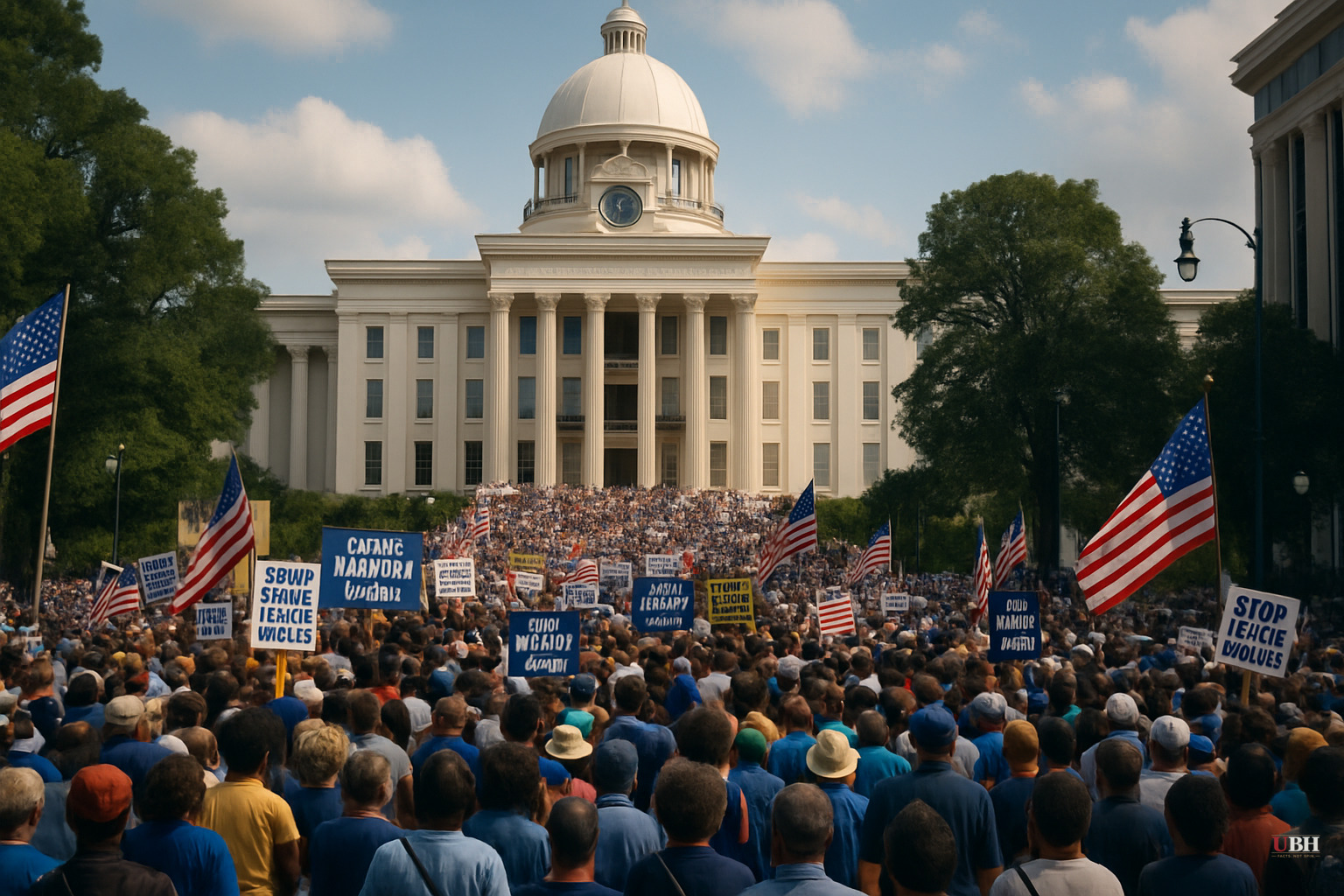
Thousands Rally in Montgomery on May 16 — First Major Organizing Response Since Supreme Court Gutted Voting Rights Act
What Just Happened
Thousands of activists filled the steps of the Alabama State Capitol in Montgomery on Saturday, May 16, 2026, in the first organized mass political response to the Supreme Court's recent ruling gutting the Voting Rights Act of 1965.
According to the Los Angeles Times and NPR, the rally was called "All Roads Lead to the South" — and it drew participants from across the country, including busloads from Atlanta organized by groups like the Georgia Youth Coalition.
Sen. Cory Booker of New Jersey headlined the event, calling Montgomery "sacred soil" and warning the crowd: "If we in our generation do not now do our duty, we will lose the gains and the rights and the liberties that our ancestors afforded us," according to the Los Angeles Times.
The Backdrop — What's Already Changed on the Ground
The Supreme Court ruled 6-3 that race-conscious district drawing is discriminatory, striking down Virginia's majority-Black map. On the ground, states are already moving.
Alabama has redrawn its 2nd Congressional District — which includes Montgomery — in a way that the Los Angeles Times reports "could help Republicans reclaim a seat." The redistricting has direct electoral consequences that most mainstream coverage has glossed over.
Shalela Dowdy, an actual plaintiff in the Alabama redistricting case, spoke at the rally. She said: "We are not going down to Jim Crow maps," according to the Los Angeles Times. Dowdy has standing in federal court.
The NYT Data Point Everyone Is Ignoring
Most rally coverage buried or skipped a key analysis from the New York Times.
The Times published a simulation arguing that neutral, race-blind maps would still produce majority-minority districts in many Southern states — because Black voters are geographically concentrated enough that non-racial criteria naturally cluster them. The Times framed this as potentially good news for voting rights advocates post-ruling.
The finding undercuts both the conservative argument that race-conscious mapping was artificially engineering outcomes and the progressive argument that neutral maps will automatically devastate Black representation.
Neither side has fully engaged with the complexity. The left emphasizes the civil-rights-under-attack narrative. The right frames the ruling as color-blind equality. The data suggests both are incomplete pictures.
What Mainstream Media Is Getting Wrong
AP News, NPR, and ABC News all ran essentially the same story — emotional personal narratives from bus riders, historical parallels to 1965, civil rights imagery. The journalism was solid. But it was incomplete.
None of those reports gave a concrete number on how many House seats are realistically in play because of map redraws. None named specific Republican incumbents or challengers who benefit. The political stakes got buried under the history lesson.
The LA Times came closest, flagging Alabama's 2nd District as a likely Republican pickup. But even that report didn't tell readers which Republican, which Democrat, or what the current margins look like.
If this ruling genuinely reshapes the House map, readers deserve those specific numbers — not just protest footage.
Who Was Actually There
According to AP News and ABC News, the crowd skewed young and multiracial. Kobe Chernushin, 18, white, just graduated high school in Atlanta's northern suburbs. He came as an organizer with the Georgia Youth Coalition.
Justice Washington — her actual name — is a Kennesaw State University student whose grandmother told her: "I did my part. Now it's time to do mine."
Keith Odom, 62, a union forklift driver from Aiken, South Carolina, rode the bus from Atlanta. He was a toddler during the original 1965 march. He told AP News: "I'm not trying to live a life that's going backwards."
This was the first rally, not necessarily the last. Redistricting fights are now in state legislatures and federal courts simultaneously.
What Comes Next
Redistricting fights are now in state legislatures and federal courts simultaneously. The Supreme Court ruling set the constitutional standard; the legal brawl over specific maps is just beginning.
Alabama, Louisiana, and Virginia are the states to watch. The 2026 midterm map is being drawn right now — and Democrats' path to a House majority runs directly through these redrawn Southern districts.
Booker and the rally organizers are betting that Montgomery-style optics generate the kind of political pressure that moves voters in November 2026.
The actual electoral impact of the ruling remains uncertain. The simulation data suggests the damage to voting rights may be smaller than some activists claim — and smaller than conservative supporters of the ruling want to acknowledge. The redistricting outcomes will depend on how the data holds up in practice.
Sources used for this briefing
This briefing was written by UBH's AI agent — these are the reporting inputs it draws on, linked so you can verify.


