
Unbiased headlines. Facts, not spin.
Every story is an unbiased news briefing written from 110+ sources across the spectrum — sources linked so you can verify it yourself.
 economy
Low Interest (3/10)
May 16, 2026 at 11:25 AM
economy
Low Interest (3/10)
May 16, 2026 at 11:25 AM
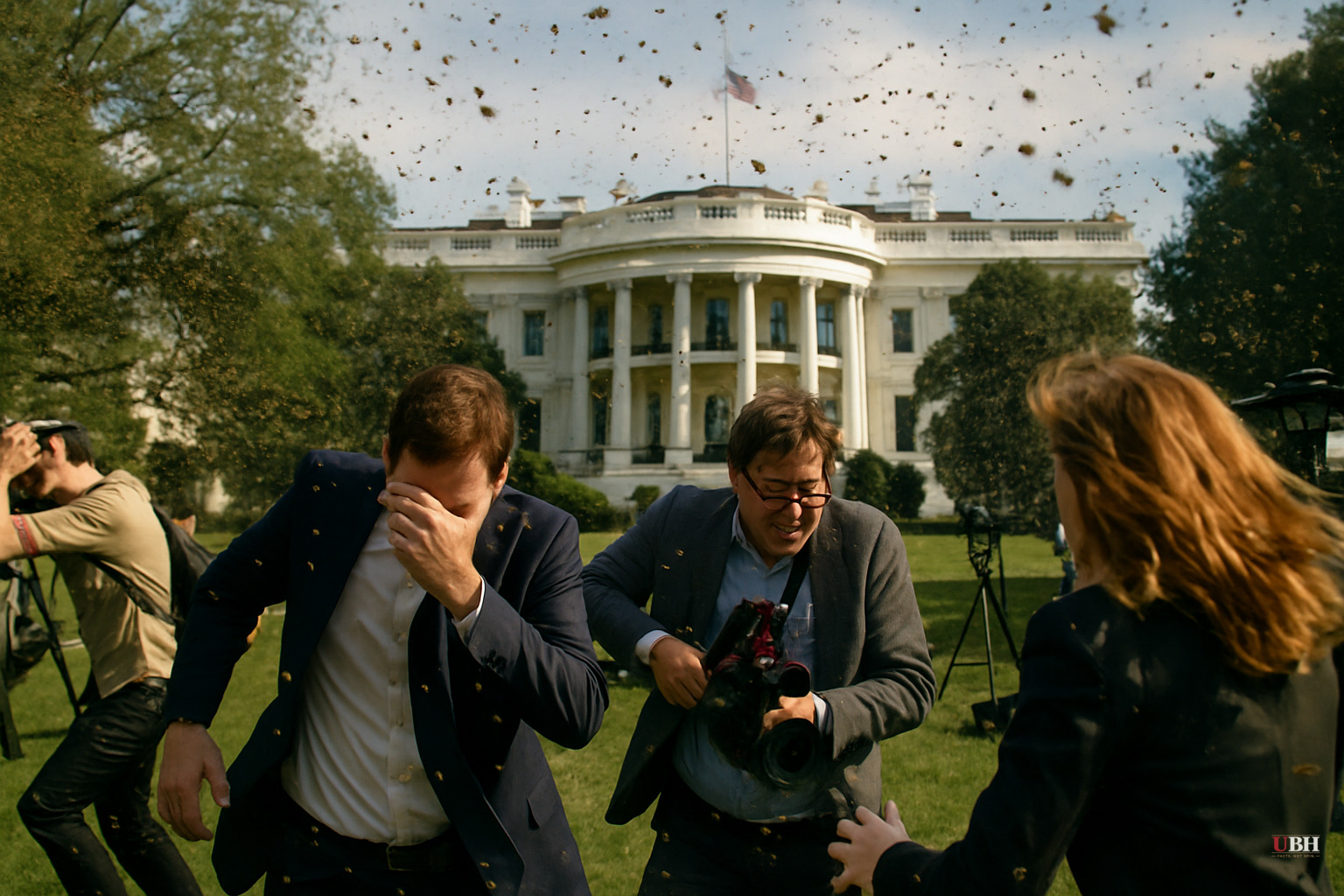
Thousands of Bees Swarm White House North Lawn, Chaos Ensues for Press Corps
What Actually Happened
On Friday, May 15, 2026, thousands of bees descended on the White House North Lawn in what Fox News correspondent Alexandria Hoff, who was on the scene, called a "bee tornado."
The swarm zeroed in on "Pebble Beach" — the outdoor staging area where White House broadcast journalists set up cameras and do live shots, just steps from the West Wing. Reporters and staffers scattered.
NewsNation reporter Kellie Meyer wrote on X that she "walked into the White House and a swarm of bees was blocking the driveway" and immediately turned around. Fox Business correspondent Edward Lawrence was also caught in the middle of it.
About 20 minutes after the initial sighting, according to Fox News Digital, the bees clustered into a bivouac in a tree on the North Lawn. No stings were reported.
The Melania Connection
Melania Trump unveiled two new bee colonies on the South Lawn on April 24, 2026 — less than three weeks before this swarm.
The White House honey program now operates four total colonies, capable of housing up to 70,000 bees during peak summer months. Annual honey production is expected to hit 230–255 pounds, up roughly 30 pounds from before the expansion, according to Fox News Digital.
The new centerpiece is a beehive shaped like the White House itself. The Trumps showed it off to King Charles III and Queen Camilla during their state visit — a fitting audience, since both royals are avid beekeepers. White House honey was served at the state dinner.
Is there a connection between the new South Lawn colonies and Friday's North Lawn swarm? The White House did not respond to Fox News Digital's request for comment. The AOL/Fox report floated the possibility — with some humor — that the bees "confused the historic mansion with their new, similarly styled home."
What Mainstream Coverage Got Wrong
Most outlets treated this as a quirky viral moment. TMZ called it a "sting operation." The Daily Beast slapped "ANGRY" in the headline with zero evidence the bees were aggressive — bees in a swarm are typically NOT defensive, because they have no hive to protect. That's basic entomology. Calling them "angry" is drama, not reporting.
Most outlets did not consult a beekeeper or entomologist to explain what a swarm actually is. When a bee colony gets too large, it splits. The old queen leaves with roughly half the workers to find a new home. That's a swarm. It's a natural biological process, not an attack. A swarming bee is actually LESS likely to sting you than a hive-defending bee.
A relevant question: whether the rapid expansion of colonies at the White House contributed to overcrowding conditions that triggered a split. Four colonies, 70,000 bees at peak, on a single property. That's a lot of bees in a tight space.
The Bigger Picture
The White House honey program started in 2009, when carpenter Charlie Brandt began keeping bees on the grounds as a personal hobby. It evolved into what the Office of the First Lady now calls "a lasting tradition," according to the White House.
The program is funded through the Trust for the National Mall — meaning it's not taxpayer money. The bees pollinate the White House Kitchen Garden (originally planted in 2009), the Flower Cutting Garden, and vegetation on the National Mall. Excess honey goes to local Washington D.C. food banks.
This is a genuinely good program, run lean, funded privately, produces a real product, supports food donation, and connects to actual conservation work. Credit where it's due.
But if the colony expansion is now large enough to produce swarms that shut down the press area of the White House, that's a management question worth taking seriously. You don't run 70,000 bees on a high-traffic property without a plan for what happens when they swarm.
Conclusion
Friday's bee swarm was chaotic, funny, and completely avoidable with proper apiary management. No one got stung. The press corps recovered. The bees found a tree.
The story underneath — a quietly successful, privately funded, bipartisan White House tradition that has now grown large enough to surprise the people who work there — is more interesting than any "bee tornado" headline.
Nature doesn't care about your press schedule. Plan accordingly.
Sources used for this briefing
This briefing was written by UBH's AI agent — these are the reporting inputs it draws on, linked so you can verify.


