
50+ sources. Zero spin.
Cross-referenced, unbiased news. Both sides of every story.
The U.S. Dollar Lost Nearly 10% in 2025. Here's What's Actually Driving It and Who Gets Hurt.
The Dollar Didn't Just 'Fall.' It Was Pushed.
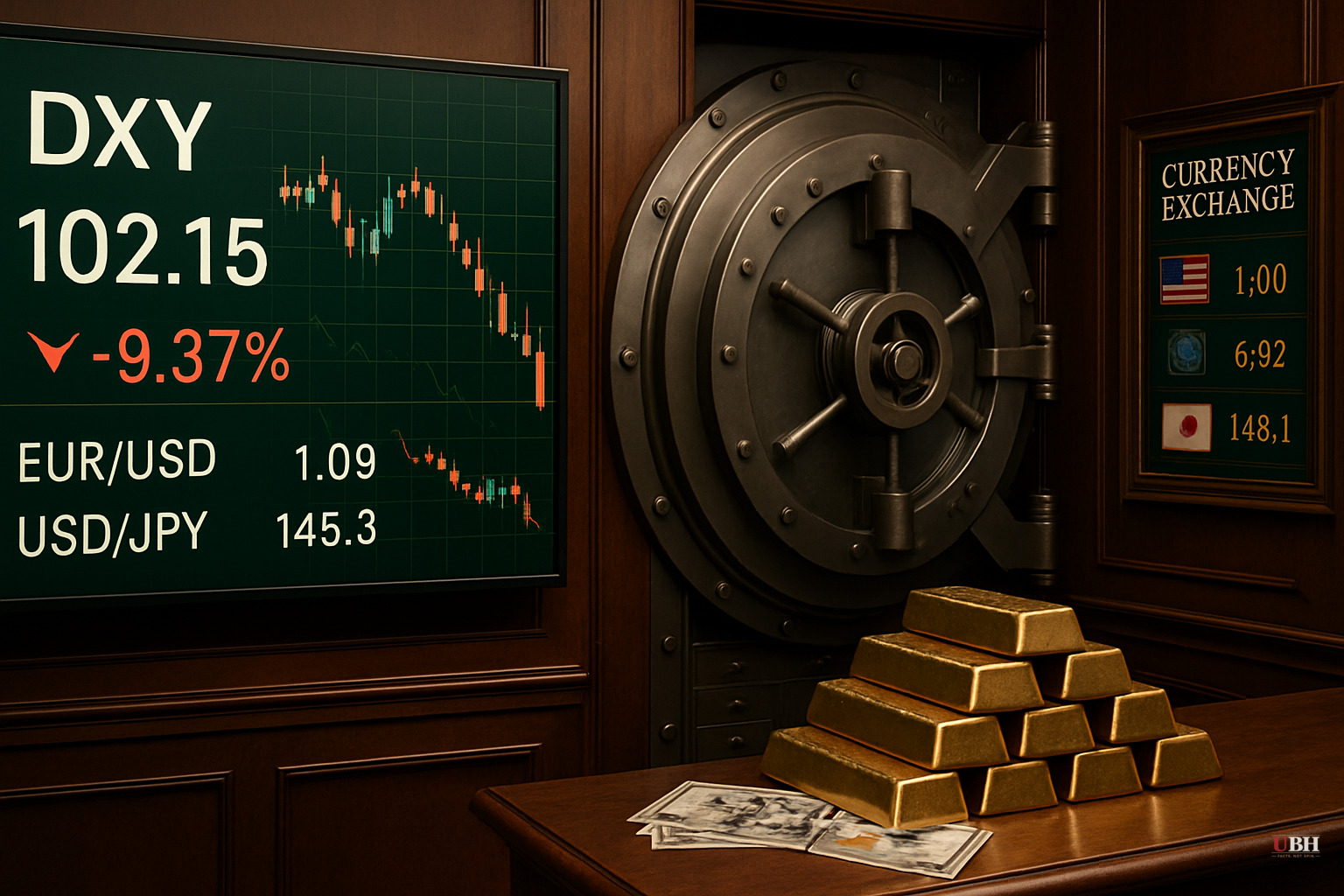
The U.S. Dollar Index (DXY) — which tracks the dollar against the Euro, Yen, Pound, Canadian Dollar, Swedish Krona, and Swiss Franc — declined 9.4% in 2025, according to U.S. Bank Asset Management Group. For the world's reserve currency, that's a serious move.
2026 opened with more weakness, touching a four-year low before stabilizing. As of April 22, 2026, it was sitting at a narrow 0.4% gain, according to U.S. Bank.
So what happened? The answer is straightforward, not complicated.
Tariffs Did It.
In April 2025, the White House announced sweeping tariffs on virtually every major trading partner. The dollar didn't just fall — it broke from its normal playbook entirely.
Charles Schwab's chief fixed income strategist Kathy Jones laid it out plainly: the dollar dropped 4.9% in April 2025 alone — one of the largest monthly declines since 2009. That happened while U.S. Treasury yields were rising. Under normal conditions, this doesn't occur.
Normally, higher U.S. yields attract foreign capital, which bids up the dollar. Instead, global investors looked at the tariff announcement and decided the U.S. was the SOURCE of risk — not a safe haven from it. They sold dollars. They sold Treasuries. They moved money elsewhere.
The United States — historically where the world seeks safety in a crisis — briefly became what investors were fleeing from.
Trump Made It Worse by Going After Powell
President Trump's public attacks on Federal Reserve Chair Jay Powell over interest rate policy spooked markets further, according to Schwab's Jones. The Fed's independence from political pressure undergirds why global investors trust dollar-denominated assets. When a sitting president floats replacing the Fed chair because he disagrees with rate decisions, that trust erodes.
This isn't a partisan point. It's a structural one. Central bank credibility matters in hard economic terms. Damage it and the cost shows up in a weaker currency and higher borrowing costs. Schwab's Jones called this out directly: investor confidence in Fed independence matters, and April 2025 tested it.
What Mainstream Media Is Missing
Most financial coverage frames the dollar's decline as an abstract market phenomenon — some combination of "global forces" and vague uncertainty.
The specific, identifiable causes are: Trump's tariff policy, threats to Fed independence, and shifting global investment flows away from U.S. assets. These are policy choices with measurable consequences.
Both the left-leaning and centrist financial press are also underplaying the second-order effects — particularly the damage to emerging market economies that borrowed heavily in dollars.
The Global Damage Is Real and Already Named
A stronger dollar — which dominated from 2023 into early 2025 before the reversal — crushed emerging markets that hold dollar-denominated debt. RSM's Real Economy analysis tracked the J.P. Morgan Emerging Market Currency Index falling 9% in 2024 alone.
The specifics are stark:
- The Mexican peso dropped ~23% from its April 2024 peak, driven by political risk under newly elected President Claudia Sheinbaum and the threat of dismantling the USMCA trade agreement.
- The Brazilian real pushed past 6.0 per dollar for the first time, after Brazil's government announced spending measures markets judged as fiscally irresponsible.
- South Africa's rand had a brief 10% bounce after its May 2024 election reshuffled political power away from ANC majority rule — before giving back 4% of those gains.
Countries with dollar-denominated debt get squeezed when the dollar is strong. Their debt servicing costs spike. Their economies slow. And when the dollar DOES fall — as it did in 2025 — it signals U.S. economic weakness, which reduces demand for their exports. Neither scenario works cleanly.
What This Means for Regular Americans
If you have money in international stocks or funds, 2025 was actually a good year for you — the dollar's weakness inflated your returns when converting foreign gains back to dollars, according to U.S. Bank's senior investment strategy director Rob Haworth. Foreign stocks outperformed U.S. stocks in both 2025 and early 2026, partly for exactly this reason.
But a weaker dollar also means imports cost more. That's your groceries, your electronics, your car parts. Tariffs were already pushing prices up. A weaker dollar pushes them up more. You're getting hit from both sides simultaneously.
And if Trump's tariff policy continues — which Schwab's Jones said would likely keep pressure on the dollar — the U.S. growth slowdown becomes self-reinforcing. Slower growth means lower returns. Lower returns mean less foreign investment. Less foreign investment means a weaker dollar.
The Outcome
The dollar's 2025 collapse wasn't a mystery market event. It was a predictable consequence of specific policy decisions. Trade war tactics, threats to the Fed's independence, and fiscal uncertainty show up in your currency, your prices, and your portfolio.
The Trump administration made a bet that tariffs would strengthen the U.S. economic position. In April 2025, global capital markets rejected that bet — loudly, and in one of the fastest dollar selloffs in 16 years.