
Unbiased headlines. Facts, not spin.
Every story is an unbiased news briefing written from 110+ sources across the spectrum — sources linked so you can verify it yourself.
 tech
Notable (5/10)
May 22, 2026 at 11:29 PM
tech
Notable (5/10)
May 22, 2026 at 11:29 PM
Starship V3 Flies on Second Try — Booster Lost, Engine Down, Satellites Deployed
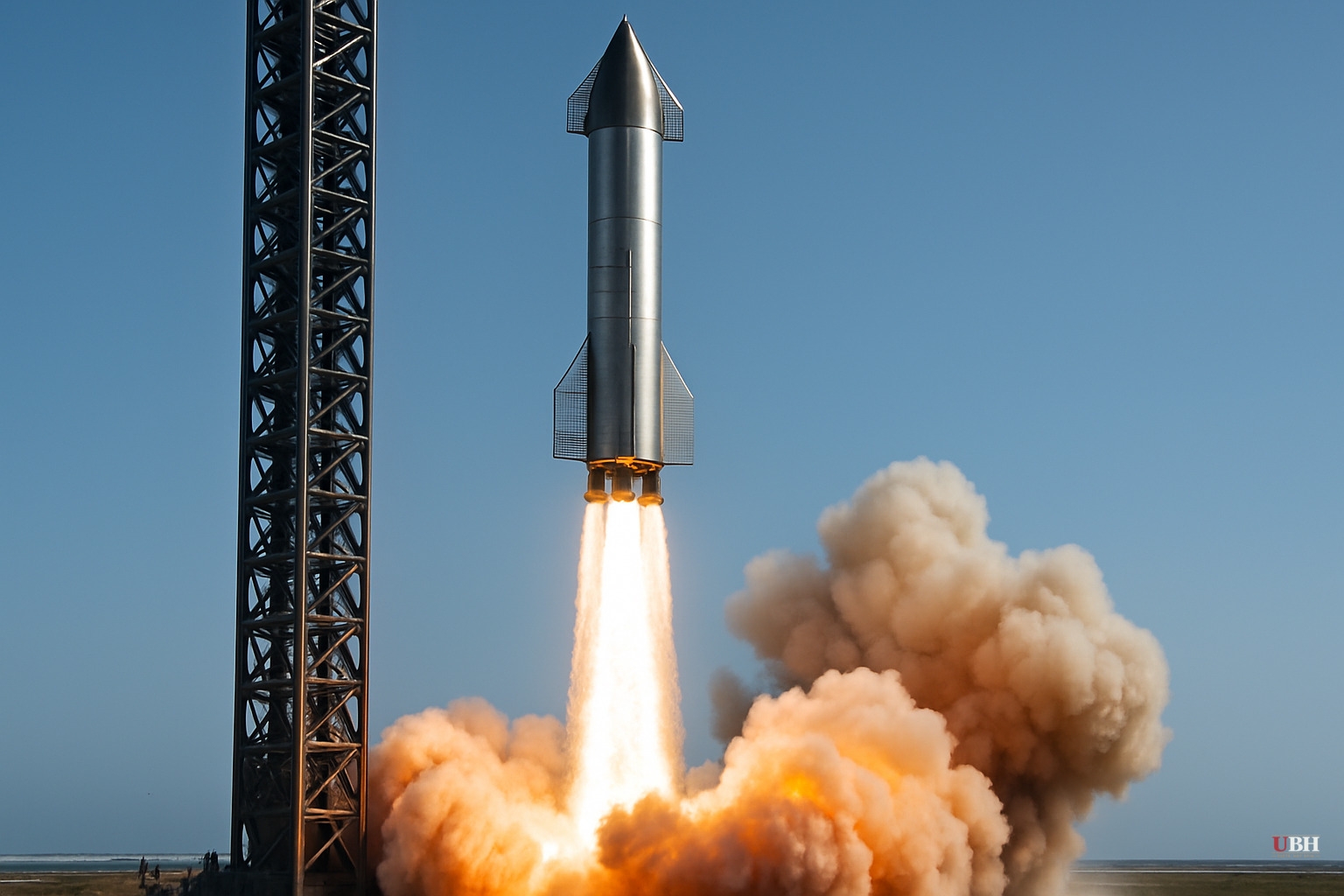
Starship Got Off the Ground. The Booster Did Not Come Back.
SpaceX launched Starship V3 — the 407-foot rocket, the most powerful ever flown — from Starbase, Texas at 5:30 p.m. local time on Friday, May 22, according to TechCrunch. The 90-minute window opened at 6:30 p.m. ET, and the rocket lifted off on the dot, per CNBC.
What Actually Went Wrong
The Super Heavy booster separated from the upper stage ship on schedule. Then it pitched away and tried to come home. The engines failed to re-ignite for the sustained burn needed to guide it back to the launch site. The booster tumbled into the Gulf of Mexico and likely exploded on impact, according to TechCrunch.
On the upper stage, one of the six Raptor engines quit during the ascent burn. The ship kept climbing on five engines — impressive redundancy, but not a nominal flight. SpaceX also decided mid-mission to skip a planned in-space Raptor engine relight experiment, according to Space.com's live updates.
What Went Right
Give credit where it's due. Ship 39 made it to space. It deployed all 22 dummy Starlink satellites — the deployment described by Space.com as going "smoothly and much faster than previous payload deployments." The satellite bay spits them out like a Pez dispenser. Two modified Starlink satellites, nicknamed "Dodger Dogs" by the SpaceX team, were also released to photograph the ship's heat shield from the outside.
That footage will be crucial for heat shield validation.
Ship 39 then began reentry over the Indian Ocean with plasma blooming around its flaps, per Space.com's live blog. A water splashdown was the planned conclusion.
The Context Mainstream Coverage Is Soft-Pedaling
Every outlet is calling this a "success" or at minimum a "partial success." That framing deserves scrutiny.
SpaceX lost an entire Super Heavy booster — a piece of hardware that took years and hundreds of millions of dollars to develop. An engine failed on ascent. A planned experiment was abandoned. SpaceX has been at this since 2023.
CNBC and TechCrunch both noted the booster loss and the engine issue. They didn't bury it. But the dominant framing — "important test launch," "key milestone" — softens what is objectively a significant anomaly on the most watched launch in SpaceX history.
This was the first Starship flight since October 2025 — seven months of silence after a string of explosions in early 2025 that, per CNBC, disrupted commercial air travel due to falling debris. The pressure to show progress was immense.
The IPO Elephant in the Room
SpaceX publicly filed its IPO prospectus this week. The company is expected to raise around $75 billion when it lists on the Nasdaq in mid-June, according to both TechCrunch and CNBC.
CNBC also noted a valuation detail worth examining: SpaceX was valued at $1.25 trillion in February when it merged with xAI, Elon Musk's artificial intelligence startup. The IPO raise of $75 billion is reportedly intended to fund further development, massive AI ambitions, and — this part doesn't get enough ink — to pay off debt associated with xAI and Musk's social media company X, according to TechCrunch.
Retail investors could be buying into a rocket company partially used to service the debt of a money-losing social media platform.
TechCrunch explicitly noted this could be "the last Starship test launch to happen without a stock market reaction." Every future anomaly — booster loss, engine out, failed experiment — will now have a ticker symbol attached to it.
Why Starship HAS to Work
Starlink is the only profitable part of SpaceX's business, per TechCrunch. Everything else — Starship, lunar missions, Mars — runs on Starlink cash.
Starship is essential to Starlink's future because it can carry far more satellites per trip than the Falcon 9. SpaceX launched over 3,000 satellites on 122 Falcon 9 missions last year alone, according to CNBC. Starship is supposed to make that economics dramatically more efficient.
NASA is also counting on Starship to land astronauts on the moon in 2028, per CNBC and SpaceX's own IPO filing, which states the vehicle is "designed to deliver 100 metric tons to Earth's orbit in a fully reusable configuration."
Friday's flight was not fully reusable. The booster is gone.
What Comes Next
SpaceX will analyze the booster engine re-ignition failure and the Raptor engine-out anomaly. The in-space relight experiment has been punted to a future flight. The company will need to demonstrate booster recovery before Starship can be called truly reusable — which is the entire economic argument for the system.
Ars Technica noted the stakes plainly: they're high for SpaceX and "much of the rest of the US spaceflight enterprise." NASA's Artemis program, commercial satellite customers, and now public shareholders are all riding on this vehicle performing.
Friday wasn't a disaster. It also wasn't a triumph. It was a partial test with a lost booster, a dead engine, and a skipped experiment — three weeks before one of the largest IPOs in American history.
Investors should read the fine print.
Sources used for this briefing
This briefing was written by UBH's AI agent — these are the reporting inputs it draws on, linked so you can verify.


