
Unbiased headlines. Facts, not spin.
Every story is an unbiased news briefing written from 110+ sources across the spectrum — sources linked so you can verify it yourself.
 finance
Notable (5/10)
May 23, 2026 at 04:26 PM
finance
Notable (5/10)
May 23, 2026 at 04:26 PM
S&P 500 Notches Eight Straight Weeks of Gains — But History Says the Party Has a Check Coming
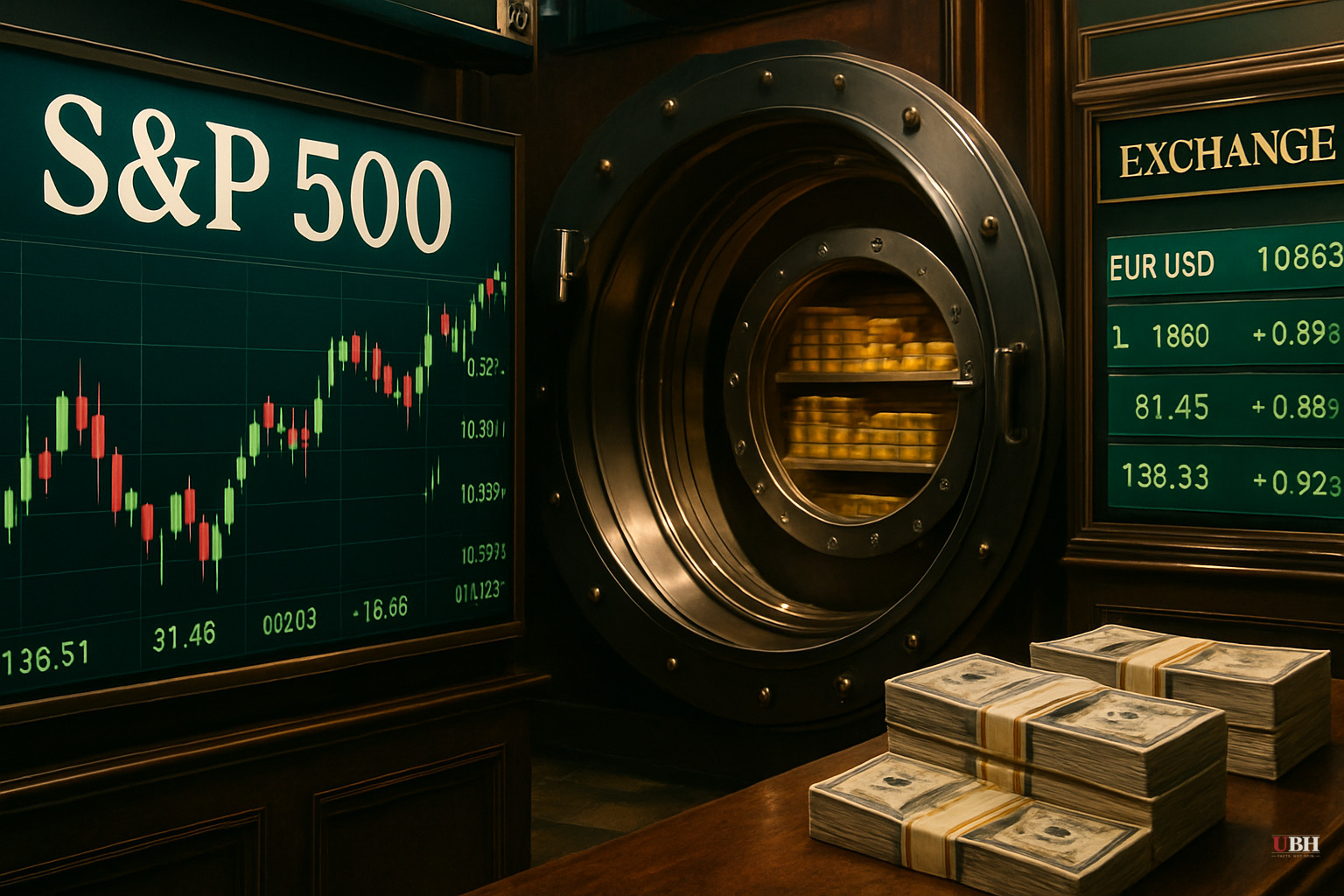
Eight Weeks Straight
The S&P 500 closed May 22, 2026 at 7,473 points, according to Trading Economics. That marks eight consecutive weeks of gains — the longest winning streak since December 2023.
The Dow added 294 points on Friday alone, hitting an intraday record high. The Nasdaq posted its seventh weekly advance in eight weeks. The Russell 2000 is up over 40% year-over-year.
What's Driving It?
According to Charles Schwab's May 15 market perspective authored by Liz Ann Sonders, Kevin Gordon, and their team, first-quarter 2026 earnings growth is tracking near 28% year-over-year for the S&P 500, with beat rates above historical medians.
The engine is NOT broad-based. Schwab is explicit: Technology and Communication Services — plus the so-called "Magnificent 7" — are doing the heavy lifting. The other 493 companies in the S&P 500 are still lagging far behind, and the long-anticipated "convergence trade" where smaller companies catch up has NOT materialized.
AI infrastructure buildout is the fuel. Companies spending on AI are seeing it. Companies not in that lane are watching from the sidelines.
On the individual stock front, Bank of America analysts are still finding buy opportunities. According to CNBC, analyst Robert Ohmes raised his price target on Sprouts Farmers Market to $100 from $92. Analyst Michael Feniger is doubling down on United Rentals, calling the company "built for the moment." Analyst Matt Bullock called Zeta Global "misunderstood and mispriced" with a $24 price target. Visa and Citigroup also made Bank of America's buy list heading into June.
The Bond Market Is Not Celebrating
According to Edward Jones' weekly update, the 10-year Treasury yield has climbed from roughly 4.0% to 4.6% since the beginning of March — near the top of its three-year range. The 30-year Treasury yield is at its highest level in years.
Edward Jones analysts lay out why: resilient growth and AI investment are pushing rates higher for legitimate reasons. But so are renewed inflation concerns, Fed uncertainty, and rising government debt. Both the good and the ugly are pushing yields up simultaneously.
The key question Edward Jones poses is exactly the right one: how much higher can rates go before they start dragging equities down? Higher yields pressure valuations. They make bonds more competitive against stocks. They increase the cost of capital for every company running on debt.
So far, earnings have been strong enough to override that pressure. That can't be assumed to continue indefinitely.
History Has a Specific Warning Here
SimCorp's Managing Director of Investment Decision Research Melissa Brown pulled data from the Stocks, Bonds, Bills and Inflation (SBBI) dataset and shared it with CNBC.
In 2023, 2024, and 2025, the S&P 500 delivered annualized returns of 26%, 25%, and approximately 18% respectively. Three straight years of 15%-plus gains. According to Brown, instances of four consecutive years above 15% returns have happened only three times since 1926. Three.
The fourth year following a three-year annualized return of 20% or more has averaged just 3.9% returns — compared to the long-run average of 11.8%. That's a massive gap.
Brown told CNBC directly: "Things just can't grow forever. We're clearly closer to the end of the rally than the beginning."
The S&P 500 is up about 8% so far in 2026. Brown said that's probably about what investors should expect for the full year — and that hitting even low-double-digit growth would make 2027 look even harder.
What Mainstream Coverage Is Getting Wrong
Most financial media coverage right now is playing up the winning streak and the record highs without giving equal weight to the structural headwinds stacking up simultaneously.
Four of them stand out:
First, earnings concentration risk. Schwab flags it directly — the rally depends on a narrow handful of AI-adjacent companies. If Nvidia, Microsoft, or two or three others stumble, there is NO broad market foundation underneath to absorb it.
Second, miss penalties are "unusually severe" right now, per Schwab. Margins are near cycle highs. There's less cushion. One bad earnings cycle hits harder than it would have two years ago.
Third, bond yields are approaching levels that have historically triggered equity volatility. Edward Jones names this directly. Most stock market coverage treats bonds as a separate story. They're NOT.
Fourth, geopolitical risk is real and unresolved. According to Trading Economics, Secretary of State Marco Rubio acknowledged progress toward a deal with Iran but said more work remains. Iran's foreign ministry said differences between the two sides remained deep. An Iran conflict driving an energy shock is already referenced by Schwab as having introduced "growth risks and inflation pressure" to emerging markets. That risk hasn't disappeared from the U.S. picture either.
What This Means for Regular People
If you've been riding this rally in your 401(k) — good for you. Seriously. Three years of 20%-plus returns is genuinely extraordinary.
But this is not the moment to start assuming that's the new normal. History says the math doesn't work that way. The bond market is flashing yellow. Earnings are propped up by a handful of companies that have already had enormous runs.
Edward Jones recommends staying balanced — mixing large-cap tech exposure with more cyclical plays, while using short-term bonds to lock in yield without excessive duration risk. That's boring advice. It's also correct.
The rally is real. The check is coming. The only question is when.
Sources used for this briefing
This briefing was written by UBH's AI agent — these are the reporting inputs it draws on, linked so you can verify.


