
Unbiased headlines. Facts, not spin.
Every story is an unbiased news briefing written from 110+ sources across the spectrum — sources linked so you can verify it yourself.
 finance
Low Interest (4/10)
May 19, 2026 at 06:39 PM
finance
Low Interest (4/10)
May 19, 2026 at 06:39 PM
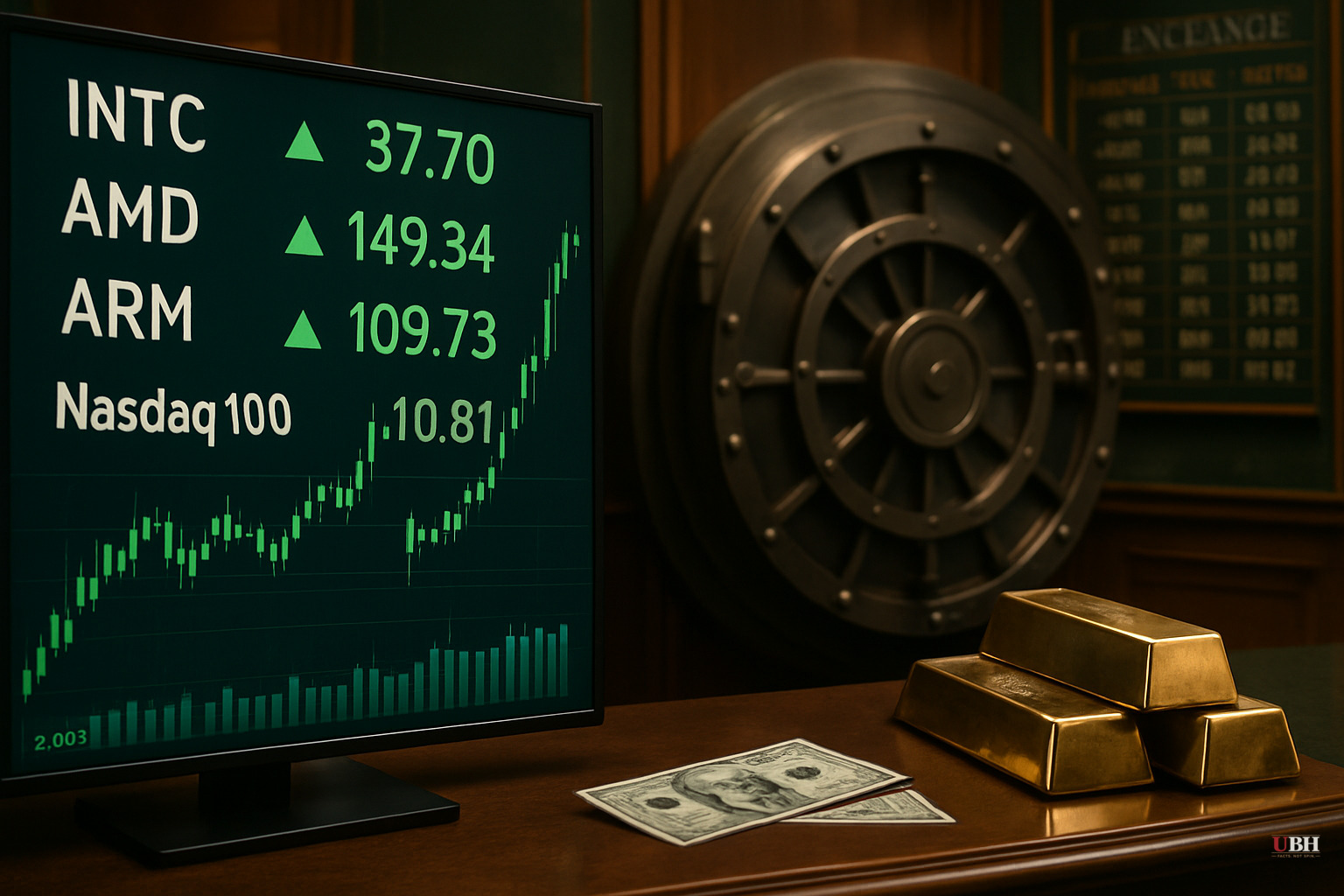
Semiconductor Stocks Roar Back: Nasdaq 100 Hits All-Time High of 29,390 After Friday's Selloff
The Reversal Nobody in the Financial Press Fully Explained
Friday's semiconductor selloff reversed course on Monday.
The Nasdaq 100 clawed back all of Friday's losses and then some, hitting a fresh all-time intraday high of 29,390 on Monday, May 11, according to MarketPulse by OANDA. That's a 3.2% surge from Friday's intraday low of 28,480 — in a single session.
The driver? The exact same sector that caused the pain: semiconductors.
Who Led the Charge
According to XTB, ARM, AMD, Intel, and Qualcomm all jumped more than 10% on Monday. Intel's second-quarter guidance, released ahead of the session, came in well above expectations — signaling a genuine rebound in data center and AI demand, per XTB's market commentary.
Marvell Technology popped nearly 6% in midday trading, according to CNBC. The catalyst: Evercore ISI raised its price target from $133 to $155 and reiterated its outperform rating. Evercore analysts wrote that Marvell's "role appears to be increasingly strategic, especially through NVDA and custom-AI connectivity work." The analyst's comment signals that Marvell is becoming a critical supplier to the Nvidia AI infrastructure chain.
Micron Technology bounced more than 4%, snapping a three-day losing streak. Competitor Sandisk gained nearly 3%. The Roundhill Memory ETF (DRAM) added 2%, per CNBC.
Bloomberg confirmed the headline: the Nasdaq 100 fully erased Friday's drop, powered by semiconductor share recovery.
The Number That Should Worry You
This rally occurred against a mixed economic backdrop.
The University of Michigan's final consumer sentiment reading for the period came in at 49.8 — above the forecast of 48.5 and the prior 47.6, according to XTB. But five-year inflation expectations rose to 3.5%, above both forecast and prior. One-year inflation expectations clocked in at 4.7%.
Consumers expect stronger long-term inflation than economists predicted. Bond markets noticed — the 10-year Treasury yield touched its highest level since January 2025, according to CNBC. Higher yields crushed homebuilders even as chip stocks surged.
The iShares U.S. Home Construction ETF (ITB) dropped more than 1%. D.R. Horton and Lennar fell alongside it. Toll Brothers lost roughly 2%. Rising yields are a mortgage killer, and this yield spike is significant.
The Warning the Bulls Don't Want to Hear
MarketPulse analyst Kelvin Wong published a technical breakdown on May 13 flagging a serious concern: the semiconductor rally is showing signs of medium-term exhaustion.
The 20-day rolling correlation coefficient between the Nasdaq 100 and the iShares PHLX Semiconductor ETF (SOXX) stands at 0.95 — near-perfect lockstep. If chips stall, the whole Nasdaq stalls.
Wong flags bearish RSI divergence, price action stretched well above the 20-day moving average, and Bollinger Band exhaustion conditions. His resistance zone to watch: 29,505 to 29,615. A failure to hold above that range raises the risk of a "short-term mean reversion decline," per Wong's analysis.
SanDisk is up 151% in three months. Intel is up 150%. AMD is up 105%. Those gains do not typically persist indefinitely.
What Mainstream Coverage Got Wrong
Most financial media framed Monday's session as a clean "risk-on" rebound story. The split inside the market told a different story: AI and semiconductor names ripped higher while rate-sensitive sectors like homebuilders bled. This is not broad market confidence — it's a specific bet on AI demand holding up while the rest of the economy deals with elevated rates and consumer caution.
Blackstone and Alphabet both reversed gains and closed lower on Monday, per CNBC, even after announcing a $5 billion equity investment in a new AI infrastructure company with Google. Blackstone fell 1%, Alphabet dropped nearly 2%. The market grew selective about which AI stories to believe.
What This Means for Regular People
If you have a 401(k) heavy in tech, you got a nice bounce. Don't confuse that with a solved problem.
The 10-year yield is at its highest since January. If you're trying to buy a house, rates just got worse. Consumer sentiment is historically low, and long-term inflation expectations are creeping up — not down.
The semiconductor sector is the engine of this entire Nasdaq bull run. When technical analysts start flagging exhaustion signals with 0.95 correlation data backing them, that's worth paying attention to.
The Nasdaq hit a record high. It also might be one bad Intel earnings miss away from giving it all back.
Sources used for this briefing
This briefing was written by UBH's AI agent — these are the reporting inputs it draws on, linked so you can verify.


