
Unbiased headlines. Facts, not spin.
Every story is an unbiased news briefing written from 110+ sources across the spectrum — sources linked so you can verify it yourself.
 finance
Low Interest (4/10)
May 18, 2026 at 07:16 PM
finance
Low Interest (4/10)
May 18, 2026 at 07:16 PM
Seagate CEO Admits Capacity Can't Keep Up, Nukes Memory Stocks Monday — Here's What's Actually Breaking
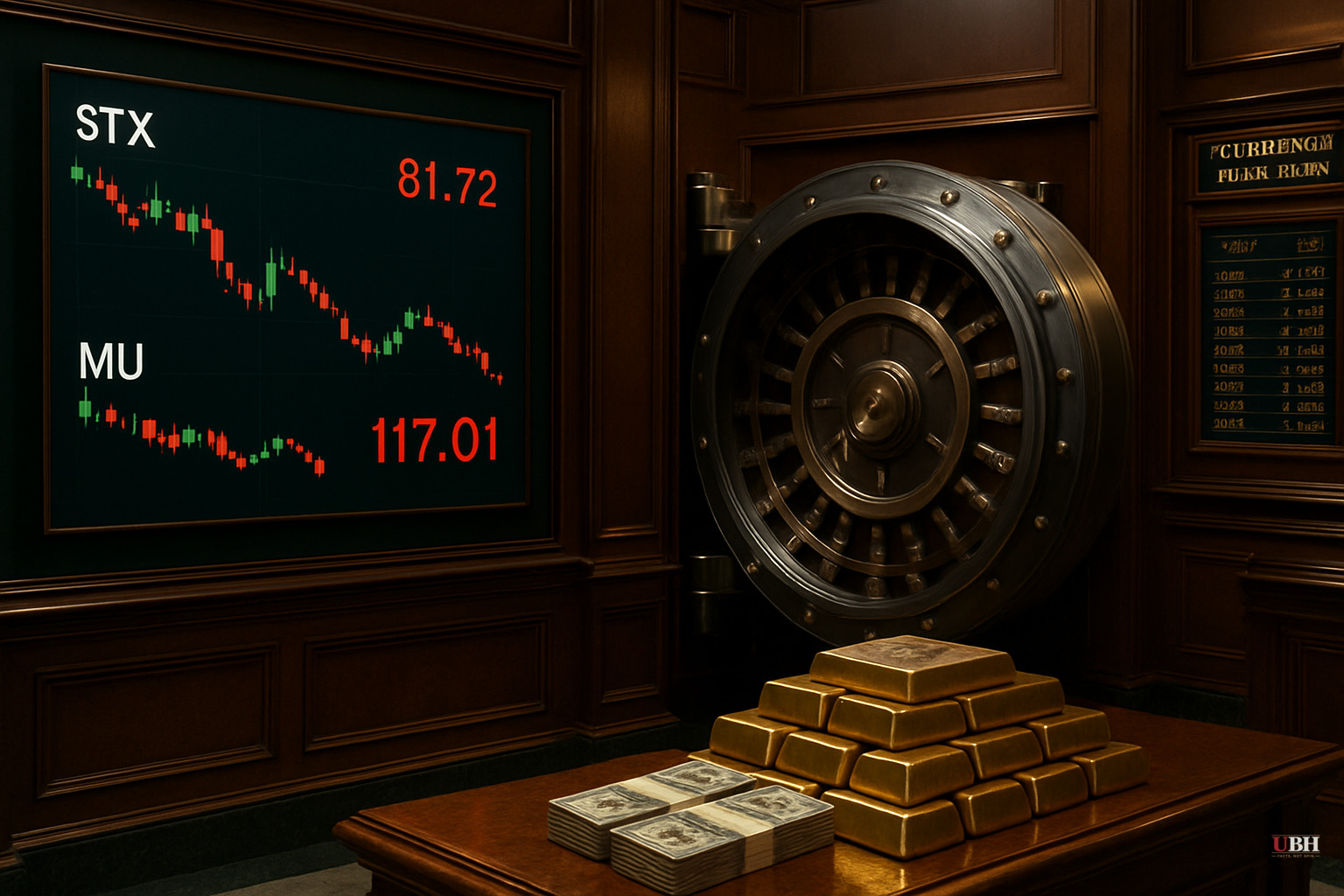
The Market Monday — By the Numbers
The S&P 500 dropped 0.7%. The Nasdaq slid 1.2%. The Dow fell 131 points. Not catastrophic — but this is day two of a pullback from record highs, and the cracks are getting harder to paper over.
Oil jumped 3% to over $109 a barrel for WTI. Brent crude hit $112. That's not a rounding error — that's a full-blown inflation accelerant.
Seagate's CEO Just Said the Quiet Part Out Loud
At a JPMorgan conference Monday, Seagate CEO Dave Mosley was asked point-blank what it would take to add more chip production capacity. His answer, per CNBC: building new factories would 'take too long.' He said it would slow the rate of technology growth.
The AI buildout is running on the assumption that memory chip supply will scale to meet demand. Mosley just admitted it won't — at least not fast enough. Seagate fell 10% on the news. Micron dropped 8%. Western Digital and SanDisk each fell 8%. This suggests the market is pricing in a supply ceiling.
Mosley also said Seagate has 'four or five quarters of visibility' and is locking clients into purchase windows up to a year out. That's a polite way of saying: don't expect relief anytime soon.
Bond Traders Are Making Enormous Bets on Rates Going Higher
Friday's bond market action deserves scrutiny. According to CNBC, options volume in the iShares 20+ Year Treasury Bond ETF (TLT) hit more than three times its average daily volume — 1.4 million contracts.
The bias was overwhelmingly toward puts — bets that bond prices fall further and yields go higher. Nearly 380,000 puts were bought versus under 240,000 calls.
One trader dropped $2 million on June 75-strike puts. If that trade pays off, the TLT ETF would hit its lowest level since its 2002 launch.
Another trader put on a $3 million straddle — betting on a massive move in EITHER direction by January 2028. The position pays if TLT goes below $74 or above $94. These are conviction trades.
The 10-year Treasury yield has been flirting with 4.60-4.63%, according to Economic Times. The 30-year hit its highest level in about a year. UK Gilt yields hit levels not seen since the late 1990s. Japanese long-dated bond yields are also surging. This is a global repricing event.
What Mainstream Coverage Is Getting Wrong
Most headlines are framing this as a 'tech pullback' or 'inflation jitters.' There are actually three separate problems converging at once.
Problem one: Memory chip supply physically cannot scale fast enough for AI demand. Mosley said it. This is a fundamental bottleneck in the AI buildout itself.
Problem two: Oil above $109 means inflation is NOT going away. Ben Fulton, CEO of WEBs Investments, told CNBC: 'There's truly inflationary problems' and called elevated oil a 'watershed' issue. The U.S.-Iran standoff — with Trump warning on Sunday that Iran 'won't have anything left' if talks stall — is keeping the Strait of Hormuz in play. Treasury Secretary Scott Bessent granted a 30-day extension for Russian oil in tankers, per Economic Times, showing Washington is already scrambling to manage supply.
Problem three: Jerome Powell is gone. CNBC noted his tenure as Federal Reserve chair has ended. Markets are now pricing in the possibility that incoming Fed leadership takes a tighter stance. That uncertainty alone adds a risk premium to every rate-sensitive asset — which is most of the stock market.
Nvidia CEO Jensen Huang Is Still Talking Up China
Nvidia CEO Jensen Huang said at an event he expects China's market to gradually reopen to U.S. chipmakers, according to Economic Times. Currently, even the H20 chips — which Nvidia has U.S. approval to sell — have NOT been cleared by China. Trump-Xi talks produced zero progress on this front.
Huang is right to be watching China. But investors betting on a near-term China revenue unlock for Nvidia are getting ahead of the facts.
Vanguard Is Already Rotating
Bloomberg reported that Vanguard is favoring Treasuries as 10-year yields approach the top of their recent range. When one of the world's largest asset managers publicly moves toward bonds, that's a signal.
Tim Ghriskey, senior portfolio strategist at Ingalls & Snyder, told Economic Times: 'There's concern about the rally we've had in a short period of time, and there's some profit taking.'
What This Means
Your 401(k) just had two bad days in a row off record highs. That's survivable. The question is whether the AI rally's core premise — infinite demand plus infinite supply equals infinite growth — holds up.
Seagate's CEO just confirmed the supply side has a hard ceiling. Oil at $109 confirms inflation persists. Bond traders with millions on the line are betting rates go higher, not lower.
The Federal Reserve cannot cut rates into this environment. That means mortgage rates stay elevated. Car loans stay elevated. Credit card rates stay elevated. Every American carrying debt feels this — whether Wall Street admits it or not.
Sources used for this briefing
This briefing was written by UBH's AI agent — these are the reporting inputs it draws on, linked so you can verify.


