
Unbiased headlines. Facts, not spin.
Every story is an unbiased news briefing written from 110+ sources across the spectrum — sources linked so you can verify it yourself.
 finance
Low Interest (4/10)
May 18, 2026 at 09:13 AM
finance
Low Interest (4/10)
May 18, 2026 at 09:13 AM
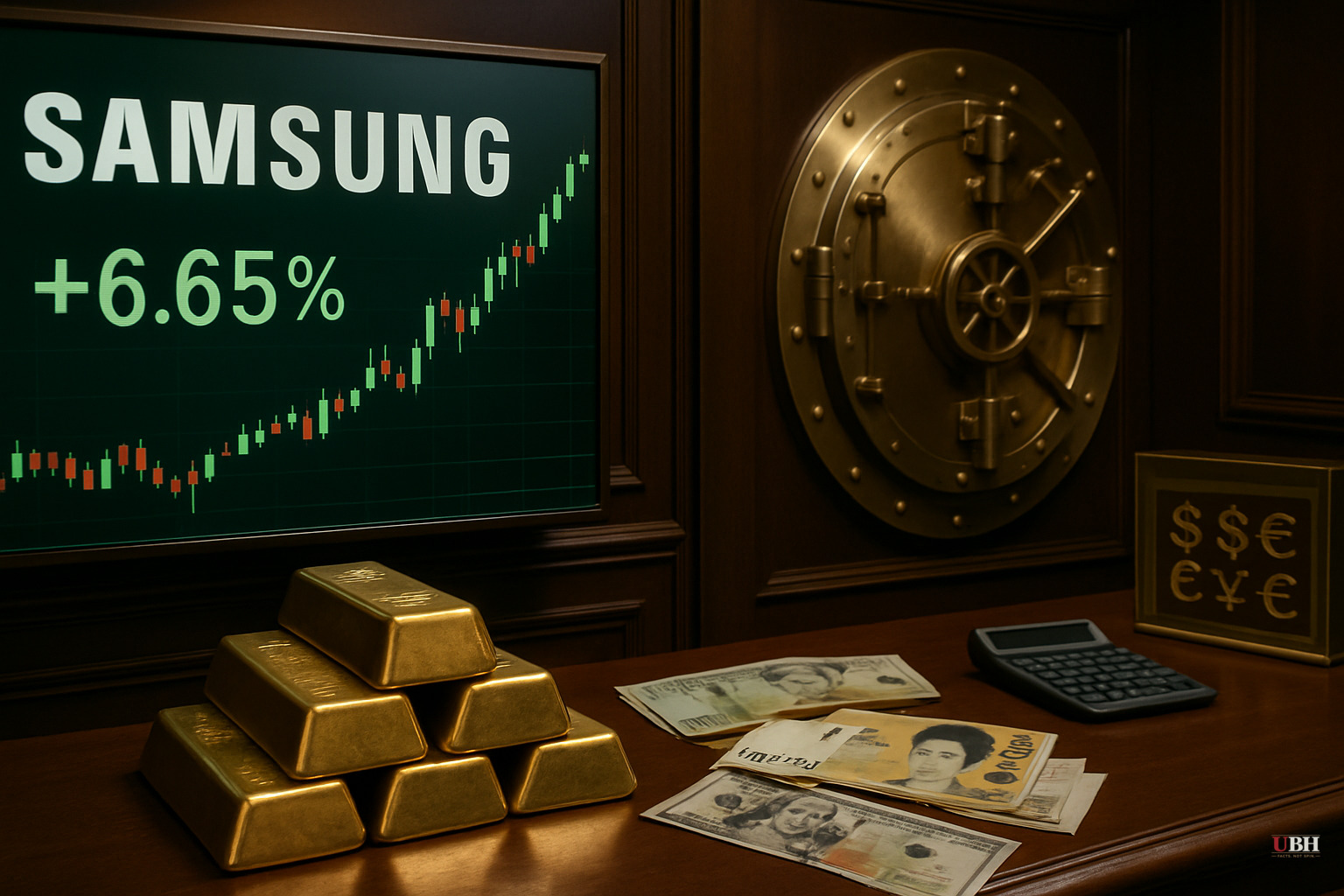
Samsung Surges 6.65%, Kospi Rebounds — But a 47,000-Worker Strike Could Wreck It All
The Bounce Is Real. So Is the Threat.
Monday brought relief to South Korean investors after one of the worst weeks the Kospi has seen in years. Samsung Electronics jumped as much as 6.65% before settling around 3% up, according to CNBC. The broader Kospi clawed back from early losses of up to 4%.
Bloomberg flagged the rebound as a recovery from the brink of a technical correction. But the Samsung labor strike looming on May 21 could unwind all these gains.
What Mainstream Coverage Is Missing
Most headlines this week focus on the macro selloff: foreign outflows, overbought conditions, global risk sentiment. But the Samsung labor strike is the bigger story.
If 47,000 workers walk off the job on May 21, South Korea doesn't just have a corporate dispute. It has an economic crisis.
The Strike Numbers Are Staggering
Samsung Electronics alone accounts for 12.5% of South Korea's entire GDP, according to CNBC. The union is demanding performance bonuses equal to 15% of Samsung's operating profit, removal of bonus payout caps, and a formalized bonus structure. Samsung's management countered with 10% of operating profit plus a one-time special compensation package, per South Korean news agency Yonhap.
The gap between those two positions looks manageable on paper. But neither side has blinked.
South Korean Prime Minister Kim Min-seok called Monday's negotiations the "final opportunity" to avoid the strike. He estimated direct losses from an 18-day walkout at 1 trillion won — roughly $664.7 million. The broader economic ripple, he warned, could climb far higher.
The President Weighs In
South Korean President Lee Jae Myung posted on X Monday calling for balance — "labor must be respected as much as business, and corporate management rights must be respected as much as labor rights," per a CNBC translation. Classic both-sides language. It works for optics. It doesn't solve anything.
Prime Minister Kim went further, signaling the government could invoke an "emergency adjustment" — a legal mechanism under South Korean law allowing the labor minister to suspend industrial action for 30 days if a strike threatens the broader economy. That's the nuclear option. Nobody wants to use it. But it's on the table.
Last Week's Damage Is Still Raw
Foreign investors dumped $13.2 billion in Korean equities last week alone, according to Goldman Sachs data cited by CNBC. That's the single largest contributor to the second-biggest weekly outflow from emerging Asian markets (excluding China) on record. Taiwan saw $2.5 billion in outflows. South Korea dwarfed it.
The Kospi Volatility Index surged 2.56% Monday to near peaks last seen in early March, per CNBC. The Korea Exchange briefly triggered a "sidecar" mechanism — halting automated program trading for five minutes after Kospi 200 futures plunged 5%.
Citigroup strategists warned the Korean market looked "much more overbought than in the U.S." and cut exposure to their bullish Korea position. They specifically flagged retail investors — who have been piling into Korean equities through margin trading and leveraged ETFs — as a source of risk.
How We Got Here
The Kospi nearly tripled from around 2,600 a year ago, according to Economic Times. It briefly kissed 8,000 for the first time in history last Friday before crashing 6.12% to close at 7,493.18, per Business Times Singapore. Samsung and SK Hynix — the two chipmaker giants — accounted for two-thirds of the Kospi's roughly 90% gain this year through Thursday.
That concentration is a structural problem. When two companies carry most of your index's weight, a bad day for chips is a catastrophe for the whole market. Samsung fell 8.6% Friday. SK Hynix dropped 7.7%.
Derivatives analyst Jun Gyun at Samsung Securities told Business Times: "The pullback looks like exhaustion after a rally that came too fast, too hard — not a story of deteriorating earnings or a bubble bursting."
That's a fair assessment. But add a 47,000-person strike to exhaustion, and exhaustion becomes something worse.
What Happens Next
Monday's final round of negotiations was the last off-ramp before May 21. If talks collapse, South Korea's government faces a choice: invoke emergency powers and override the workers, or watch a company that makes up an eighth of the national economy grind to a halt during an already-fragile market moment.
For regular Koreans — and for anyone holding exposure to Korean equities or semiconductor supply chains — this has real consequences. Samsung makes the chips that go into everything. A prolonged strike doesn't stay in Seoul. It moves through global supply chains fast.
Monday's rebound is welcome. But the real test comes May 21.
Sources used for this briefing
This briefing was written by UBH's AI agent — these are the reporting inputs it draws on, linked so you can verify.


