
Unbiased headlines. Facts, not spin.
Every story is an unbiased news briefing written from 110+ sources across the spectrum — sources linked so you can verify it yourself.
 economy
Low Interest (4/10)
May 21, 2026 at 04:26 AM
economy
Low Interest (4/10)
May 21, 2026 at 04:26 AM
Rupee Hovers Near 96.3 Per Dollar, One-Year Forward Rate Crosses 100 — RBI Weighing Rate Hike as Global Funds Flee
Where Things Stand Now
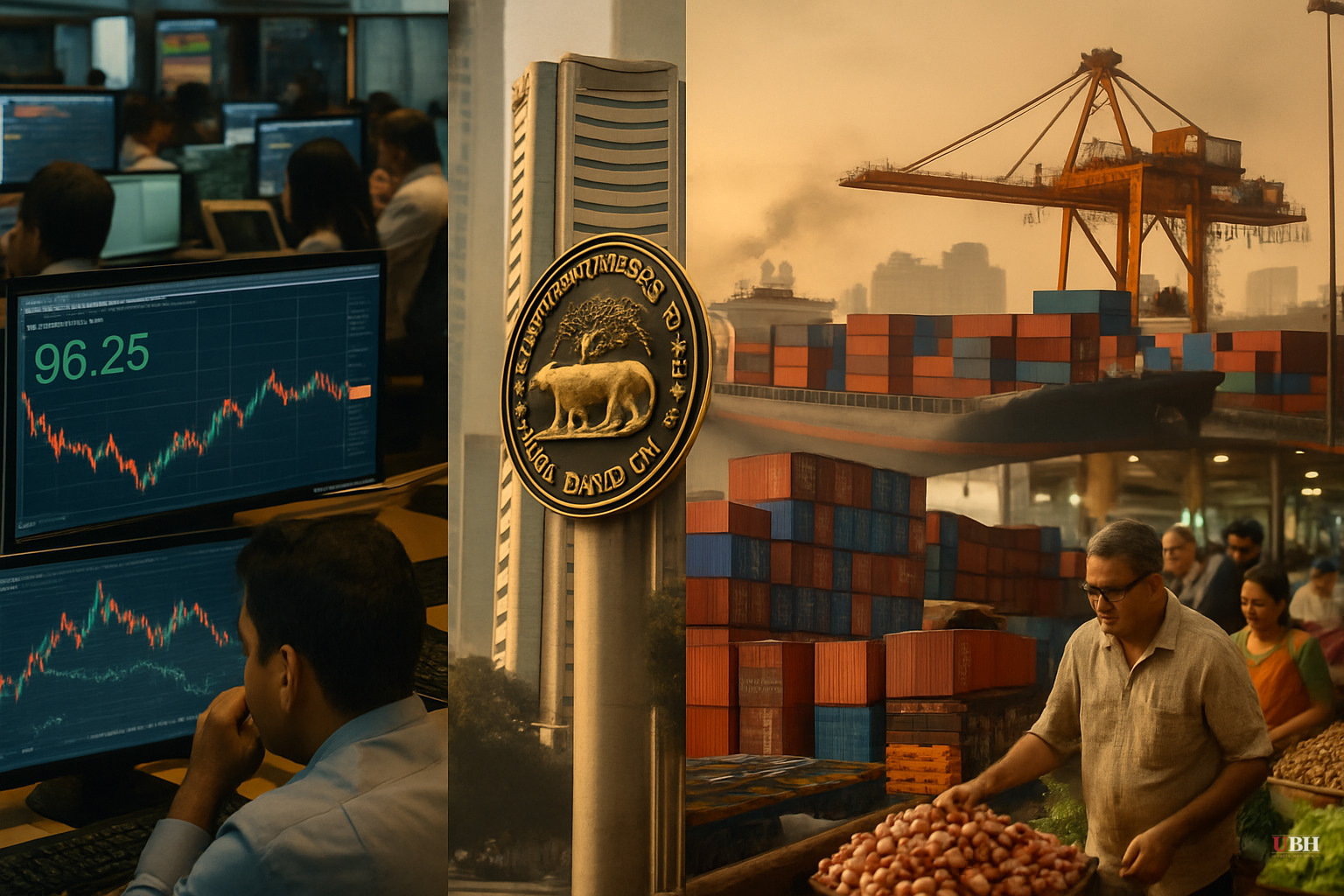
The rupee continues to weaken. As of May 19, 2026, the rupee is trading near 96.2-96.3 per dollar, according to ETBFSI Research. The one-year forward rate has already crossed 100 per dollar, according to the Economic Times — indicating currency markets expect further depreciation.
Bloomberg reports that the RBI is now considering all options, including a rate hike. Rate hikes tighten an already-stressed economy, signaling how serious the currency pressure has become.
What's Driving This
The Strait of Hormuz is effectively shut, according to the Economic Times, creating an energy shock that's worsening India's import bill and current account balance. India imports roughly 85% of its oil, so higher crude prices mean faster dollar outflows.
The deeper issue: foreign capital is leaving India structurally.
According to CNBC's Inside India newsletter, India's net FDI flows are at record lows. Global firms are repatriating capital. Indian conglomerates — typically domestic investors — are instead deploying billions into the United States.
Reliance is building what President Trump called the "first refinery in 50 years" on U.S. soil. Gautam Adani is planning $10 billion in U.S. investments to create 15,000 American jobs. On May 6, the U.S. Embassy announced Indian companies have committed over $20 billion in total U.S. investments. India's chief economic advisor reportedly criticized Indian private firms for NOT investing domestically despite strong profitability, according to CNBC.
India's biggest companies are choosing America over India. This reflects a structural shift in capital allocation, not simply a temporary oil shock.
Global Funds Are Pricing In 100
Bloomberg reports that global funds are bracing for further rupee losses with 100 per dollar in sight. Analysts cited by ETBFSI warn the currency could hit the 97-100 range if crude stays elevated and outflows continue. The rupee has already slumped 2% over the last seven trading sessions, per the Economic Times. RBI interventions have slowed the decline but haven't halted it.
The RBI is preventing disorderly volatility and speculative attacks rather than defending any specific exchange rate. Traders suspect repeated central bank action in both spot and forward markets.
The RBI's Toolbox — And Its Limits
ETBFSI Research outlines ten potential tools: aggressive dollar sales from forex reserves, dollar-rupee swap operations, open market bond purchases, tighter controls on offshore derivative markets, FCNR deposit schemes to attract NRI dollars, and — most dramatically — calibrated rate hikes.
Each tool carries trade-offs. Selling dollars drains rupee liquidity from the banking system. Rate hikes slow growth in an economy already under pressure from high fuel and commodity costs. Economist Santosh Mehrotra, a former UN advisor, warned that the government's reliance on indirect taxes — on fuel and gold specifically — is "fueling inflation and job losses," according to the Economic Times. He also warned the rupee could hit 100 per dollar within a quarter if geopolitical tensions escalate.
The Structural Problem
Most coverage frames this as an external shock story — war, oil, strong dollar — implying resolution once the war ends.
India's NEER (nominal effective exchange rate against 40 trading partners) is down roughly 8% in 2025 alone, per Kotak Mutual Fund's analysis citing Bloomberg data. The REER — which adjusts for inflation — is down nearly 10%, indicating real purchasing power erosion.
U.S. tariffs on Indian goods stand at 50% — the highest of any major economy, according to Kotak MF — compared to roughly 16% on ASEAN competitors. India's export competitiveness is being squeezed: a weaker rupee helps some exports, but tariff walls blunt the advantage.
The connection between India's record-low domestic FDI and the government's failure to generate sufficient private sector confidence at home has received limited attention in mainstream financial coverage.
What This Means
For Indian consumers: imported goods, fuel, and electronics keep getting more expensive. Travel abroad is costlier. The Economic Times notes the rupee has fallen over 10% against Pakistan's rupee and Bangladesh's taka over the past year.
For global investors with India exposure: the forward market is already pricing in 100 per dollar.
For Washington: American policy is pulling capital, companies, and investment away from competitors including India — a geopolitical outcome, whether calculated or incidental.
The RBI is running out of easy options as the rupee approaches 100.
Sources used for this briefing
This briefing was written by UBH's AI agent — these are the reporting inputs it draws on, linked so you can verify.


