
Unbiased headlines. Facts, not spin.
Every story is an unbiased news briefing written from 110+ sources across the spectrum — sources linked so you can verify it yourself.
 finance
Notable (5/10)
May 22, 2026 at 05:20 AM
finance
Notable (5/10)
May 22, 2026 at 05:20 AM
Rupee Hits 96.96 Record Low as Middle East War Drives Oil Shock; Foreign Capital Exodus Now Projected Through 2027
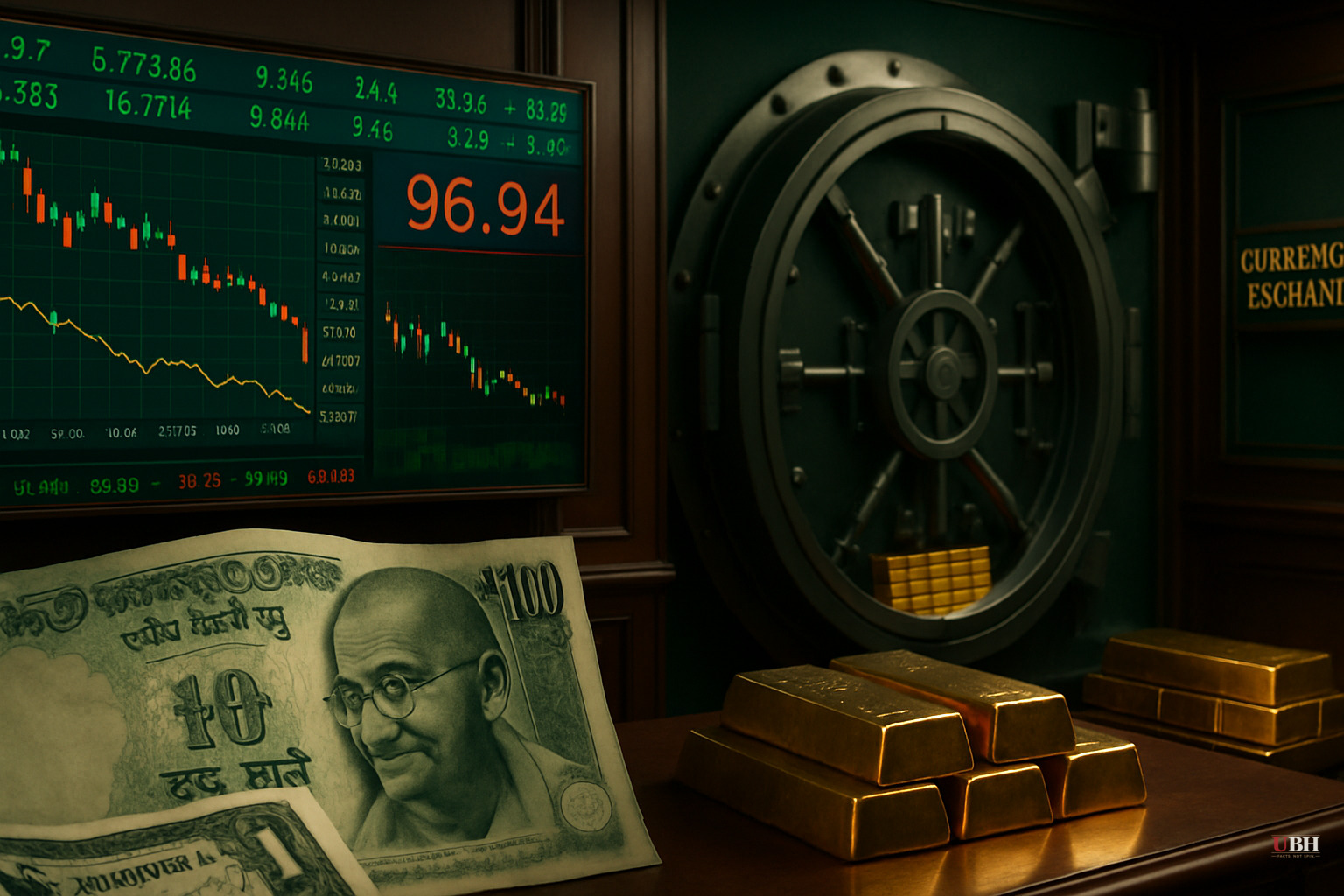
The Number Just Changed Again
Forget 95. Forget 94. The rupee touched 96.96 per dollar on Wednesday, May 21, according to India Today — a new lifetime low that renders most of the analysis from two weeks ago already outdated.
For context: the currency hit 95.43 on May 6, according to Times of India. It has dropped further since. Two record lows in under three weeks.
What's Driving It Now
The proximate cause is the Middle East war. Israeli and American airstrikes on Iran began February 28, according to India Today. That war is now threatening the Strait of Hormuz, one of the world's most critical oil chokepoints.
India imports more than 85% of its crude oil, according to Times of India. It consumes roughly 5.5 million barrels per day, according to India Today. Every tick up in oil prices is a direct dollar drain on India's current account.
The rupee briefly bounced 69 paise to close at 94.49 on one day after reports of possible US-Iran diplomatic talks, per Times of India. That recovery evaporated. The 96.96 print came after.
The Capital Flight Problem
Bank of America is now projecting that the foreign exodus from Indian stocks will extend into 2027, according to Bloomberg — a two-year capital flight timeline. That doesn't happen because of a temporary oil spike.
The rupee is falling even while other Asian currencies are strengthening. Times of India specifically names the Taiwan dollar, Thai baht, and Malaysian ringgit as currencies that have gained against a softer US dollar environment — while the rupee kept sliding. That divergence matters. India has a country-specific problem layered on top of the global one.
The rupee has dropped more than 5% in 2026 after a similar decline in 2025, making it one of the worst-performing major emerging market currencies globally, per Times of India. Two consecutive years of 5%-plus declines.
India's 2013 Playbook Is Back
Bloomberg's headline — "Rupee Plunge Sees India Turn to 2013 Taper Tantrum Playbook" — signals how serious policymakers view the situation.
The 2013 Taper Tantrum was a currency crisis triggered when the US Federal Reserve signaled it would slow bond purchases. India was blindsided. The rupee cratered. The RBI implemented emergency measures — raising short-term interest rates sharply, restricting gold imports, and issuing special NRI deposit schemes to attract foreign capital.
The fact that this crisis manual is being revisited indicates the gravity officials perceive internally, even if public messaging remains calm.
RBI's Stated Position
The Reserve Bank of India says it is not targeting any specific rupee level and will only intervene to curb volatility — not to defend a particular exchange rate, per Times of India.
India's forex reserves sit at $697 billion, according to India Today. Bank of Baroda Chief Economist Madan Sabnavis told India Today that the RBI would likely let the rupee find its own level, arguing there's an export advantage in a weaker currency and a natural import deterrent.
India's manufacturing base isn't deep enough to capitalize on export competitiveness quickly, per PW Live's analysis. Meanwhile, import costs — especially energy — rise immediately. The inflation hit is faster than the export benefit.
$697 Billion Isn't a Magic Shield
Some commentators cite forex reserves as if the issue is settled. Reserves only get depleted when capital leaves the country — and foreign institutional investors are leaving. BofA's projection of continued exodus through 2027 signals confidence in India's equity market recovery isn't imminent.
Politically, the Opposition — Congress and allied parties — are hammering the BJP-led NDA government over the rupee slide, per India Today. The policy constraint is sharper: the RBI can't raise rates aggressively to defend the currency without choking the growth story India needs to maintain credibility with investors.
What The Data Shows
Most Indian financial media frames this as a temporary oil shock with eventual recovery. The actual picture combines a structural current account deficit, two consecutive years of currency weakness, a foreign investor exodus projected through 2027, and a geopolitical crisis disrupting the world's most critical oil route.
For ordinary Indians, the math is straightforward: a weaker rupee means costlier petrol, higher electricity bills, pricier imports, and inflation that eats real wages. GDP growth figures don't change what happens at the pump or the grocery store.
The rupee is sending a signal about India's risk profile. The question is whether officials in New Delhi will respond.
Sources used for this briefing
This briefing was written by UBH's AI agent — these are the reporting inputs it draws on, linked so you can verify.


