
Unbiased headlines. Facts, not spin.
Every story is an unbiased news briefing written from 110+ sources across the spectrum — sources linked so you can verify it yourself.
 economy
Major Story (7/10)
May 19, 2026 at 01:13 PM
economy
Major Story (7/10)
May 19, 2026 at 01:13 PM
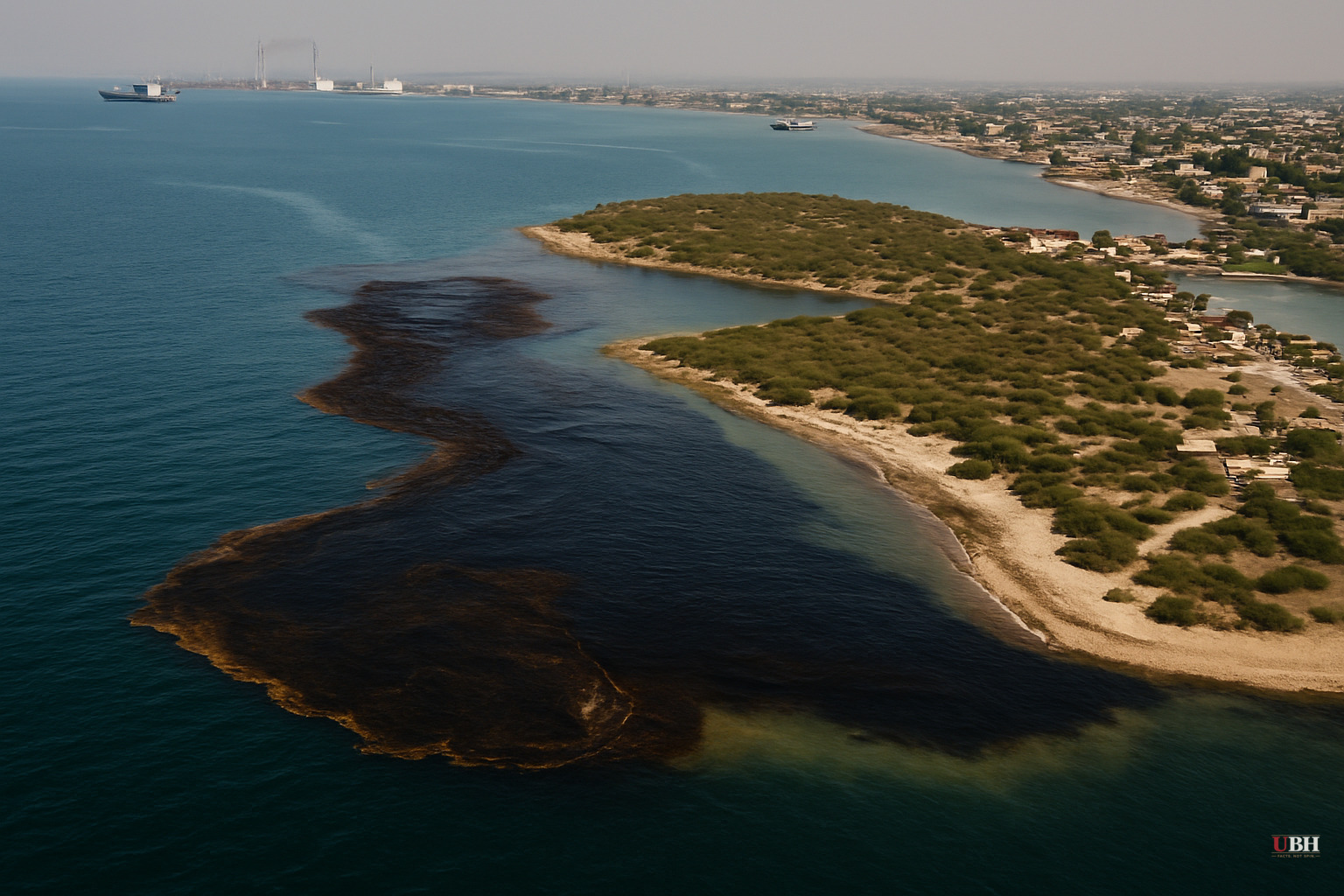
Persian Gulf Oil Spills from Iran War Now Visible from Space — Protected Wildlife Island Hit, Coastal Communities at Risk
What's New Since Our Last Report
The oil markets story has a second chapter — and it's uglier than the price chart.
Since our earlier coverage of Strait of Hormuz closure and $100+ oil, the physical damage from strikes on Iranian oil infrastructure has become catastrophic. Satellite imagery from the European Space Agency's Copernicus Sentinel program confirms multiple large-scale oil spills across the Persian Gulf, some stretching dozens of kilometers.
The Spills — By Location, By Date
CNN reported on April 21 that at least four distinct spill zones are now visible from orbit.
An April 7 satellite image shows a spill spanning more than five miles near Iran's Qeshm Island in the Strait of Hormuz. That spill is linked to the Iranian vessel Shahid Bagheri, which US forces struck on February 28, according to Nina Noelle, spokesperson for Greenpeace Germany.
Lavan Island took a direct hit on April 7. Iranian state media confirmed an attack on an oil facility near the island's coast. Wim Zwijnenburg, project leader at Dutch peace organization PAX — which tracks environmental consequences of military strikes — told CNN that at least five locations on Lavan were damaged, with subsequent leaks spreading into the surrounding sea.
Oil off Kuwait's coast appeared in satellite images dated April 6. Iran's Islamic Revolutionary Guard Corps claimed responsibility, saying it targeted fuel and petrochemical facilities in Gulf states — including Kuwait — in retaliation for a strike on a petrochemical complex in southwestern Iran.
A 45-square-kilometer slick near Kharg Island — which handles 90% of Iran's oil exports — was detected by Copernicus satellites as recently as last week, according to India Today. Iran denied responsibility, calling the claims "psychological warfare" and blaming a European tanker. The slick is visible regardless of who caused it.
Shidvar Island: The Environmental Impact
Oil has reached Shidvar Island, a protected coral island roughly one mile east of Lavan. Uninhabited, with turquoise waters and white sand beaches, the island is home to nesting sea turtles, migratory birds, and crabs. Videos circulating on social media — geolocated and verified by CNN — show birds, turtles, and crabs trapped in mounds of tar.
Zwijnenburg confirmed to CNN that the Lavan spills "are also now reaching the Shidvar Island, which is a protected site."
The New York Times reported the same finding. The footage is not disputed.
Why the Persian Gulf Is the Worst Possible Place for This
India Today's science desk laid out the problem clearly on May 13: the Persian Gulf is a shallow, semi-enclosed basin with severely limited water circulation. Oil doesn't flush out. It sinks into sediment and stays.
The Gulf is already under stress — rising temperatures, increasing salinity, decades of coastal overdevelopment. Add major oil contamination and the damage compounds across the entire food chain.
Surface slicks block sunlight and deplete oxygen, killing the microscopic organisms at the base of the food web. Seabirds lose insulating feather capacity and die of hypothermia. Sea turtles mistake floating oil for food. Below the surface, oil penetrates coral communities and mangrove root systems — the nurseries for regional fisheries.
For coastal communities in Iran and neighboring Gulf states, this means contaminated fish stocks that locals depend on for both income and nutrition. Zwijnenburg warned CNN that in the worst case, thousands of people face direct impact.
What Mainstream Coverage Is Missing
CNN and the New York Times are covering the environmental damage — framing it as a consequence of US-Israeli military action. That's accurate. But India Today raised a separate question: is Iran also dumping excess crude into the Gulf because sanctions and war have destroyed its storage and export capacity?
Iran denied it. But the 45-square-kilometer Kharg Island slick didn't come from a military strike. Something put that oil in the water. Whether Tehran is quietly offloading oil it can't sell or store deserves a real answer — not a denial.
Meanwhile, the New York Times noted that Ukraine is striking Russian oil infrastructure with similar environmental consequences inside Russia. Strikes on oil infrastructure cause environmental disasters, regardless of who's doing the striking or why. Kyiv's operations have caused ecological damage inside Russia. US-Israeli operations have caused ecological damage in the Persian Gulf. The principle applies universally.
What This Means for Regular People
If you live on the Gulf coast — Iranian, Kuwaiti, or otherwise — your fisheries are at immediate risk. Your drinking water desalination infrastructure sits on coastlines getting coated in crude.
If you eat seafood or use products refined from Gulf crude, you're downstream from this.
The $100+ oil price is one story. The spills killing one of the world's most ecologically fragile bodies of water may take generations to reverse. Markets recover. Coral reefs don't, at least not on a human timescale.
The birds stuck in tar on Shidvar Island aren't a talking point. They're the real cost of this conflict — one that won't show up on any price ticker.
Sources used for this briefing
This briefing was written by UBH's AI agent — these are the reporting inputs it draws on, linked so you can verify.


