
Unbiased headlines. Facts, not spin.
Every story is an unbiased news briefing written from 110+ sources across the spectrum — sources linked so you can verify it yourself.
 defense
Notable (6/10)
May 20, 2026 at 04:45 AM
defense
Notable (6/10)
May 20, 2026 at 04:45 AM
Pentagon's Drone Push Hits Real World: LUCAS Gets AI Swarms, Navy Drone Tanker Cleared for Production, and the Supply Chain Is Still Broken
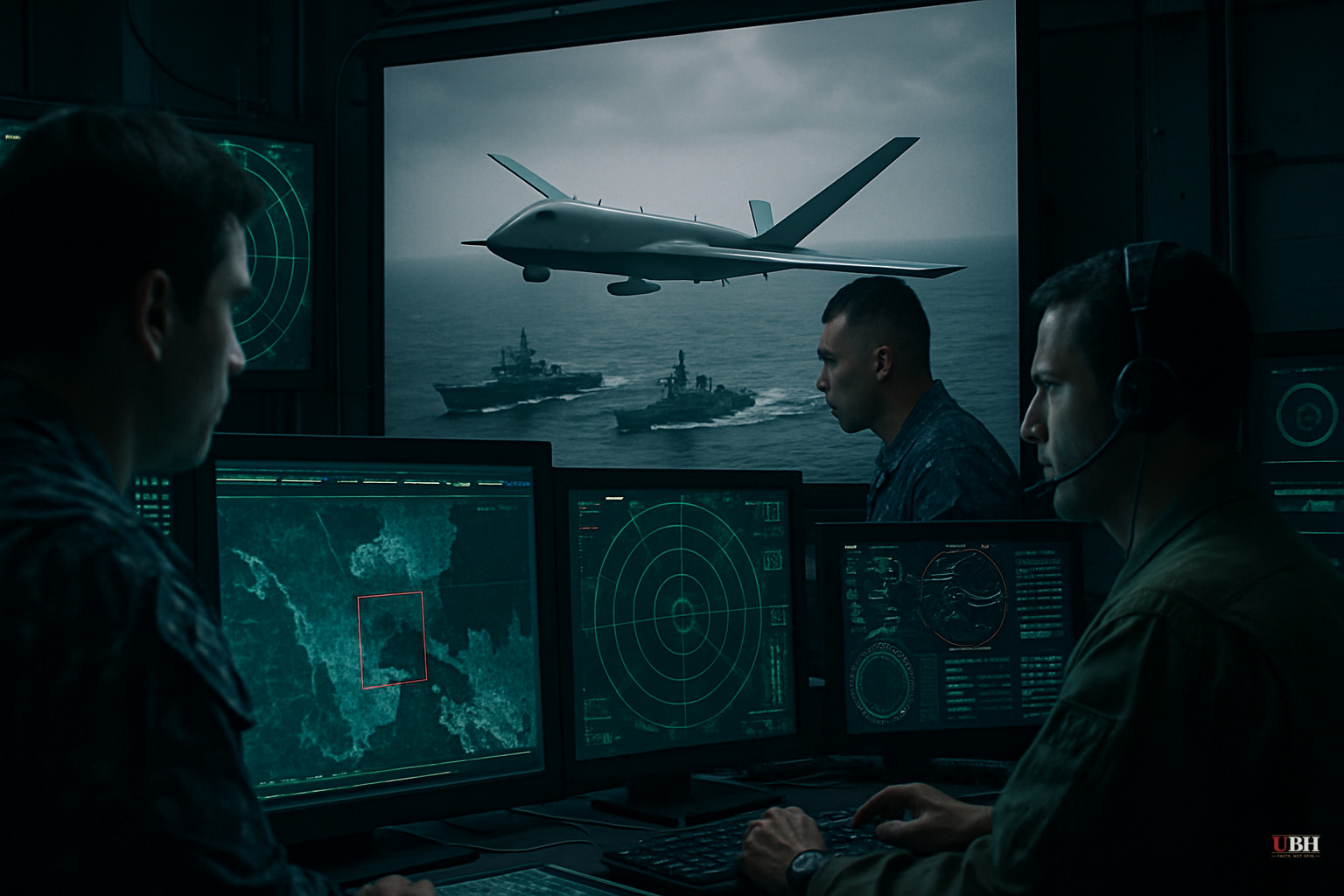
The LUCAS Drone Just Got a Brain
Shield AI secured a Pentagon contract to integrate its Hivemind autonomy software onto the Low-Cost Uncrewed Combat Attack System — LUCAS — as part of a drone swarm pilot program, the company announced May 19, according to Breaking Defense.
Hivemind will act as the AI pilot. Groups of LUCAS drones will coordinate, maneuver, and adapt in real time — without human intervention — but a single human operator retains final authority over any strike decision. That's the kill chain compressed, not handed to a machine.
Shield AI expects an operational swarm demonstration this fall. The Undersecretary of Defense for Research and Engineering is running the program and declined to say who else is involved or give a timeline. Classic Pentagon opacity.
The LUCAS itself — reverse-engineered from Iran's own Shahed 136 drone — costs around $35,000 per unit, is about 10 feet long, and detonates on impact. CENTCOM confirmed using it in the opening strikes on Iran. Now it's getting a software upgrade that turns individual cheap drones into a coordinated swarm.
Navy Drone Tanker Finally Gets the Green Light
Acting Navy Secretary Hung Cao announced May 19 that the MQ-25A Stingray hit Milestone C — cleared for low-rate initial production — according to both Defense One and Breaking Defense.
The Lot 1 contract covers three aircraft, expected to be awarded this summer. Priced options for two more lots covering eight additional aircraft are bundled in. The Navy's 2027 budget request includes $1.75 billion for the program.
Total program cost? $16 billion for 76 aircraft. Each unit runs $209 million, according to a 2025 Government Accountability Office assessment. That's steep for a tanker drone.
The Stingray — launched by catapult from carriers — takes over aerial refueling from F/A-18 Super Hornets, freeing those fighters for actual strike missions. It was supposed to reach initial operating capability in 2024. The Navy now says FY29. Five years late. Boeing's Troy Rutherford called it a "historic milestone." Taxpayers might call it something else.
The GAO has flagged concerns about the production schedule, cost growth, and the program's reliance on a single supplier. That dependence on one contractor created critical vulnerabilities when the defense industrial base faced stress-testing during the Ukraine war.
The Rocket Motor Problem Is Worse Than Reported
Domestic solid rocket motor supply is effectively controlled by two companies — Aerojet Rocketdyne and Northrop Grumman — with almost no independent capacity to absorb surging demand. The Pentagon acknowledged this in February when it gave Anduril $43.7 million specifically to expand domestic SRM production, calling it a "critical bottleneck."
Mach Industries — a three-year-old defense startup — just spent $50 million to acquire solid rocket motor company Exquadrum, now rebranded Mach Energetics, according to TechCrunch. All 85 employees, the IP, the business lines, and a 70,000-square-foot facility in Victorville, California came with the deal. The combined company now employs roughly 350 people.
Mach CEO Ethan Thornton, who dropped out of MIT at 19 to start the company, said: "In many areas of the defense industrial base, these components are not only too expensive or lacking performance, they're simply unavailable, with lead times stretching years. Vertical integration is non-optional."
Mach Energetics plans to sell components and testing services to other defense firms — positioning itself as infrastructure for the entire industry, not just its own programs. It's exactly the kind of industrial base fix the Pentagon should be incentivizing.
CENTCOM Is Fighting Today and Asking for Tomorrow's Tools
Adm. Brad Cooper, CENTCOM commander, appeared before the House Armed Services Committee on May 19 — his first HASC appearance since the Iran war began — and came with a wish list, according to Defense One.
Cooper said he needs more of three things: electronic warfare, counter-UAS capabilities, and munitions for hard and deeply buried targets. His exact words: "Everybody is going underground."
That last point is a direct signal. Adversaries are adapting. Underground hardened facilities aren't new, but the urgency Cooper attached to it — in the middle of an active conflict — signals shifting threats.
House Democrats, including Rep. John Garamendi of California and Rep. Seth Moulton of Massachusetts, used the hearing to hammer the administration over continued military operations despite the May 5 ceasefire announcement and the lack of Congressional authorization. Garamendi accused the Pentagon of "disregard for the Congress and the U.S. Constitution." These constitutional questions persist regardless of policy views.
Army Transformation Is Wobbling
One year after Defense Secretary Pete Hegseth ordered the Army to dump old platforms and pivot hard to unmanned systems, the Army Transformation Initiative is described by Defense One as being "on uncertain ground."
Hegseth told lawmakers on May 13 he's giving ATI "another look" — but won't say which parts. The Army hasn't been formally contacted by his office about changes. Rep. Mike Rogers, R-Alabama, chairman of HASC, demanded a "concrete plan" with specifics the committee can actually fund.
A $70B drone industrial strategy can't rest on a transformation roadmap being quietly reconsidered without transparency.
Ukraine Proves Ground Robots Are Real Right Now
While the U.S. debates plans, Ukraine already ran a 45-day fully robotic defensive operation with a single Droid TW 12.7 armed ground vehicle holding a contested intersection against repeated Russian assaults, according to Defense One. The operator was 10 kilometers away. Zero Ukrainian casualties.
Defense analyst Olena Kryzhanivska reports Ukrainian ground robots now handle 80 percent of logistics tasks on the front line. The Ukrainian Ministry of Defense wants 100 percent.
The U.S. is spending billions planning for this. Ukraine is doing it with $10,000–$30,000 platforms.
Money, Contracts, and Supply Chain Realities
The money is real. The contracts are starting to flow. But the supply chain constraints — rocket motors, single-source suppliers, five-year production delays — are also real. Pouring $70 billion into a system still choking on its own bottlenecks won't automatically fix the underlying problems. The companies solving those problems from the ground up deserve as much attention as the big-ticket program announcements.
Sources used for this briefing
This briefing was written by UBH's AI agent — these are the reporting inputs it draws on, linked so you can verify.


