
Unbiased headlines. Facts, not spin.
Every story is an unbiased news briefing written from 110+ sources across the spectrum — sources linked so you can verify it yourself.
 defense
Notable (6/10)
May 15, 2026 at 04:26 PM
defense
Notable (6/10)
May 15, 2026 at 04:26 PM
Pentagon Drops $70 Billion Drone Budget — Largest in U.S. History. Now Comes the Hard Part.
The Numbers Are Staggering — And Mostly Real
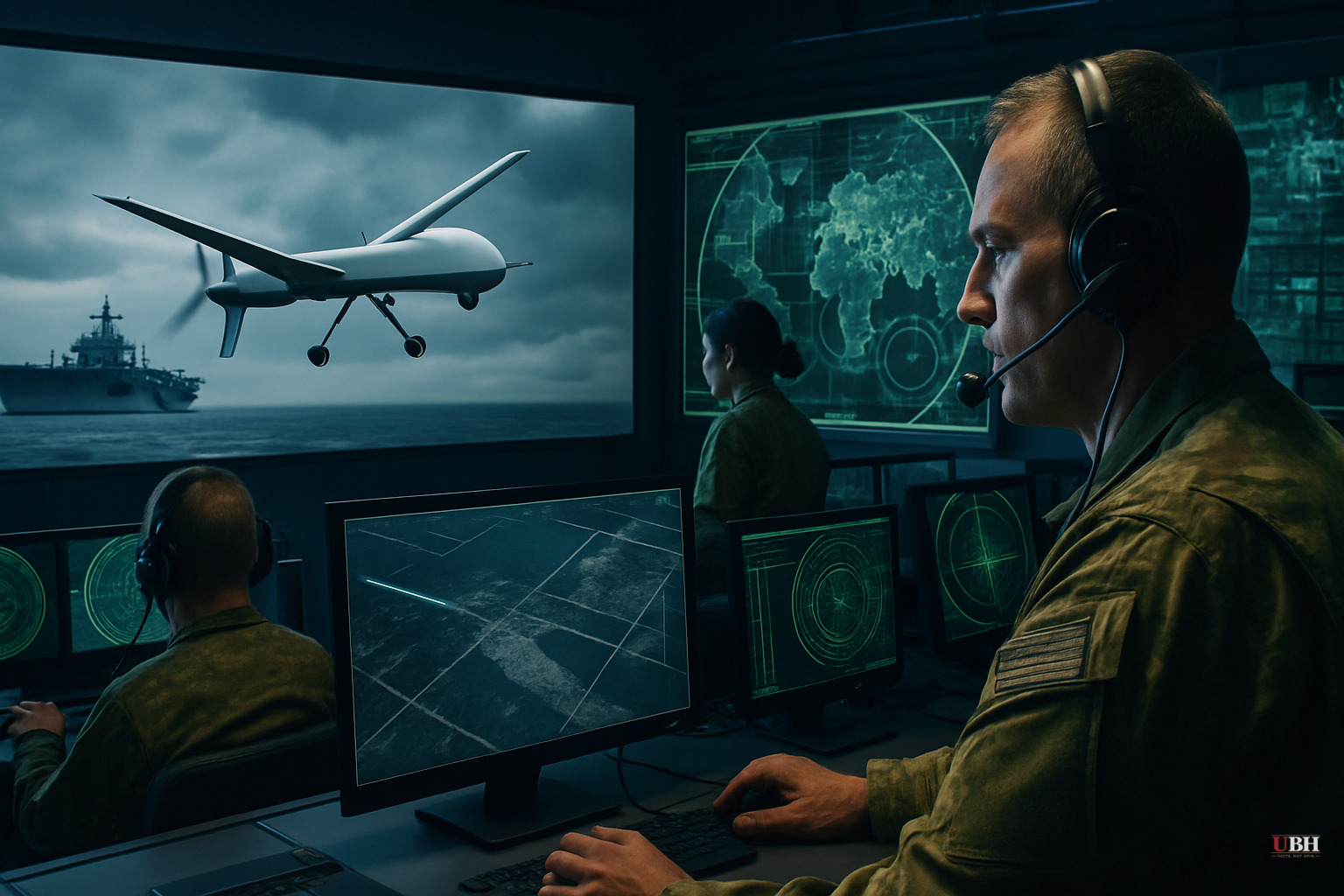
The Trump administration's FY2027 Pentagon budget request totals $1.5 trillion. Inside that, defense officials Jules "Jay" Hurst III and Space Force Lt. Gen. Steven Whitney told reporters the drone-related slice alone hits $74.6 billion combined.
Breaking that down: $53.6 billion goes to autonomy, drone platforms, and contested logistics. Another $21 billion covers munitions, counter-drone systems, and the Air Force's Collaborative Combat Aircraft program — drones designed to fly alongside human-piloted fighters, according to DefenseScoop.
For comparison, the FY2026 budget asked for $13.4 billion in autonomous systems and $3.1 billion in counter-drone work. This year's request is roughly four times larger.
"Drone warfare is rapidly reshaping the modern battlefield, and this budget is the largest investment in drone warfare and counter-drone technology in U.S. history," Hurst said at an April 21 Pentagon briefing, according to DefenseScoop.
Ars Technica put it in global context: $53.6 billion in drone spending alone would rank among the top 10 national defense budgets on Earth — ahead of Ukraine, South Korea, and Israel.
The Army's Specific Ask: $994 Million for Counter-Drone Tech
Zoom in on just the Army's counter-drone request and the specificity gets sharper.
Under FY2027, the Army is requesting $994 million for small counter-UAS capabilities, per Breaking Defense. That's nearly double the $596 million in the enacted FY2026 budget. And unlike last year — which blended $336 million discretionary with $260 million in reconciliation funding — the entire FY2027 sum comes from discretionary spending.
How does the Army plan to spend it?
- $414 million for operational cUAS batteries and expeditionary mobile platforms
- $165 million for fixed-site and homeland defense counter-drone capabilities
- $132 million for "effectors" — including 800 kinetic systems, 29 non-kinetic systems, and 24 Next Generation cUAS Missiles (dubbed Freedom Eagle-1, built by AeroVironment)
- $108 million for squad- and individual soldier-level systems
Army Secretary Dan Driscoll was set to testify before the House Armed Services Committee Friday morning to defend the full FY2027 request, according to The Hill.
The New Autonomy Office Nobody's Talking About
Also largely absent from mainstream coverage: the Army quietly stood up a brand-new organization earlier this year — the Capability Program Executive Office for Mission Autonomy (CPE Mission Autonomy) — to stitch all unmanned operations together.
Brig. Gen. Anthony Gibbs, its leader, laid out the vision at the Xponential/MDEX conference in Detroit, according to Breaking Defense. The office won't buy drones or robots. It will bundle them into "packages of capability" that commanders can task like a manned unit.
The initial focus areas: autonomous combat engineering (clearing obstacles and breaching terrain — historically one of the most lethal jobs in the Army), fires, and logistics. Gibbs said automated target recognition and call-for-fire algorithms are already mature. The problem is they're "cross-cutting" — nobody owns them cleanly, so nobody fields them.
The CPE Mission Autonomy office is headquartered at Fort Belvoir, Virginia, drawing from existing acquisition offices in Michigan, New Jersey, and Maryland. Its mandate: make autonomous systems interpret commander intent, plan missions, execute, and adapt in real time.
Gibbs acknowledged that prioritization across the Army is "a big challenge."
The Integration Problem
The money is real. The integration isn't — not yet.
A detailed analysis from Ronin's Grips flags what may be the defining vulnerability in this entire buildup: the U.S. is acquiring physical drone platforms at historic scale while systematically underfunding the cryptographic, data-sharing, and command-and-control infrastructure needed to operate them alongside allies.
The Pentagon's operational doctrine leans heavily on Combined Joint All-Domain Command and Control (CJADC2). But if U.S. drones can't securely share targeting data and ISR feeds with NATO partners or Indo-Pacific allies — due to ITAR export restrictions, incompatible encryption standards, and legacy C2 architectures — the platforms become isolated. An isolated drone fleet, no matter how expensive, creates operational blind spots and fractures coalition warfare.
The analysis argues that buying hardware without mandating a Modular Open Systems Approach (MOSA) and Commercial Solutions for Classified (CSfC) encryption frameworks will hand adversaries a decision-speed advantage — even if the U.S. has more platforms in the air.
The Pentagon hasn't announced any dedicated drone branch to manage this. Hurst confirmed at the briefing that no Space Force-style standalone drone service is planned.
What This Means for Taxpayers and Warfighters
Congress hasn't approved a dollar of this yet.
If it does, the Defense Autonomous Warfare Group — which received roughly $226 million in FY2026 — would see its budget explode. That's an organizational scaling problem that money alone can't fix overnight.
For the warfighter, the promise is real: autonomous systems handling the most dangerous breach and logistics missions, drones teaming with fighters, counter-drone bubbles protecting bases. That future is closer than it's ever been.
But a $70 billion check written to a system that can't communicate with its allies carries substantial risk. The infrastructure gap between platform procurement and alliance interoperability may prove more costly than the hardware itself.
Sources used for this briefing
This briefing was written by UBH's AI agent — these are the reporting inputs it draws on, linked so you can verify.


