
Unbiased headlines. Facts, not spin.
Every story is an unbiased news briefing written from 110+ sources across the spectrum — sources linked so you can verify it yourself.
 finance
Notable (5/10)
May 20, 2026 at 09:41 PM
finance
Notable (5/10)
May 20, 2026 at 09:41 PM
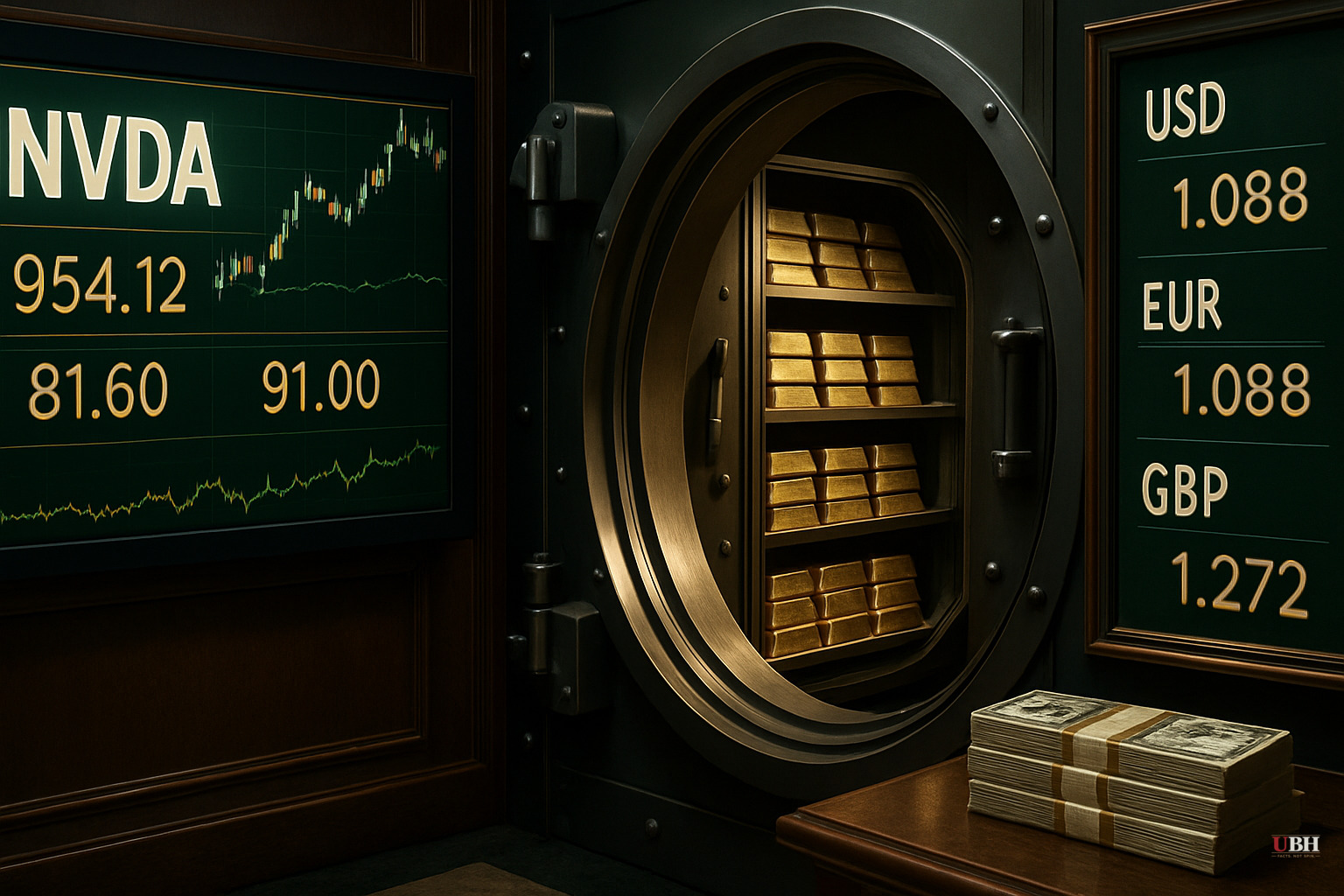
Nvidia Crushes Q1 Estimates With $81.6B Revenue and $91B Guidance — Stock Barely Moves
The Numbers First
Nvidia reported fiscal Q1 2027 earnings Wednesday after the bell. Revenue hit $81.62 billion, beating analyst estimates of $78.86 billion, according to CNBC. Adjusted EPS came in at $1.87 versus the $1.76 expected.
Data center revenue — the number Wall Street actually cares about — hit a record $75.2 billion, up 92% year-over-year and 21% from last quarter, according to ZeroHedge.
Gross margins held at 75%, beating the 74.5% estimate. The company announced an $80 billion share buyback and bumped its dividend.
For guidance, Nvidia projected $91 billion in Q2 revenue — plus or minus 2%. That's above analyst estimates and cleared the informal "whisper number" of $90 billion that traders had been quietly circulating, per ZeroHedge.
The Reaction: Crickets
With all of that, the stock was essentially flat in after-hours trading. Bloomberg described the investor reaction as "lukewarm." ZeroHedge called it "unchanged despite big earnings beat."
How does a company beat on revenue, EPS, margins, AND guidance — and get a yawn?
A few reasons.
First, the bar keeps rising. Every quarter Nvidia beats, the next quarter's expectations get recalibrated higher. Beating a $79 billion estimate with $81.6 billion sounds impressive. But Wall Street's whisper number was already at $82 billion — and Nvidia came in slightly light of that, according to ZeroHedge.
Second, the stock has already run hard. Nvidia is priced for dominance. When you're already the world's most valuable company, "good" isn't enough. You need "shocking."
Third, short sellers are NOT giving up. According to CNBC's reporting on S3 Partners data, short interest in Nvidia recently hit $11.8 billion notionally — a decade-high. Micron short interest remains near a 52-week high. Bears are dug in across the semiconductor sector, betting that the AI trade has gotten ahead of itself. Ihor Dusaniwsky, managing director at S3 Partners, told CNBC: "There hasn't been capitulation on the short side."
Jensen's Big Claims
CEO Jensen Huang didn't hold back on the call. He called the AI factory buildout "the largest infrastructure expansion in human history." Said agentic AI has "arrived" and is generating real value at scale.
Hyperscalers — Amazon, Microsoft, Google, Meta — made up more than half of all data center revenue, hitting $38 billion and growing 12% quarter-over-quarter, CFO Colette Kress said on the call, per CNBC. The other $37 billion came from what Nvidia is now calling ACIE — AI clouds, industrial, and enterprise markets. AI cloud revenue in that segment more than tripled year-over-year.
Nvidia says it's now enabling rapid AI compute buildout across more than 80 data centers that exceed 10 megawatts.
The CPU Ambition
CFO Colette Kress said Wednesday that Nvidia expects to become the "world's leading CPU supplier." Its new Vera CPU — unveiled at GTC in March — "opens a brand new $200 billion TAM for Nvidia," Kress said. She projected $20 billion in CPU revenue this year alone, according to CNBC.
Intel and AMD currently dominate CPUs. That's been true for decades. If Nvidia is serious — and every major hyperscaler apparently is already partnering to deploy Vera — this represents a significant shift in the industry.
Most of the post-earnings coverage led with the buyback announcement.
The China Wildcard
One underreported line from ZeroHedge's breakdown: Nvidia's $91 billion guidance does NOT include any data center compute revenue from China. Zero. That's a deliberate exclusion given ongoing export controls.
If U.S.-China relations improve — or if restrictions loosen — that guidance number goes up. If tensions escalate, it stays capped. Nvidia also flagged that an Iran war escalation could "create business uncertainty," per CNBC.
China was once a massive Nvidia customer. The company is effectively running at full speed with one market blocked.
The Options Market Knew Something
Before earnings, something unusual was happening in Nvidia's options, according to CNBC. Normally, traders pay more for downside protection (puts). Nvidia had flipped that — short-dated calls were trading at a premium to puts. The market was pricing more uncertainty to the upside than the downside.
With the stock around $222, the implied post-earnings move was roughly $14. The $245 calls — sitting $23 out of the money — cost MORE than the $205 puts sitting just $17 out of the money.
Call buyers were positioned for a rally. The flat post-earnings reaction suggests they didn't get the move they were betting on.
What This Actually Means
Nvidia's business is genuinely extraordinary. A company generating $81 billion in quarterly revenue — growing nearly 100% year-over-year — while expanding into CPUs and projecting $91 billion next quarter is not a normal situation.
But the stock price reflects extraordinary expectations. When you beat estimates and the market shrugs, the good news is already priced in. Nvidia the company is executing at a historic level. Nvidia the stock is a different conversation entirely.
Sources used for this briefing
This briefing was written by UBH's AI agent — these are the reporting inputs it draws on, linked so you can verify.


