
Unbiased headlines. Facts, not spin.
Every story is an unbiased news briefing written from 110+ sources across the spectrum — sources linked so you can verify it yourself.
 finance
Notable (6/10)
May 21, 2026 at 09:02 AM
finance
Notable (6/10)
May 21, 2026 at 09:02 AM
Nvidia Concedes China to Huawei, Bets $200B on AI Agents, and Quietly Doubled Its Startup Stakes to $43B
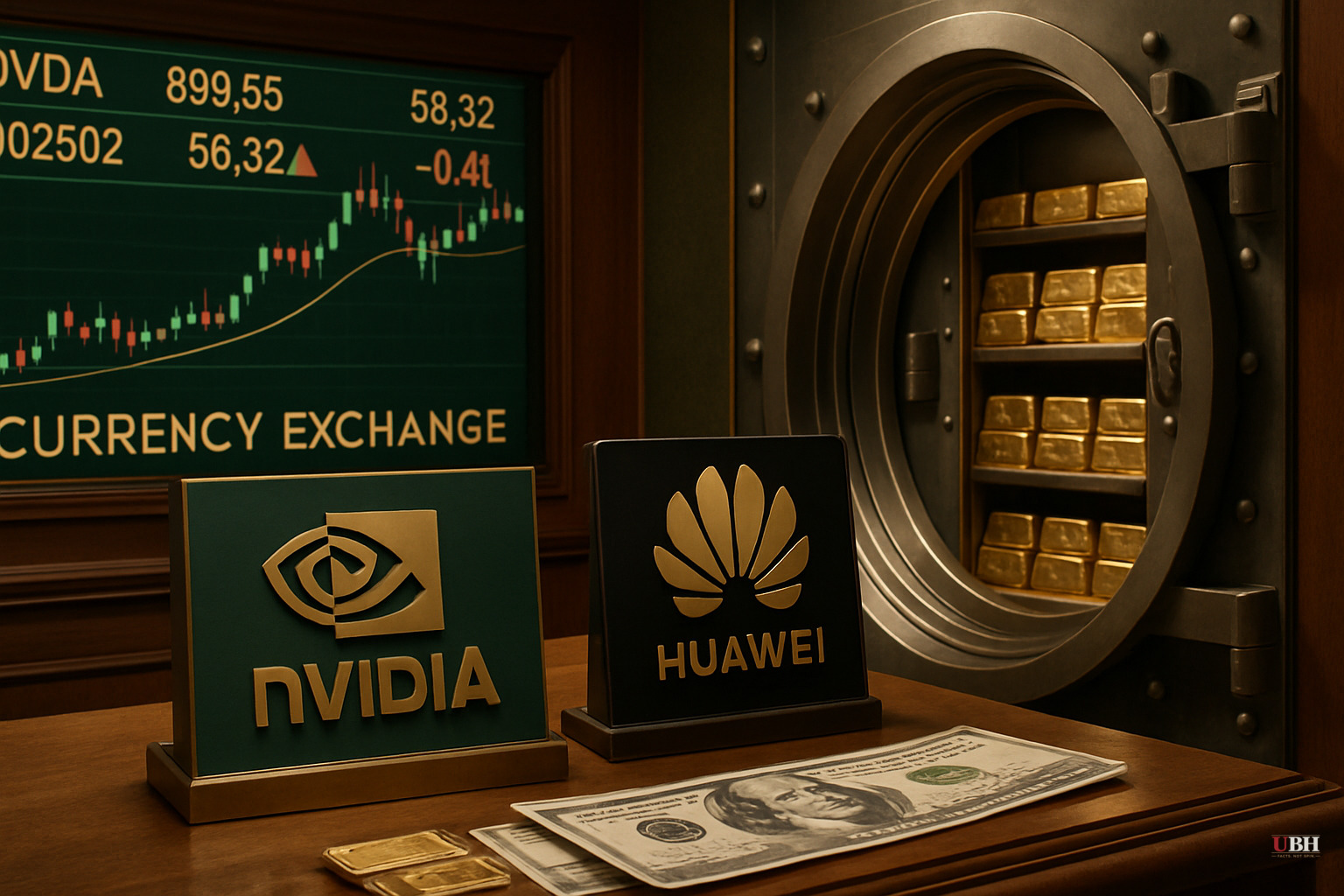
The China Concession Nobody Wanted to Talk About
Jensen Huang said it plainly. "We've really largely conceded that market to them."
Him is Huawei. The market is China's AI chip sector — which once accounted for at least one-fifth of Nvidia's data center revenue, according to CNBC.
The Trump administration's export restrictions locked Nvidia out. H200 chips now require a license to export to China, and according to CFO Colette Kress on the earnings call, Nvidia has generated ZERO revenue from those approvals so far.
Huang told CNBC's Sara Eisen that Huawei had "a record year" and will "very likely have an extraordinary year coming up." Their domestic chip ecosystem is thriving — because Nvidia evacuated the field.
He still wants back in. "We would be more than delighted to serve the market," Huang said. But he told investors to "expect nothing" on China approvals. That's a write-off.
Most mainstream coverage glossed over this. The Guardian mentioned it briefly. CNBC covered it more thoroughly. But framing Nvidia's quarter purely as a win while a $10B+ annual revenue stream is permanently in Huawei's hands overlooks a significant development.
U.S. export policy just handed Huawei a monopoly on the world's second-largest AI market. Whether or not those restrictions were strategically necessary — and there are real arguments they were — the cost is real and Huang is now saying it out loud.
$43 Billion in Startup Bets. In One Quarter.
According to TechCrunch's reporting on Nvidia's filing, the company's stakes in privately held companies nearly doubled in a single quarter — from $22 billion at the start of the period to $43 billion by April. That's $21 billion in new purchases in roughly 90 days.
The previous quarter? $649 million in equivalent purchases.
Those figures don't include Nvidia's investments in publicly traded companies like Corning and IREN. And they don't yet reflect Nvidia's approximately $500 million commitment to OpenAI, announced earlier this year, whose structure hasn't been fully disclosed.
Nvidia is no longer just a chip company. It's building an equity empire across the AI ecosystem — betting that owning stakes in the companies buying its hardware creates a self-reinforcing loop. Smart? Probably. Risky? Also yes.
The $200B CPU Bet — and Why It Matters
Huang used the earnings call to pitch Nvidia's new Vera CPU as the gateway to a "brand new $200 billion TAM" — a market Nvidia has never addressed, he said, according to TechCrunch.
Skepticism is warranted. Jensen Huang is, as TechCrunch's Julie Bort put it, possibly the greatest corporate hype man alive.
But Nvidia has already sold $20 billion worth of standalone Vera CPUs this year. That's not a projection. That's booked revenue.
The logic is straightforward. GPUs handle the thinking — training and inference. But AI agents, the programs that execute tasks autonomously, run mostly on CPUs. Classic cloud CPUs were designed for multi-core parallelism. Vera is designed to process AI tokens as fast as possible. Different architecture for a different job.
Huang's claim: every major hyperscaler and system maker is already partnering to deploy it. Vera ships bundled with the Rubin GPU during Nvidia's fiscal Q3, with a ramp in Q4, CFO Colette Kress confirmed per Kiplinger. Q1 of the following year is expected to be very strong.
The competitive threat is real — Amazon Web Services is pushing its own homegrown AI CPUs, and CEO Andy Jassy has made clear he thinks AWS can match or beat Nvidia on both GPUs and CPUs, according to TechCrunch. But $20 billion in Vera sales already on the books is a hard number to dismiss.
Ripple Effects: Asia Rallied Hard
Nvidia's print moved more than Nvidia stock — which, notably, slid after the call, marking a fourth straight post-earnings decline according to CNBC. Wall Street beats expectations and yawns. The valuation bar is that high.
Asia was a different story. SoftBank Group surged 19.85% in Tokyo trading Thursday, adding over $35 billion in market cap in a single session, per CNBC. SoftBank's exposure to Nvidia's ecosystem runs through its stake in Arm Holdings — whose chip designs power AI servers — and its $30 billion-plus investment in OpenAI.
Arm Holdings closed over 15% higher in U.S. trading. Taiwan's TSMC, Nvidia's primary manufacturer, rose over 2%. Japan's Renesas Electronics climbed 8.2%. The whole supply chain caught a bid.
The Bigger Picture
The revenue beat was already priced in. Four developments actually matter going forward:
One — Nvidia has formally surrendered China to Huawei. That's a geopolitical win for Beijing and a permanent revenue hole for Nvidia, whatever the quarterly numbers say.
Two — Nvidia quietly became one of the largest startup investors on earth in a single quarter. That $43 billion in private equity stakes makes it as much a venture fund as a chip company.
Three — The Vera CPU, if it delivers, opens a market Nvidia has never competed in. $20 billion in early sales suggests it's not just a concept.
Four — The stock keeps sliding post-earnings because expectations are stratospheric. Being the world's most valuable company at a $5.4 trillion market cap means "beating estimates" is table stakes, not a celebration.
Nvidia is printing money. It's also making some enormous bets — on startups, on new chip categories, and on a U.S.-China trade war it has no control over. Those bets will define the next chapter far more than any single quarter's revenue figure.
Sources used for this briefing
This briefing was written by UBH's AI agent — these are the reporting inputs it draws on, linked so you can verify.


