
Unbiased headlines. Facts, not spin.
Every story is an unbiased news briefing written from 110+ sources across the spectrum — sources linked so you can verify it yourself.
 finance
Low Interest (4/10)
May 19, 2026 at 02:25 AM
finance
Low Interest (4/10)
May 19, 2026 at 02:25 AM
Nomura Projects 110%+ Gains for Korean Memory Giants While S&P 500 Rally Reveals Dangerous AI Concentration
What Changed Since Monday
Our previous coverage tracked the Monday selloff — Seagate down 6%, Micron and Western Digital each shedding roughly 5% — after CEO Dave Mosley told a JPMorgan conference that building new factories would "take too long." That spooked investors already nervous about supply constraints.
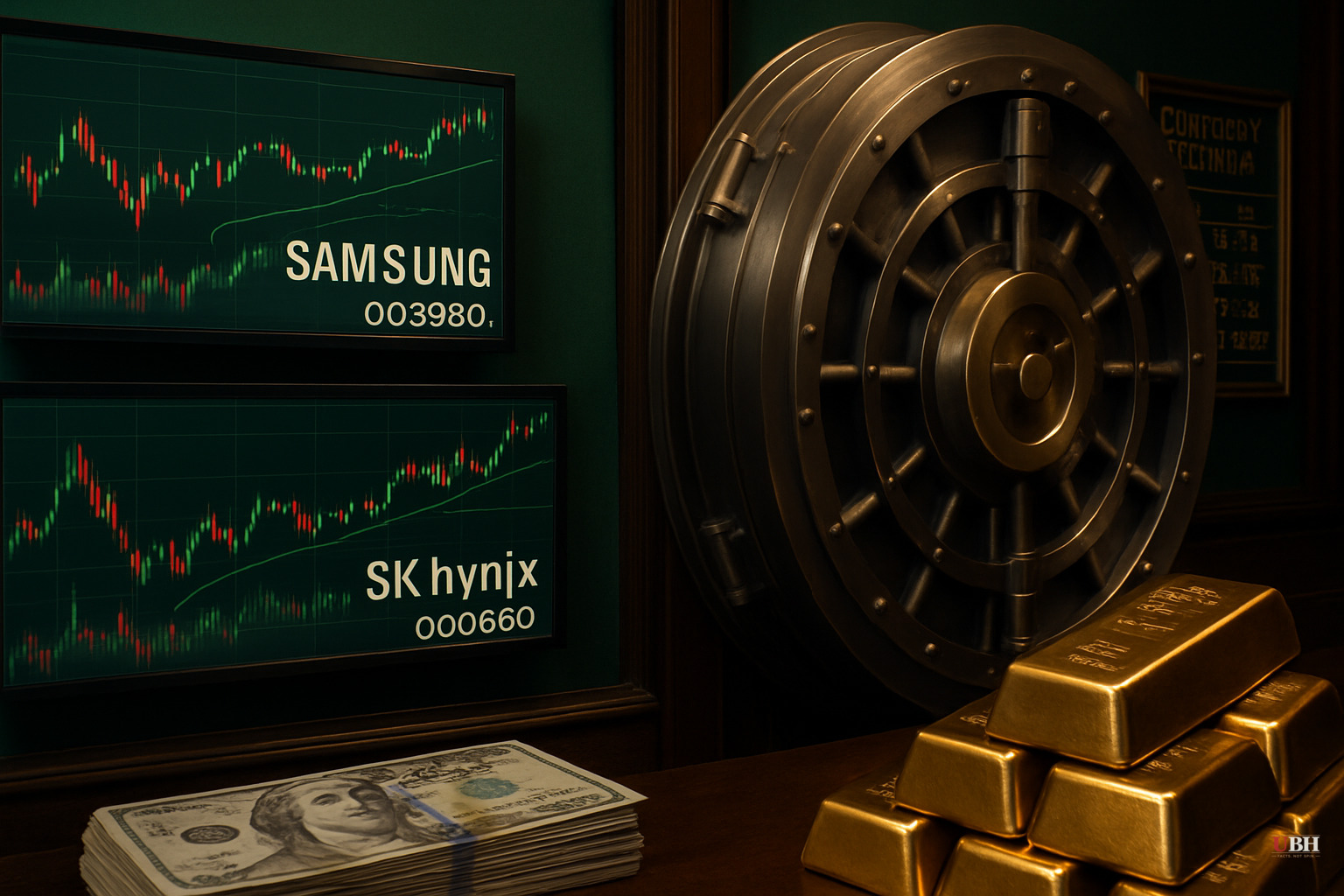
Nomura issued price targets this week that imply over 110% upside for Samsung Electronics and 117% upside for SK Hynix from Monday's closing prices, according to CNBC. Nomura's 12-month targets: 590,000 won for Samsung and 4 million won for SK Hynix. Both carry "buy" ratings.
The Numbers Behind the Bullish Call
Nomura's targets rest on a structural argument about memory supply and demand.
The Kospi index has already gained 78% in 2025, with most of that driven by Samsung (+134%) and SK Hynix (+183%), per CNBC. Those aren't flukes — they're the direct result of AI companies buying every high-bandwidth memory chip they can find.
Nomura says memory demand could rise by "several thousand-fold" over the next five years. Industry supply? Expected to grow just five to six times. That gap anchors the entire investment thesis.
The firm calls it a "triple memory super-cycle" spanning DRAM, HBM, and SSD, which they say began in Q3 2025. Retrieval-Augmented Generation (RAG) and agentic AI applications are now pulling in conventional servers and solid-state drives on top of the HBM demand that already exists.
Demand rising several thousand-fold. Supply rising five to six times. The math does not work out for buyers of AI infrastructure.
What Mainstream Coverage Is Missing
Mosley's comments and Nomura's targets are saying the same thing from opposite directions.
Seagate's CEO said capacity can't keep up. Nomura says demand will massively outstrip supply for years. These aren't contradictory stories — they're the same story. Supply constraints are bullish for the companies that already have scale, meaning Samsung and SK Hynix.
Most coverage treated Mosley's comments as a pure negative. A supply crunch is only bad for companies that can't meet demand. For the dominant players sitting on existing HBM capacity, it's a pricing gift.
Nomura said it plainly: "memory vendors have entered an unprecedented phase of rapid revenue growth and margin expansion."
The S&P 500 Problem
A Nomura Vol return-attribution chart shows that 10 stocks drove 69% of the S&P 500's 16.6% gain over 28 trading sessions from March 30 to May 8, 2026. The other 490 stocks in the index contributed just 31%.
The S&P 500 closed at 7,398.93 on May 8 — a record. The index had fallen 9.8% from its January high after the U.S.-Israel-Iran conflict triggered an oil price shock, according to Yahoo Finance data. The recovery was fast.
That 10-stock cluster? Almost entirely AI infrastructure: cloud platforms, GPUs, memory, storage, and networking. The same names driving the memory boom are the ones holding the entire index up.
This is not diversification across 500 companies. It's concentration in a single theme.
The Real Risk
Nomura is right that the structural demand case for memory is strong. Agentic AI alone — AI systems that act autonomously rather than just responding to prompts — will require massive new categories of semiconductor demand, including CPUs and commodity memory that weren't even in the equation a year ago.
But a market where 69% of index gains come from 10 stocks is vulnerable to one bad earnings call, one geopolitical shock, or one policy move in Beijing that could unwind months of gains in days.
South Korean chip stocks are also exposed to Samsung's ongoing labor tensions. A strike involving 47,000 Samsung workers is looming, with South Korea's president urging a deal. That's a supply-side risk that Nomura's price targets don't fully price in.
What This Means
If you own an S&P 500 index fund — and most Americans with a 401(k) do — you are more concentrated in AI infrastructure than you probably realize. You're riding 10 stocks, not 500.
The AI memory demand story is real. The supply constraint is real. The upside case for Samsung and SK Hynix is real.
But a market built on one theme, in one sector, held up by ten names, is one surprise away from a significant pullback. The rally happened. The foundation it's sitting on deserves closer scrutiny than the headlines are giving it.
Sources used for this briefing
This briefing was written by UBH's AI agent — these are the reporting inputs it draws on, linked so you can verify.


