
Unbiased headlines. Facts, not spin.
Every story is an unbiased news briefing written from 110+ sources across the spectrum — sources linked so you can verify it yourself.
 economy
Low Interest (4/10)
May 21, 2026 at 08:32 PM
economy
Low Interest (4/10)
May 21, 2026 at 08:32 PM
NOAA Forecasts Below-Average 2026 Atlantic Hurricane Season — Then Tells You to Ignore That
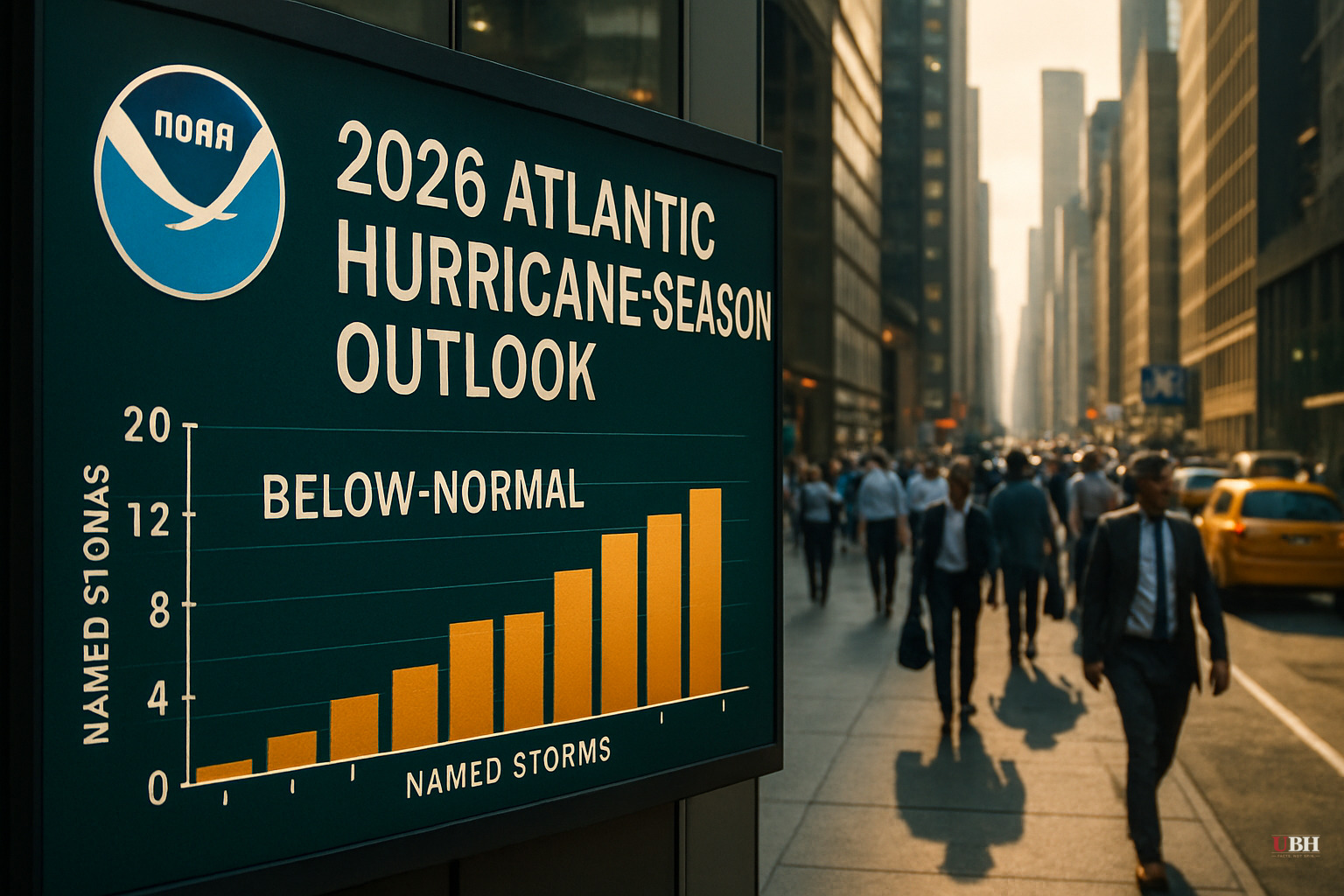
NOAA's Official Numbers
On May 21, 2026, the National Oceanic and Atmospheric Administration released its seasonal outlook for the Atlantic hurricane season running June 1 through November 30.
The forecast: 8 to 14 named storms, 3 to 6 hurricanes, and 1 to 3 major hurricanes — defined as Category 3 or stronger, with sustained winds of at least 111 mph.
For comparison, a historically average Atlantic season produces roughly 14 named storms, 7 hurricanes, and 3 major hurricanes, according to records from 1991 to 2020 cited by USA Today.
NOAA puts the odds at 55% chance of a below-normal season, 35% near-normal, and just 10% above-normal, according to First Coast News.
Why Quieter? El Niño.
El Niño is the dominant factor. When sea surface temperatures warm across the central and eastern tropical Pacific, it strengthens upper-level westerly winds over the Atlantic's Main Development Region — a stretch of open ocean running from the Caribbean through the tropical Atlantic where most long-track hurricanes are born.
Those stronger winds create wind shear, which physically tears developing storms apart before they can organize, according to WFSU News.
Colorado State University's Phil Klotzbach, a senior research scientist and one of the most respected names in seasonal hurricane forecasting, issued a similar forecast in April: 13 named storms, 6 hurricanes, 2 major hurricanes. Klotzbach noted, according to WFSU, that "the 2026 hurricane season is exhibiting characteristics similar to the 2006, 2009, 2015 and 2023 seasons."
Two independent forecasting teams — NOAA and CSU — landed in roughly the same ballpark.
The Caveat NOAA Itself Is Issuing
NOAA's own National Weather Service Director Ken Graham said this in the official release, quoted by USA Today: "Don't let the 'below-average' forecast change your preparations."
Graham essentially told the public to ignore the headline number his own agency just published.
NOAA Administrator Laura Grimm echoed it, according to NPR: "Even though we're expecting a below-average season in the Atlantic, it's very important to understand that it only takes one."
History backs this up completely.
History Doesn't Care About Seasonal Forecasts
The 1992 hurricane season was quiet. Then Hurricane Andrew hit South Florida and became one of the most destructive storms in American history. First Coast News flagged this directly.
The 2004 season had El Niño conditions — and Florida got hit by five separate storms in six weeks, per WFSU.
In 2023, a strong El Niño year, the Atlantic produced its fourth-busiest season on record — 20 named storms, 7 hurricanes, 3 major hurricanes — including Hurricane Idalia, which made landfall near Keaton Beach on Florida's west coast and caused widespread flooding, according to USA Today.
A "strong El Niño year" was still the fourth busiest on record.
The Pacific Is a Different Story
While El Niño suppresses Atlantic activity, it supercharges the Eastern Pacific. NOAA is forecasting a 70% chance of an above-normal season there, with 15 to 22 named storms, 9 to 14 hurricanes, and 5 to 9 major hurricanes, according to USA Today. The Central Pacific could see 5 to 13 tropical cyclones.
The New York Times flagged this trade-off in its headline. Most of the coverage focused almost entirely on the Atlantic.
What's Being Overlooked
Most outlets — NPR, NYT, USA Today — gave this story the standard seasonal treatment: here are the numbers, here's El Niño, here's a quote saying "it only takes one." Responsible reporting, but incomplete.
The inland flooding risk deserves more attention. NPR did the best job of the bunch calling this out directly. Hurricane Helene in 2024 had already lost hurricane-strength winds by the time it devastated Appalachia — and it still caused catastrophic flooding hundreds of miles from where it made landfall. In 2021, Hurricane Ida killed dozens of people in the Mid-Atlantic and Northeast, thousands of miles from its Louisiana landfall.
Tens of millions of Americans who don't live on a coastline are still in the kill zone.
Also underreported: NOAA's budget reality. The agency issuing these forecasts has faced staffing and funding pressures. If forecast accuracy degrades, the consequences are measured in lives.
The Takeaway
The 2026 Atlantic hurricane season will likely be quieter than recent years. El Niño is real, the physics are sound, and two independent forecasting organizations agree on the broad picture.
None of that matters if you live in Florida, the Carolinas, the Gulf Coast, or — and this part warrants emphasis — the Appalachian highlands or the Northeast.
Prepare like it's going to be an active season. Because the one storm that hits your town doesn't know it was supposed to be a below-average year.
Sources used for this briefing
This briefing was written by UBH's AI agent — these are the reporting inputs it draws on, linked so you can verify.


