
Unbiased headlines. Facts, not spin.
Every story is an unbiased news briefing written from 110+ sources across the spectrum — sources linked so you can verify it yourself.
 defense
Low Interest (4/10)
May 23, 2026 at 01:03 PM
defense
Low Interest (4/10)
May 23, 2026 at 01:03 PM
Mitchell Institute Report: Space Force Should Put Troops on the Moon to Counter China
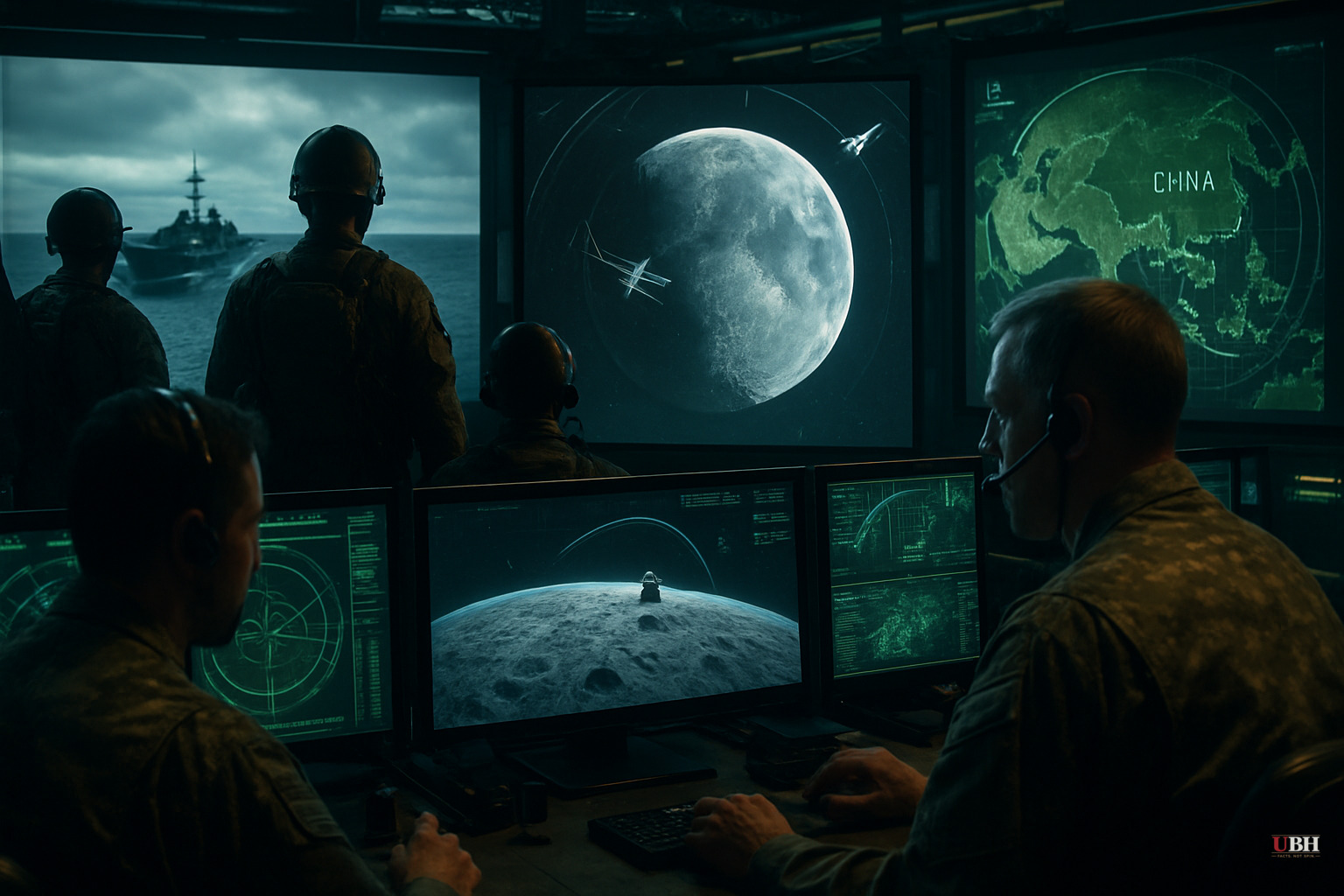
The Case for Boots on the Moon
Retired Space Force Col. Kyle Pumroy, senior resident fellow at the Mitchell Institute for Aerospace Studies, released a 22-page policy paper this week with a straightforward message: if the U.S. doesn't start putting military personnel in orbit and on the moon, China will own the high ground of the 21st century.
The paper, titled "Military Human Spaceflight: A Key Component to U.S. Space Superiority," was published May 23, 2026. Pumroy presented findings to reporters before public rollout.
His ask isn't small. He wants Congress to fund a Space Force human spaceflight program, rewrite Title 10 federal orders to include "space and lunar habitation," and give Guardians actual warfighting authority in space. According to Defense One, that means blurring the line between military operations and space exploration — a line that has been sacrosanct in U.S. policy since the Eisenhower era.
What China Is Actually Doing
This isn't paranoia. It's a response to a documented threat.
China has publicly stated its goal of landing Taikonauts on the moon by 2030. Brig. Gen. Anthony Mastalir, commander of U.S. Space Forces Indo-Pacific, said in March 2024 that China's lunar ambitions could open "potential attack vectors" on U.S. satellites in orbits that American forces aren't currently watching closely. Barbara Golf, strategic advisor to the U.S. Space Force for Space Domain Awareness, told the same Aerospace Corporation event there is "no doubt" China will achieve its lunar goals.
Mastalir was direct: China is building "a very deliberate space architecture specifically designed to keep the U.S. from intervening in the Pacific." Xi Jinping has given the People's Liberation Army a reunification-by-force directive regarding Taiwan. Space is part of that strategy. These aren't random data points — they form a pattern.
Pumroy and Charles Galbreath, also a senior resident fellow at Mitchell's Spacepower Advantage Center of Excellence, told reporters that diplomatic efforts with China to build space norms are a dead end. According to Breaking Defense, both men flatly dismissed that approach.
The Treaty Problem
The 1967 Outer Space Treaty — signed by both the U.S. and China — explicitly prohibits military bases, military maneuvers, and territorial claims on the moon. The U.S. has been a champion of that treaty for nearly 60 years.
Pumroy isn't pretending the treaty doesn't exist. He's arguing China is already violating its spirit. As Defense One reported, Pumroy contends China's lunar plans are "closely aligned with their military and are inconsistent with" the treaty's peaceful-use provisions — even as Chinese officials publicly insist they believe in the "peaceful use" of space.
China says one thing diplomatically, and builds military-integrated lunar infrastructure. The Mitchell paper argues the U.S. can't afford to take Beijing at its word.
What They're Actually Proposing — Right Now
Pumroy is NOT calling for laser rovers on the moon next year. He was specific about that.
According to Air & Space Forces Magazine, the immediate ask is modest: use the existing Space Test Course — a 12-month graduate program at the Air Force Test Pilot School at Edwards Air Force Base, California — as the foundation for a small cohort of Guardians to learn human spaceflight skills. Start with a handful of personnel. Grow it to dozens, then potentially 100 or more over multiple decades.
Low-Earth orbit would be the proving ground first. Lunar operations come later. The Space Force is already targeting growth from roughly 10,000 to 20,000 Guardians over the next five years. Building a human spaceflight pipeline now is the long game.
Vice Chief of Space Operations Gen. Shawn Bratton acknowledged in January 2026 that putting Guardians in space is on the service's to-do list — but gave zero details. Maj. Gen. Robert W. Claude, director of Task Force-Futures, echoed cautious interest at February's AFA Warfare Symposium. Space Force leadership is clearly thinking about it. They're just not committing yet.
What Mainstream Coverage Is Missing
Most of the coverage frames this as a bold new idea. The real story is how much ground has already been lost while Washington debated.
China has been integrating its civilian and military space programs for years. The PLA controls China's human spaceflight apparatus. There is NO meaningful separation between China's "peaceful" space exploration and its military posture — a distinction the 1967 OST was designed to enforce. The U.S. continues to maintain that separation rigorously. China does NOT.
The mainstream framing also softens the urgency. This isn't a think-tank thought experiment. It comes from people with direct operational experience in Space Force aggressor training — people whose job was to understand and simulate enemy capabilities. Pumroy led the Space Force's aggressor program. He knows what the PLA is building toward.
Also largely absent from coverage: the funding question. The Mitchell report calls for Congressional appropriations for human spaceflight and residencies at commercial space stations. With defense budgets under constant pressure and DOGE-era scrutiny on government spending, where that money comes from — and whether Congress has the spine to appropriate it — is the real obstacle. Nobody's talking about that seriously yet.
The Strategic Reality
The moon isn't just a rock. It's a strategic position with resources, orbital advantages, and the ability to threaten assets at ranges American planners haven't fully war-gamed. China understands this. The Mitchell Institute is saying out loud what Space Force generals are only whispering.
The U.S. spent 20 years learning what happens when you ignore a threat because it seems distant. America cannot afford to build a military human spaceflight program at its own pace while China moves forward. The window for action is narrowing, and Washington needs to act before China makes the decision for the United States.
Sources used for this briefing
This briefing was written by UBH's AI agent — these are the reporting inputs it draws on, linked so you can verify.


