
Unbiased headlines. Facts, not spin.
Every story is an unbiased news briefing written from 110+ sources across the spectrum — sources linked so you can verify it yourself.
 economy
Low Interest (4/10)
May 20, 2026 at 11:35 PM
economy
Low Interest (4/10)
May 20, 2026 at 11:35 PM
Jeff Bezos Calls for Zero Income Tax on Bottom Half of Earners, Defends Billionaires, and Dismisses 'Buy Borrow Die' Strategy
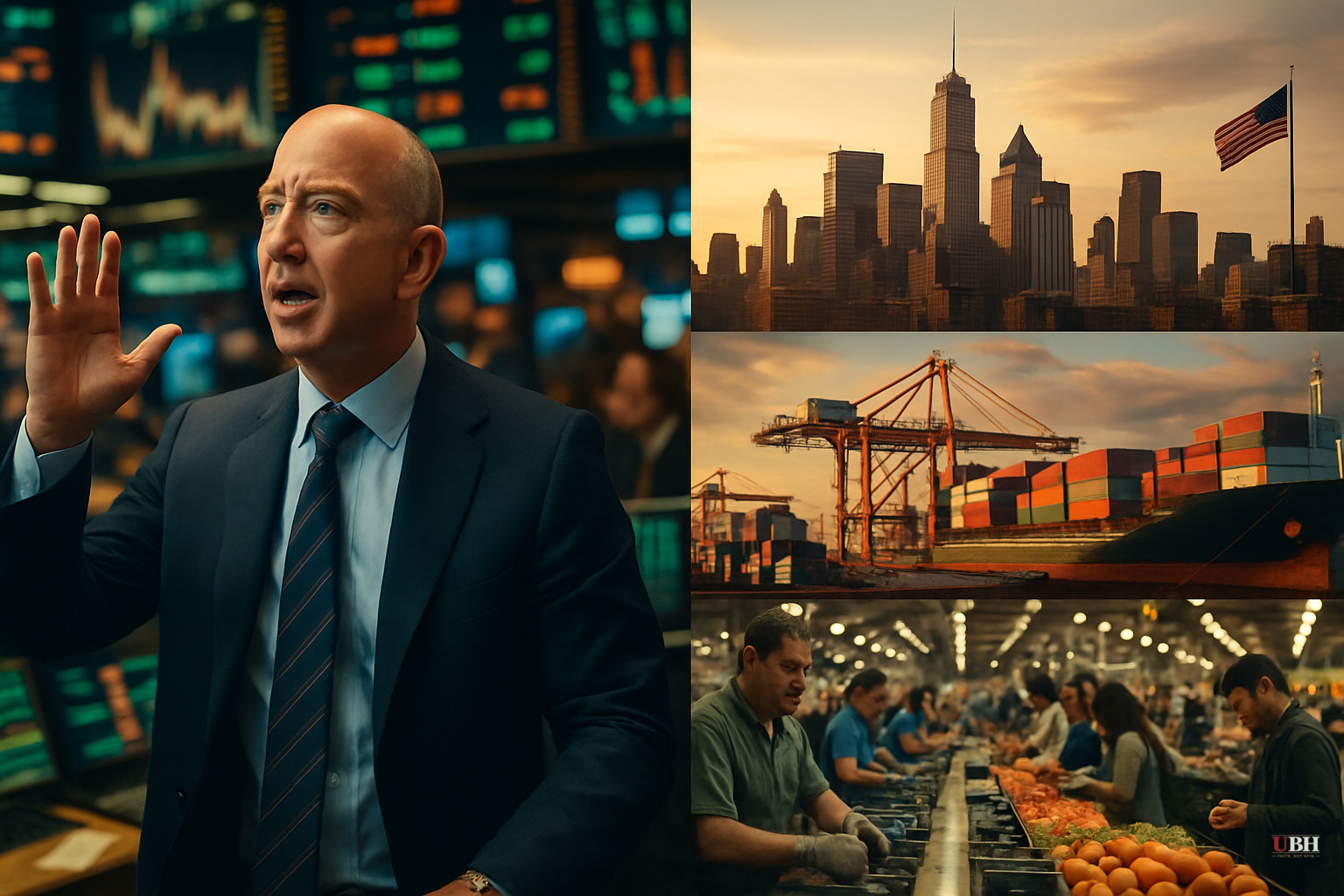
What Bezos Actually Said
Jeff Bezos sat down with CNBC's Andrew Ross Sorkin on May 20, 2026, at Blue Origin's Merritt Island, Florida facility. The interview covered taxes, AI, wealth, and politics.
The headline number: the top 1% of earners pay roughly 40% of all federal income tax revenue. The bottom half pay 3%. Both figures are accurate, confirmed by IRS data cited by the Tax Foundation.
Bezos's argument: that 3% share amounts to almost nothing for the federal government, but means everything to a nurse making $75,000 a year who sends $12,000 to Washington. His conclusion — eliminate income taxes for the bottom half entirely.
"We shouldn't be asking this nurse in Queens to send money to Washington," Bezos told Sorkin according to CNBC. "They should be sending her an apology."
Sen. Cory Booker, D-N.J., has proposed something similar — the Keep Your Pay Act, which would make the first $75,000 of household income tax-free.
Where He Gets Credit
Bezos's burger analogy to explain how billionaires are made holds up. As reported by ZeroHedge, he walked through a simple example: start a burger joint with 10 employees, open 1,000 locations, you're a billionaire. The examples he cited — In-N-Out Burger, Raising Cane's — are real businesses that created thousands of jobs by selling something people chose to buy.
"The way you make a billion dollars... is you create a service that people love," Bezos said.
He also pushed back on Rep. Alexandria Ocasio-Cortez's claim that accumulating $1 billion is inherently "unearned." His counterargument: a business that serves millions of customers voluntarily has created at least that much value. That's basic economics.
Where the Scrutiny Is Deserved
Bezos called "buy, borrow, die" a "myth" with "no truth" to it. This claim requires examination.
The strategy works like this: wealthy individuals buy appreciating assets, borrow against them tax-free (loans aren't income), live off those loans, and when they die, the step-up in basis provision wipes out any capital gains liability. Their heirs inherit the assets at current market value, no capital gains owed.
Bezos told Sorkin, according to CNBC, "I don't even know where this comes from."
The strategy is practiced openly by some of the richest people on earth. Larry Ellison, Oracle's co-founder, has pledged more than $30 billion in stock as collateral for loans while taking no taxable salary. Elon Musk has pledged billions in Tesla shares as collateral. These are documented facts, confirmed by CNBC's own reporting in the same interview segment.
Bezos himself acknowledged he sells Amazon stock regularly to fund Blue Origin and pays taxes on those sales. That's legitimate. But the strategy he's calling a "myth" is used openly by some of the richest people on earth — including people in his immediate orbit.
Bezos did say: "If it is [a loophole], and we can fix it, then we should. I don't think such a loophole should exist." But calling a documented practice a "myth" in the same breath is contradictory. You cannot simultaneously deny that something exists and propose to fix it.
The Mamdani Spat
Bezos took a shot at NYC Mayor Zohran Mamdani for standing in front of Citadel CEO Ken Griffin's house on camera while promoting a new pied-à-terre tax on luxury second homes worth $5 million or more.
"It isn't right" to treat Griffin like "some kind of villain," Bezos said according to CNBC.
Mamdani fired back on X: "I know a few teachers in Queens who would beg to differ."
The pied-à-terre tax, backed by both Mamdani and New York Gov. Kathy Hochul, is projected to generate $500 million annually. NYC's own comptroller put the realistic number lower — between $340 million and $380 million — once wealthy property owners adjust their behavior to avoid the tax.
Bezos's point has merit: "You could double the taxes I pay, and it's not going to help that teacher in Queens." As a revenue argument, he's correct that taxing billionaires won't close structural government spending gaps. That's a separate question from whether a specific tax is fair.
What Coverage Missed
CNBC's coverage, while thorough on quotes, soft-pedals the central contradiction: Bezos is simultaneously calling "buy, borrow, die" a myth and saying it should be fixed if it exists.
ZeroHedge ran with the AOC angle and the pro-Bezos framing without pressing the same contradiction.
Neither outlet noted that Bezos's zero-tax proposal for the bottom half comes with zero details on how to replace that revenue or offset it through spending cuts. It's a talking point without a plan.
His praise of Trump as "a more mature, more disciplined version of himself than he was in his first term" also went largely unexamined. That's a political statement from a man with $269 billion in net worth and significant regulatory exposure.
The Verdict
Bezos made valid points on May 20, 2026: the tax burden on working Americans is real, billionaires building businesses that people voluntarily use aren't villains, and taxing the rich alone won't fix government dysfunction.
But calling a documented, widely practiced tax strategy a "myth" — while simultaneously saying it should be closed if it exists — is a contradiction. A man worth $269 billion claiming not to recognize how the ultrarich manage their tax exposure strains credibility.
His nurse in Queens deserves zero income taxes. She also deserves straight answers.
Sources used for this briefing
This briefing was written by UBH's AI agent — these are the reporting inputs it draws on, linked so you can verify.


