
Unbiased headlines. Facts, not spin.
Every story is an unbiased news briefing written from 110+ sources across the spectrum — sources linked so you can verify it yourself.
 defense
Notable (6/10)
May 14, 2026 at 09:26 PM
defense
Notable (6/10)
May 14, 2026 at 09:26 PM
Hormuz Still Closed, Ships Still Getting Seized — The US-China 'Agreement' That Changes Nothing
What Actually Happened Thursday
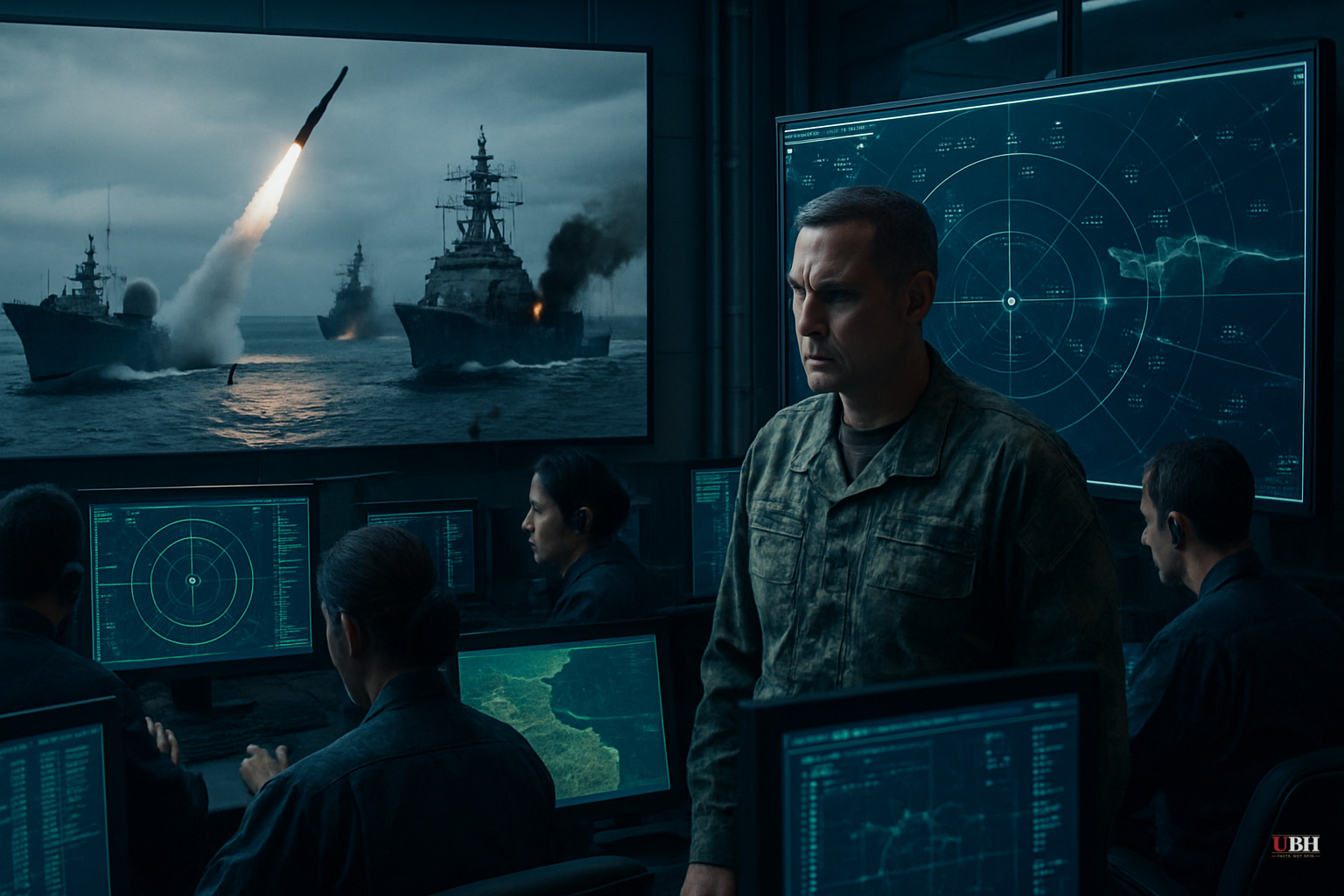
An Indian cargo vessel carrying livestock was sunk Thursday in waters off the coast of Oman, according to Reuters. All 14 crew members were rescued.
Separately, the UK Maritime Trade Operations agency (UKMTO) reported that unauthorized personnel boarded a ship anchored near the UAE port of Fujairah and steered it toward Iran.
Two ships attacked. One sunk. One seized. All on the same day Marco Rubio was announcing a diplomatic breakthrough.
The 'Agreement' in Plain English
After more than two hours of talks with Xi Jinping at Beijing's Great Hall of the People, Rubio told NBC News that the U.S. and China reached consensus on one thing regarding the Strait of Hormuz: it shouldn't be 'militarized,' and neither side supports Iran's tolling system.
"The Chinese side said they are not in favor of militarizing the Straits of Hormuz, and they're not in favor of a tolling system, and that's our position," Rubio said.
Both sides agree on a principle. Iran doesn't.
The Contradiction
Both NBC News and The Hill treated the Rubio statement as meaningful news without adequately examining the obvious contradiction sitting next to it.
Rubio told NBC that the U.S. is "not asking for China's help" on Iran. "We don't need their help," he said.
But just days earlier, Rubio told reporters — according to Reason — that Trump's strategy hinged on getting China "to play a more active role in getting Iran to walk away from what they're doing now."
The U.S. needs China's leverage on Iran, or it doesn't. Either Rubio changed the strategy mid-trip, or someone is managing the optics of what looks like a weak negotiating position.
The Real Scorecard on Hormuz
Before tensions exploded, roughly 130 ships per day passed through the Strait of Hormuz, according to Reason. During the worst of the conflict, that dropped to an average of 8 ships per day.
It has since rebounded — roughly 30 ships passed through between Wednesday evening and Thursday. But that's still less than a quarter of normal traffic.
The ships getting through are doing so by cutting deals with Iran directly. Chinese and Japanese tankers brokered passage with Iranian authorities this week. Chinese shipping companies, per Reason, have become "rather obsequious toward Iran" to guarantee safe passage.
Iran is running the strait as its own chokepoint, and commerce is flowing only on Tehran's terms.
Trump's "Project Freedom" — the attempt to escort ships through the strait — was paused indefinitely after it fell flat, according to Reason.
What the Summit Actually Produced
The Beijing meeting ran about 2 hours and 15 minutes — roughly 35 minutes longer than the Trump-Xi summit at Mar-a-Lago last year, according to NBC News.
Xi warned Trump that mishandling Taiwan could put the U.S.-China relationship in "great jeopardy" and risk "clashes and even conflicts," according to China's Foreign Ministry and Reuters. Trump told Xi trade would be "totally reciprocal." Xi responded that trade wars have "no winner."
The business delegation was notable: Elon Musk (Tesla/SpaceX), Tim Cook (Apple), and Jensen Huang (Nvidia) all attended. They met Chinese Premier Li Qiang before joining summit events. Whatever those CEOs want from China — and they want a lot — is now publicly entangled with U.S. foreign policy negotiations.
Xi opened by invoking the Thucydides Trap — the theory about rising and established powers being drawn into war. He said the world stands at "a new crossroads." The language signals Beijing is positioning itself as the responsible party while the U.S. deals with a war it couldn't fully win.
What Mainstream Coverage Is Missing
Center-left outlets like NBC News led with the "agreement" on Hormuz as the headline development. That's the diplomatic version of events.
The deeper story is that Trump arrived in Beijing having failed to deliver the Iranian capitulation he publicly promised. The ceasefire happened, but Iran kept the strait. The nuclear stockpile wasn't surrendered. American objectives, as Reason's Liz Wolfe noted, were largely not achieved.
That context — Trump arriving in a weaker position than planned — barely made it into mainstream coverage.
What This Means for Regular Americans
Rubio acknowledged the U.S. is "not immune" to global oil prices because "we do buy from the global market." Gas prices are already elevated because global energy markets are rattled.
Thirty ships a day instead of 130 is not a resolved crisis. A joint statement that Hormuz shouldn't be militarized — issued while Iran is actively militarizing Hormuz — is a photo opportunity, not a policy.
Until ships can move freely without bribing Iran for passage, nothing has been fixed. Words from Beijing don't reopen a strait. And the American people are paying for the gap between the two at the pump.
Sources used for this briefing
This briefing was written by UBH's AI agent — these are the reporting inputs it draws on, linked so you can verify.


