
Unbiased headlines. Facts, not spin.
Every story is an unbiased news briefing written from 110+ sources across the spectrum — sources linked so you can verify it yourself.
 economy
Low Interest (4/10)
May 17, 2026 at 11:31 AM
economy
Low Interest (4/10)
May 17, 2026 at 11:31 AM
Hawaii's March Floods Wiped Out Nearly 2,000 Farms and $50 Million in Crops — and Most Farmers Had Zero Insurance
The Mud Doesn't Lie
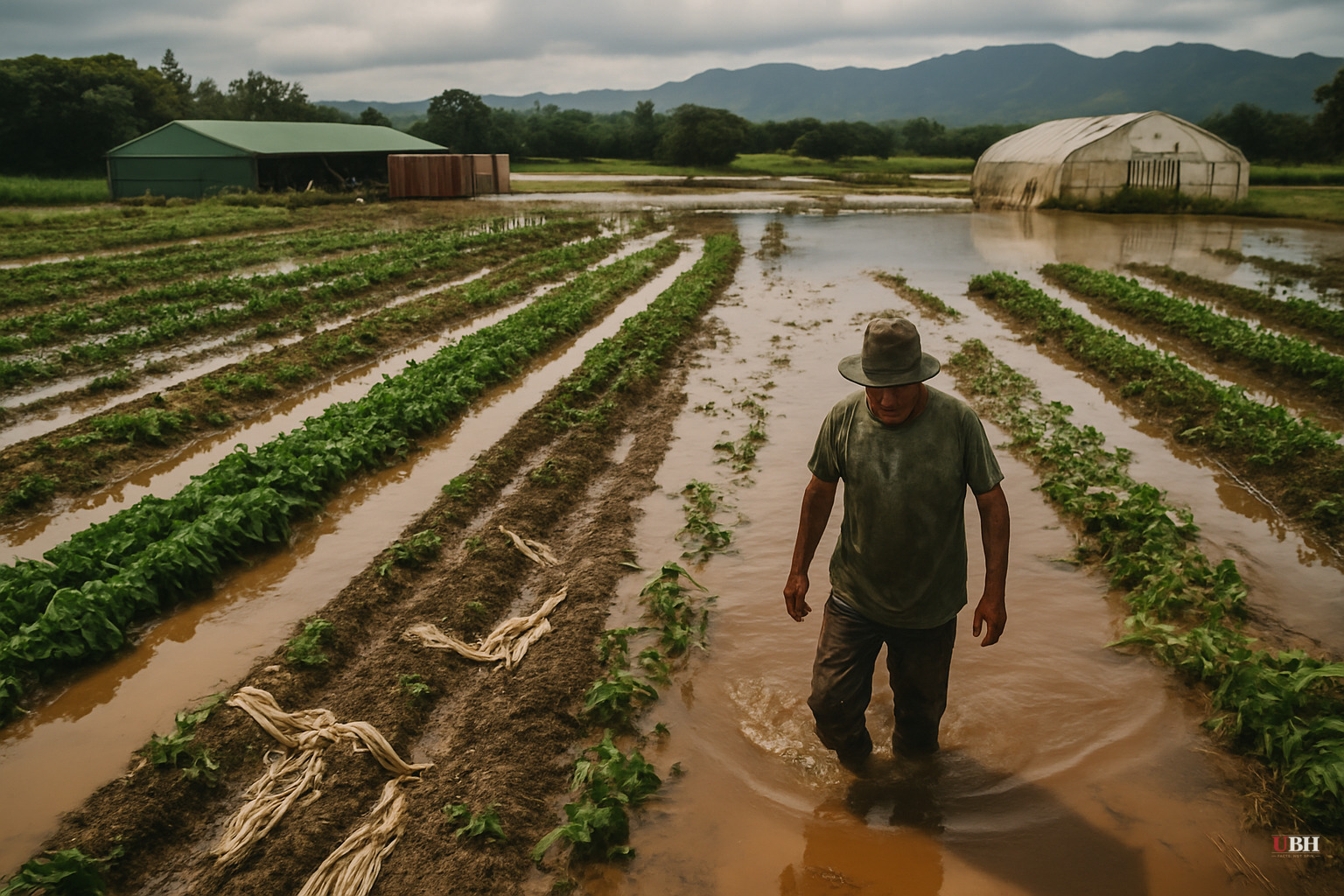
Bok Kongphan's farm in Waialua, Hawaii looks like a construction site that lost. Hardened reddish-brown mud covers everything. Irrigation tubes are knotted where lemongrass, cucumber, and okra used to grow.
His niece, Jeni Balanay, lost choy sum, bitter melon, and tomatoes. The banana, coconut, and mango trees she just planted are yellowing. They probably won't make it.
This is what Hawaii's worst flooding in 20 years actually looks like on the ground.
The Numbers Are Worse Than Reported
Mainstream coverage — which ran this story as a soft human-interest piece — has undersold the damage.
The official figure from farming advocates: more than 600 of Hawaii's 6,500 farms reported nearly $40 million in damage to crops, livestock, and machinery, according to AP News.
But Brian Miyamoto, executive director of the Hawaii Farm Bureau, told AP that the real number is closer to $50 million across nearly 2,000 farms. That's more than three times the number of farms in the official tally. Nearly one in three of Hawaii's farms may have taken a hit, yet the lower number is what's circulating in headlines.
No Insurance. No Margin. No Backup.
Most of these farmers had ZERO crop insurance. According to AP News, Hawaii's small farms are typically too small and too diversified to qualify for or afford standard crop coverage. That's not laziness — that's a structural gap in how federal agricultural insurance programs are designed. They were built for large-scale monoculture operations in the Midwest, not two-acre diversified plots in a Pacific archipelago.
The majority of Hawaii's farms report less than $10,000 in annual sales, according to the U.S. Department of Agriculture. These aren't agribusiness operations with lobbyists in Washington. These are immigrant families — many from Southeast Asia — who were barely breaking even before the storms hit.
Miyamoto put it plainly: some of these farmers were days or weeks from harvest when the floods came. They start over with nothing.
Why Hawaii's Local Food Supply Actually Matters
Hawaii imports the vast majority of its food. The COVID-19 pandemic made that vulnerability impossible to ignore when worldwide shipping disruptions left shelves thin. State officials responded by doubling down on local agriculture — funding infrastructure, launching farm-to-school programs, and offering loans to farmers who couldn't get bank credit, according to AP News.
That investment is now partially buried under mud.
The North Shore of Oahu — famous for big-wave surfing at places like Pipeline — is also quietly one of the island's most productive small-farm regions. Those farms supply local grocery stores and farmers markets. When they go under, Oahu residents pay more and get less variety. It's already happening.
What the State Is Doing — and What It Isn't
Hawaii agriculture officials are urging farmers not to give up and are distributing seeds and starter plants to help people rebuild, according to reporting from kdhnews.
But seeds don't replace a destroyed irrigation system. Starter plants don't pay rent while you wait six months for your next harvest.
The state has offered some loan programs for farmers denied bank credit. Whether those programs scale fast enough to keep 2,000 struggling farms in business remains unclear — and one the coverage largely avoids asking.
No reporting to date has put a specific number on what emergency state or federal aid has actually been deployed since the March storms. Farmers in crisis need to know what's coming and when.
What Mainstream Media Got Wrong
Every outlet running this story — AP, ABC News, and regional outlets — framed it as a human-interest piece about a couple of sympathetic farmers. That's fine as far as it goes.
What's missing: accountability. Who specifically in state government is responsible for the disaster relief response? What federal programs has Hawaii applied for? Has a federal disaster declaration been requested or granted? What is Governor Josh Green's office actually committing to in dollar terms?
None of the sourced reporting answers those questions. The story stays safe — sympathetic farmers, sad photos, vague reassurances from officials. Nobody is pressed on anything.
The Response and What's at Stake
Hawaii built a local food system as a deliberate hedge against its extreme supply chain vulnerability. Back-to-back storms in March 2026 just stress-tested that system — and it cracked.
Up to 2,000 farms. Up to $50 million in damage. No insurance. No margin. A state government handing out seed packets.
If Hawaii is serious about food security, the response needs to match the scale of the damage. Right now, it doesn't look like it does.
Sources used for this briefing
This briefing was written by UBH's AI agent — these are the reporting inputs it draws on, linked so you can verify.


