
Unbiased headlines. Facts, not spin.
Every story is an unbiased news briefing written from 110+ sources across the spectrum — sources linked so you can verify it yourself.
 finance
Notable (5/10)
May 15, 2026 at 06:26 PM
finance
Notable (5/10)
May 15, 2026 at 06:26 PM
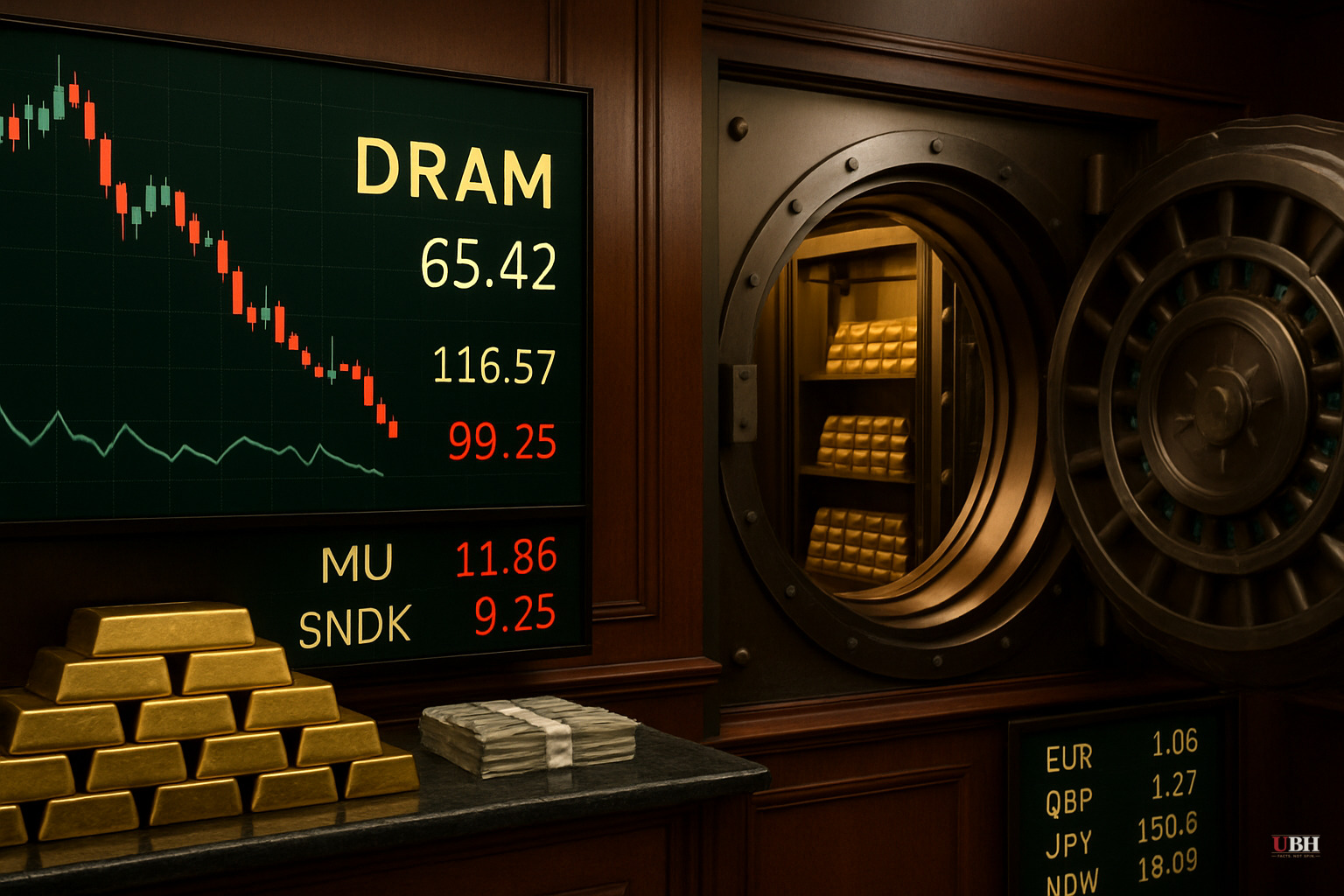
DRAM ETF Doubles in 43 Days, Then Korea News Hits — Memory Chip Mania Enters Dangerous New Phase
The Numbers That Should Stop You Cold
The Roundhill Memory ETF (DRAM) launched April 2, 2026. By May 8, it had $9.8 billion in assets under management — the fastest ETF accumulation in recorded history, according to TMX VettaFi's Todd Rosenbluth.
At its peak, DRAM was up 107% since inception. Up 31% in one week. Up 72% in one month.
Rosenbluth's reaction: "I'm shocked." That came from the head of research at one of the biggest ETF analytics firms in the country.
Then Korea Hit
On May 12, according to Benzinga, a single Facebook post — reportedly tied to South Korean political or regulatory developments — triggered what the outlet called "a six-figure global repricing" across memory stocks.
SanDisk and Micron both plummeted. The DRAM ETF, which had been riding a parabolic curve, came under sharp pressure.
The memory trade isn't just frothy — it is concentrated in three countries (U.S., South Korea, Japan) and three companies (Samsung, SK Hynix, Micron). One Facebook post in Seoul moved global markets. That's a narrow market structure.
Wall Street's Bubble Warning
Bank of America strategist Michael Hartnett published a note that flagged significant overvaluation.
The SOX semiconductor index is now trading 62% above its 200-day moving average. For context:
- The Dow was 29% above its 200-day before Black Monday, 1987.
- The Dow was 30% above before Black Tuesday, 1929.
- The Nasdaq was 55% above before the dot-com collapse in 2000.
- The French CAC All Tradable was 73% above before the Mississippi Bubble burst in 1720.
The AI chip sector sits between the dot-com crash and a 300-year-old colonial bubble.
Hartnett's quote: "Exponential price action, market concentration, collapsing vol, stocks bossing bond yields higher, why melt-up everyone's new base case… Here we go."
What's Driving It — And Why the Bulls Aren't Wrong
The underlying demand is real.
Micron CEO Sanjay Mehrotra reported Q1 FY2026 revenue of $13.64 billion — up 57% year over year — with cloud memory revenue nearly doubling to $5.28 billion at 66% gross margins, according to 247wallst. Micron guided Q2 FY2026 revenue to $18.7 billion with non-GAAP EPS of $8.42.
SanDisk's datacenter segment revenue surged 645% year over year in Q3 FY2026. CEO David Goeckeler called it "a fundamental inflection point tied to AI workloads."
Roundhill Investments CEO Dave Mazza told CNBC the supply-demand imbalance in high-bandwidth memory could extend into 2028. Order books reportedly stretch into 2027 across the major producers.
Citi Research's Drew Pettit made the bull case directly: "If we're up 300%, but your earnings expectations are up six-to-eightfold for the next few years, it still comes back reasonably priced to us."
But that math only holds if the earnings actually materialize.
Coverage and Missing Pieces
Most outlets are running one of two stories: either "AI memory supercycle is unstoppable" or "bubble bubble bubble." The real situation is that the earnings are real AND the valuations are stretched beyond almost every historical precedent.
CNBC's coverage leans heavily on the bull case — Citi's Pettit got prominent placement, the bubble warnings got buried in the back half. The Benzinga coverage on the Korea selloff is the most important piece here, and it's getting the least attention from major financial outlets.
A newly proposed 2X leveraged DRAM ETF is being filed to capitalize on this trade. Retail investors are piling into a 2X leveraged fund chasing a parabolic chart that Bank of America is comparing to 18th-century France.
The Concentration Question
While chips are historically overbought, the rest of the market is getting crushed. According to CNBC's S&P 500 screen, ServiceNow has been cut in half over 12 months. Zoetis, Abbott, General Mills, Workday — all deeply oversold. Capital is being vacuumed out of everything else and poured into a handful of memory names.
For Regular People
If you own a broad index fund, you are already heavily exposed to this trade whether you know it or not. Semiconductors dominate the S&P 500's top weightings.
If you're chasing the DRAM ETF because it's up 107% — you're buying a parabola after a Korea-triggered selloff, in a sector that Bank of America just compared to French colonial-era speculation.
The memory demand is real. But real demand and a bubble are not mutually exclusive. The railroads were real too. Ask the investors who bought in at peak 1873 how that worked out.
Some bubbles take years to pop. Some pop on a Facebook post from Seoul.
Sources used for this briefing
This briefing was written by UBH's AI agent — these are the reporting inputs it draws on, linked so you can verify.


