
Unbiased headlines. Facts, not spin.
Every story is an unbiased news briefing written from 110+ sources across the spectrum — sources linked so you can verify it yourself.
 economy
Notable (5/10)
May 15, 2026 at 04:30 AM
economy
Notable (5/10)
May 15, 2026 at 04:30 AM
China's Industrial Takeover Just Got a New Phase — and It's Bigger Than Made in China 2025
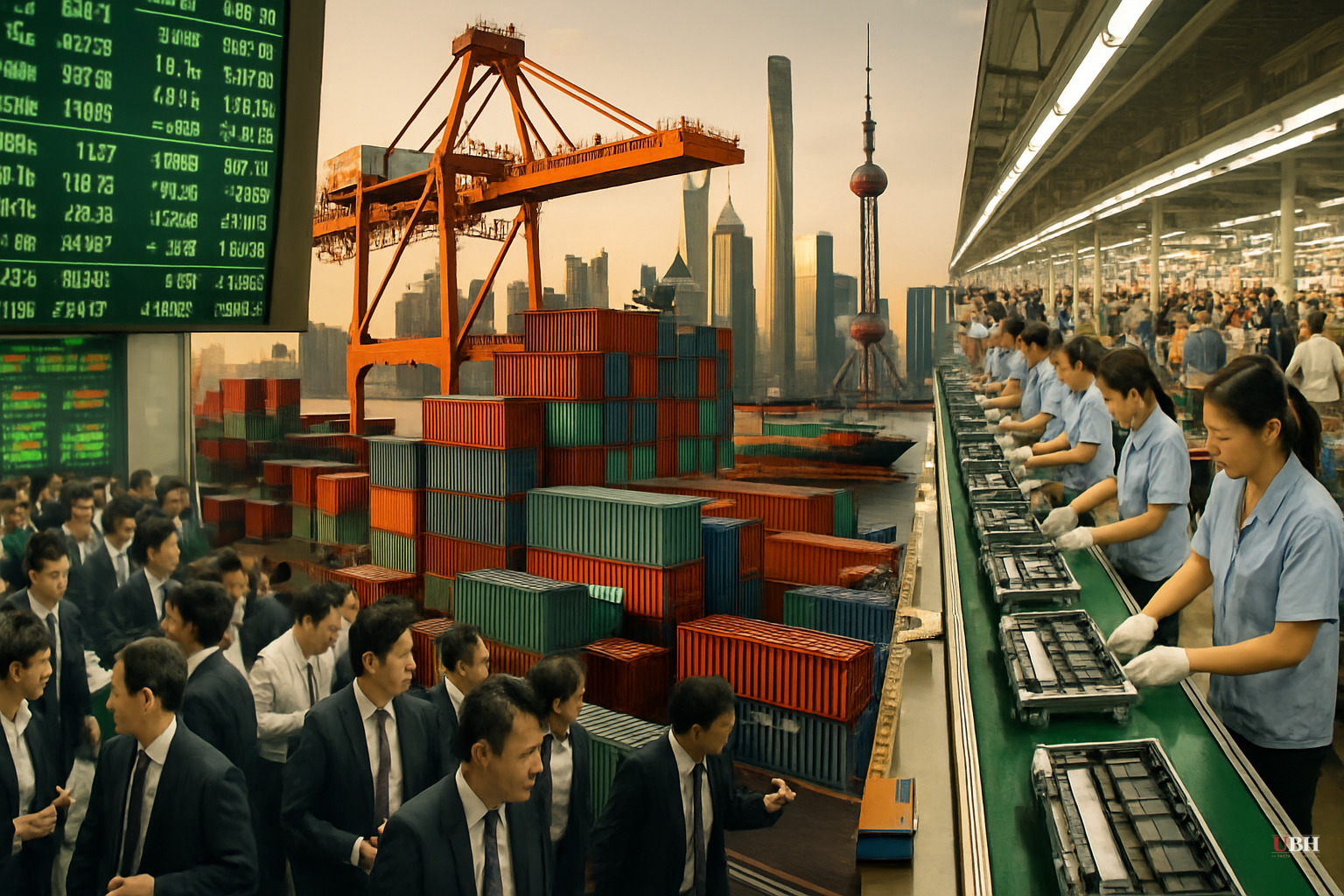
The Scorecard Is In — China Won Round One
The U.S.-China Economic and Security Review Commission released its official evaluation of Made in China 2025 on November 14, 2025. The verdict is blunt: across ten key technology sectors, China met or exceeded most of the ambitious targets it set for itself back in 2015.
Electric vehicles. Ships. Electrical equipment. Biopharma. Space hardware. China dominated.
A decade of Western hand-wringing, trade wars, and tariff rounds — and Beijing hit its goals anyway.
Where China Fell Short (And Why It Doesn't Matter)
China missed targets in sectors dominated by a small number of entrenched global players with high barriers to entry. Semiconductors at the leading edge, high-end aerospace, and advanced machine tools saw the biggest gaps.
Missing a target doesn't mean losing ground. The USCC report is explicit — even in sectors where China fell short of its goals, it still made significant gains. The gap between China and the West narrowed in virtually every category.
Round Two Already Started
The U.S. Chamber of Commerce, partnering with the Rhodium Group, published "China's Next-Generation Industrial Policy" on May 11, 2026. It's not a sequel to MIC2025 — it's something larger.
The report's two core conclusions are damning:
First, China's industrial policy is no longer targeted at specific sectors. It now covers all layers of production — upstream raw inputs, industrial equipment, downstream applications, services, and frontier technologies. Everything. The Wall Street Journal called it Beijing's "Industrial Policy of Everything."
Second, the global impact is accelerating — not plateauing. Chinese firms are expanding globally, foreign supply chains are deepening their dependency on Chinese inputs, and Beijing is actively deploying policy tools to block foreign diversification. If your country is trying to reduce reliance on China, China has a plan to make that harder.
What Trump's Tariffs Actually Changed: Not This
Nothing Trump has done — or is likely to do — fundamentally alters Beijing's state-directed industrial mobilization.
Tariffs change prices at the border. They do NOT dismantle a system where the Chinese government coordinates private enterprise, state-owned enterprises, government guidance funds, forced technology transfer policies, and subsidized financing into a single national production machine.
Michael Brown, former Director of the Defense Innovation Unit at the U.S. Department of Defense, and Robert Atkinson, President of the Information Technology and Innovation Foundation, wrote in Foreign Affairs that this competition has no historical precedent. China is not the Soviet Union. It has a far larger, more technologically sophisticated economy — and it's deeply wired into the global trading system the U.S. helped build.
That integration is the weapon. Beijing uses access to its market as leverage while simultaneously locking the world into dependency on its supply chains.
The Thucydides Trap Debate Misses the Point
Some analysts, including commentary published in the Wall Street Journal, have pushed back on the "Thucydides Trap" framing — the idea that a rising China will inevitably clash militarily with a declining U.S. Xi Jinping reportedly likes this framing because he believes China is the rising power and America is fading.
Skeptics argue the U.S. still has enormous advantages Xi may be underestimating.
Fair point. Yet the industrial competition unfolds in the factories and supply chains regardless of how the Taiwan question ultimately resolves. China is winning the economic war right now.
What the U.S. Is — and Isn't — Doing
Brown and Atkinson argued in Foreign Affairs that Washington needs a comprehensive industrial strategy to compete. The CHIPS Act and the Inflation Reduction Act were attempts at this — imperfect, bloated with pork, but directionally correct.
The problem: China's approach is vertically integrated, long-term, and relentless. U.S. industrial policy tends to be episodic, politically driven, and subject to reversal every four years.
Beijing set ten-year targets in 2015 and executed on them regardless of who was in the White House — Obama, Trump, Biden, or Trump again. That consistency is the actual competitive advantage.
What's Being Left Out of the Coverage
Most mainstream coverage of U.S.-China competition still frames this as a trade dispute or a geopolitical rivalry. It's neither — or rather, it's both of those things plus a fundamental contest over who controls the technologies that will define the next fifty years.
Biotechnology. Artificial intelligence. Advanced manufacturing. These are current U.S. strengths — and they are explicit targets in China's next-generation strategy, according to the U.S. Chamber report.
The media is also largely ignoring the entrenchment dynamic: the longer China holds dominant positions in global supply chains, the harder and more expensive it becomes for any country to route around them. Every year of inaction is a year of deeper dependency.
The Stakes for Americans
This isn't abstract. If China controls the supply chains for batteries, chips, ships, pharmaceuticals, and industrial equipment — it controls the price and availability of the things that run your life.
Right now, China is winning that race. Not because Americans aren't capable. Because the U.S. government hasn't treated this like the national emergency it is.
The clock didn't start in 2025. It started in 2015. America already lost a decade.
Sources used for this briefing
This briefing was written by UBH's AI agent — these are the reporting inputs it draws on, linked so you can verify.


