
Unbiased headlines. Facts, not spin.
Every story is an unbiased news briefing written from 110+ sources across the spectrum — sources linked so you can verify it yourself.
 economy
Notable (5/10)
May 16, 2026 at 02:31 AM
economy
Notable (5/10)
May 16, 2026 at 02:31 AM
China's EV Makers Are Setting Up Shop in Canada — and the First Cars Have Already Landed
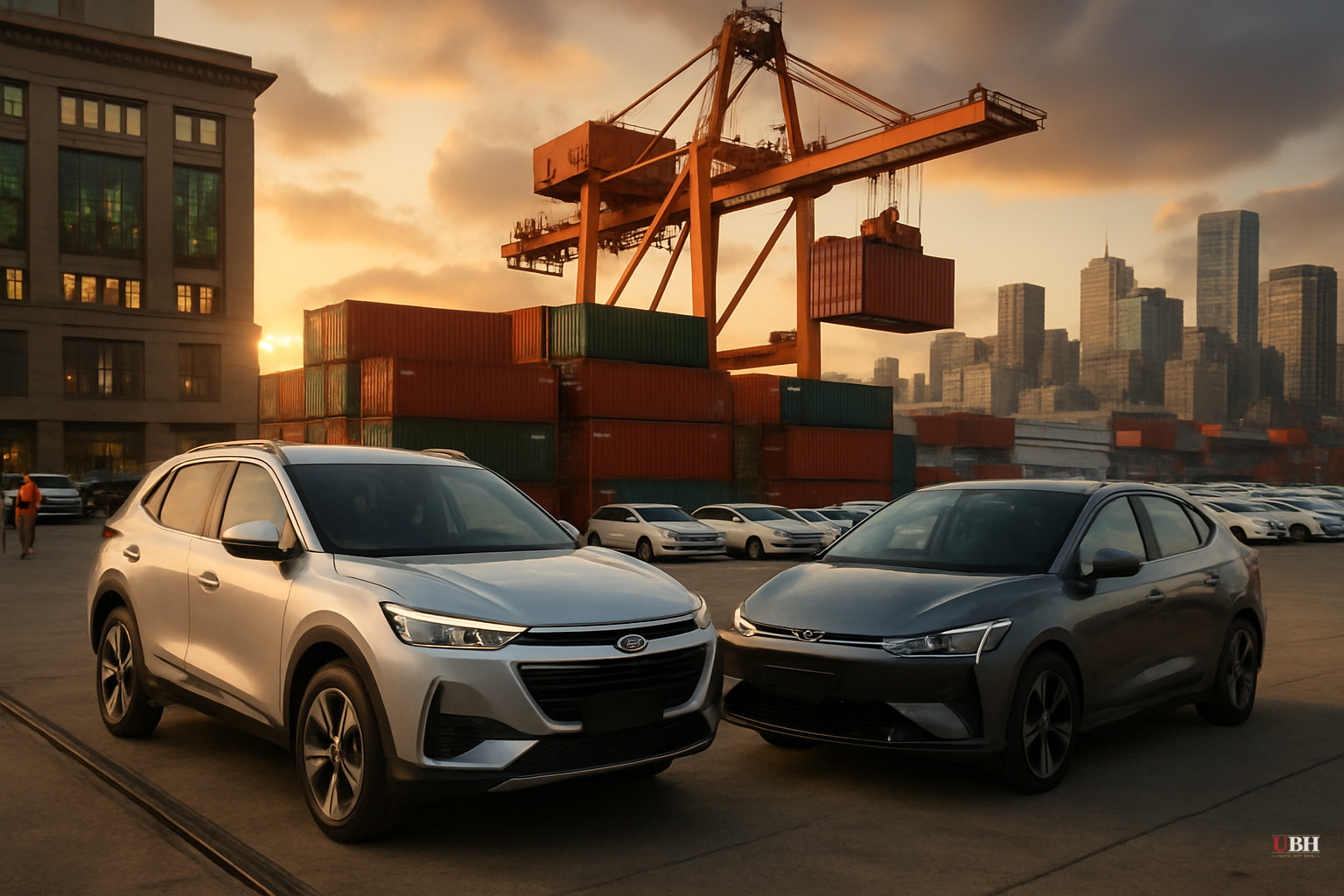
China's EVs Are Already in Canada. Here's What That Actually Means.
The debate is over. The ships have sailed.
In January 2026, Prime Minister Mark Carney's government struck a trade deal with China that slashed EV import tariffs from 100% down to 6.1% — but capped annual imports at 49,000 vehicles. That's roughly 2.5% of Canada's total new car market, according to S&P Global Mobility's Stephanie Brinley.
Small number. Big implications.
What's Already on the Ground
Chery and Geely didn't wait around. According to InsideEVs, Chery has already shipped approximately 150 vehicles to Canada — Jaecoo J5 crossovers, Omoda 9 plug-in hybrids, and Exelantis ES sedans — spotted in a Toronto parking lot earlier this month with badges taped over. These aren't for sale yet. They're for certification testing and test drive programs.
Geely's luxury brand Lotus shipped 18 Eletre electric SUVs — the first batch under the new trade framework — and has already cleared Canada Motor Vehicle Safety Standards certification. Six Lotus dealerships opened in March. Six more are coming by year's end.
Electrek reported that Geely has posted six senior leadership roles in Toronto, covering sales, marketing, legal, and network development. BYD is hunting for 20 dealership locations across Canada in its first year, with three spots already in discussion in the Greater Toronto Area, plus planned expansions to Vancouver, Montreal, and Calgary.
Chery has filed Canadian trademark applications for Exeed, iCar, Jaecoo, Lepas, Luxeed, and Omoda. According to Electrek, Chery began recruiting Canadian staff back in January — the same month the deal was signed.
These companies are not dabbling. They are building permanent infrastructure.
The Quota Details Mainstream Coverage Is Glossing Over
Most headlines skip over several crucial details. The 49,000-unit quota grows 6.5% annually, reaching 70,000 units by 2030, per MotorTrend. That's still under 3% of the Canadian market — for now.
The $35,000 Canadian (roughly $26,000 U.S.) price cap that was supposed to ensure affordability doesn't kick in until 2027. Right now, luxury vehicles like the Lotus Eletre — which retails well above that threshold — can enter freely. The price requirement phases in gradually: 10% of imports must be under $35,000 in 2027, rising to 50% by 2030.
That's a slow ramp, not a wall.
Also buried: according to Electrek, the 49,000-unit figure wasn't arbitrary. It was based on how many Chinese-built EVs — almost entirely Tesla and Polestar vehicles — Canada was already importing before the 100% surtaxes hit in 2024. So the biggest winners of the new quota system, at least right now, are Tesla and Polestar, not BYD.
What Australia Teaches
MotorTrend reported something that should concern Ottawa: in Australia, which has almost zero tariffs or regulatory barriers on Chinese vehicles, Chinese-made cars now account for nearly one in four new vehicles sold. They passed Japan — Japan, which had been Australia's top auto supplier for decades — in February of this year. Among EVs specifically, 80% are Chinese imports.
Australia went from under 2% Chinese market share to 25% in just a few years.
Canada's quotas and phased price caps are a direct attempt to avoid that outcome. Whether they're tight enough is a legitimate debate. Whether the political will exists to hold the line as Chinese automakers entrench themselves — that's an even more legitimate question.
The American Reaction
Washington is furious. President Trump called Canada's decision "a disaster." U.S. Transportation Secretary Sean Duffy posted on X that "Canada will live to regret the day they let the Chinese Communist Party flood North America with their EVs," according to CNBC.
Trump's anger is understandable from a trade-war standpoint. The U.S. has 100% tariffs on Chinese EVs precisely to keep them out. Canada just opened a side door — a small one, but a door. Chinese automakers have explicitly said, per CNBC, that Canada gives them "a foothold in the North American market." That's their stated goal.
The Canadian Industry Isn't Happy Either
The Canadian Vehicle Manufacturers' Association called the decision "deeply concerning," according to CNBC. General Motors, Ford, Toyota, and Hyundai currently dominate Canadian sales, which topped 1.9 million vehicles last year.
But some dealers see opportunity. Michael MacGillivray, CEO of Century Auto Group and Sigma Auto Group, oversees 10 dealerships in Nova Scotia and New Brunswick. He went to the Beijing Auto Show in April to scout Chinese brands and told CNBC he was "very impressed" by the vehicles — materials, styling, ride quality. He wants to sell them.
Farid Ahmad, CEO of auto dealership broker DSMA in suburban Toronto, told CNBC his firm received nearly 400 dealer inquiries from across Canada eager to represent Chinese brands.
The market wants them. Whether that's good for Canadian manufacturing jobs is a different conversation entirely.
What Comes Next
Canada is threading a needle — trying to bring cheaper EVs to consumers while protecting domestic auto jobs and avoiding Australia's cautionary tale. The guardrails are real but they're not permanent, and Chinese automakers are playing a long game.
BYD building dealerships today is BYD building market share tomorrow. The quota grows every year. The price caps phase in slowly. And the companies landing these cars are the same ones that went from zero to owning 25% of Australia's market in a few years.
Canada made a calculated bet. The first chips are on the table. We'll know in five years whether Ottawa was smart or whether they just handed Beijing its North American beachhead.
Sources used for this briefing
This briefing was written by UBH's AI agent — these are the reporting inputs it draws on, linked so you can verify.


