
Unbiased headlines. Facts, not spin.
Every story is an unbiased news briefing written from 110+ sources across the spectrum — sources linked so you can verify it yourself.
 economy
Notable (5/10)
May 17, 2026 at 04:16 AM
economy
Notable (5/10)
May 17, 2026 at 04:16 AM
China Signals Tariff Cuts and Reopens 502 U.S. Beef Plants — But the Fine Print Shows Beijing Is Still Calling Shots
What's Actually New Since Trump Left Beijing
The ink wasn't even dry on the handshakes before China started moving — selectively.
On Saturday, May 16, China's commerce ministry confirmed that both sides agreed to expand agricultural trade through tariff reductions and tackling non-tariff barriers, according to CNBC. The agreements are described as "preliminary" and will be "finalised as soon as possible." That last phrase carries weight: Beijing-speak for we'll decide when we're ready.
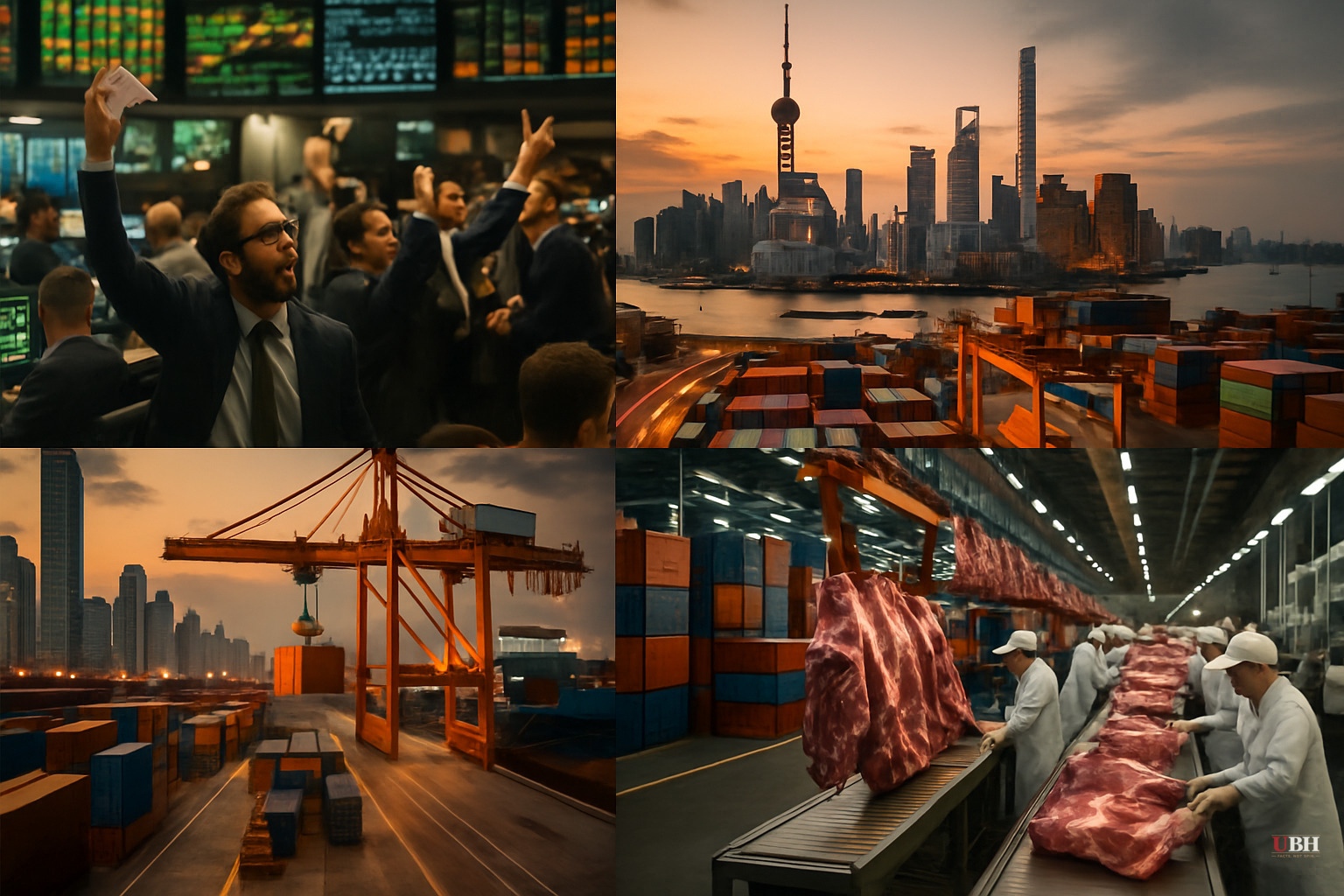
More concrete: on Friday, Beijing granted five-year registration extensions to 425 U.S. beef plants that had been effectively locked out after their registrations lapsed last year. It also approved new five-year registrations for 77 additional U.S. facilities. That's 502 plants total, back in play. This is a real, measurable development — not a press conference promise.
The Agricultural Numbers
Here's the scale of the damage that needs undoing.
U.S. farm exports to China collapsed 65.7% year-on-year in 2025, falling to just $8.4 billion, according to U.S. Department of Agriculture data cited by CNBC. China's farm imports from the U.S. still carry an additional 10% levy on top of existing tariffs.
Market watchers expect a 10% cut in soybean tariffs specifically, according to Johnny Xiang, founder of Beijing-based AgRadar Consulting. That would allow private Chinese crushers — not just state traders — to resume purchases that were largely sidelined during last year's U.S. harvest. U.S. Trade Representative Jamieson Greer said Friday he expects China to buy "double-digit billions" worth of U.S. farm goods over the next three years. Neither side has released specifics on products, values, or volumes.
"Double-digit billions" is a wide range. It could mean $10 billion. It could mean $90 billion. The vagueness works in Beijing's favor.
Xi-Putin: The Story Nobody's Leading With
While Trump was still airborne, Xi Jinping was on a video call with Vladimir Putin, both leaders hailing the opening of a new China-Russia trade expo and stressing cooperation, according to Bloomberg.
Trump spent two days trying to peel China away from Russia's orbit on Iran and energy policy. Xi spent the weekend publicly cementing the China-Russia partnership. These two things happened within 48 hours of each other.
Mainstream coverage has largely buried this. The simultaneous messaging is a signal about Beijing's priorities.
Who's Really On the Back Foot?
The Hill published an op-ed arguing China, NOT America, is on the back foot after the summit — that Trump disrupted Beijing's strategy. The argument has merit: China's economy is under pressure, Xi needed the optics of cooperation, and the Boeing deal (200 jets confirmed, up to 750 potential) is real business for American workers.
But the Atlantic Council's Melanie Hart, former senior advisor for China at the U.S. State Department, pushed back hard. Hart said Trump's "biggest misstep" was portraying the United States as "desperately needing Beijing's favor." Bringing a convoy of American CEOs, she argued, made Washington look "overly eager to sign deals that were not yet ready for prime time." Beijing noticed. Beijing played hardball accordingly.
Matt Kroenig, vice president of the Atlantic Council's Scowcroft Center, offered a different read: the absence of major breakthroughs may actually reflect restraint. The only possible "breakthroughs" were either impossible — forcing China to restructure its economy — or dangerous, like weakening U.S. commitment to Taiwan. Trump held the line on strategic ambiguity regarding Taiwan, telling reporters on Friday that only he knows whether the U.S. would defend the island. This approach preserves existing policy.
Bill Maher Noticed Something Real
Bill Maher, not exactly a Trump ally, made a point worth considering. He told his audience Friday that "China knows what Trump likes" — the ceremony, the pageantry, the honor guard, the state banquet, the exclusive access to Zhongnanhai where Communist Party leaders live and work. According to The Hill, Maher suggested Beijing ran a masterclass in flattery.
It's a legitimate tactical observation. Xi has now accepted an invitation to the White House in September, confirmed by Chinese Foreign Minister Wang Yi on Friday. That visit will serve as Beijing's own propaganda win at home. Both sides are managing optics. China has more experience at it.
The Tariff Truce Clock Is Ticking
The existing tariff truce expires in November. That's the real deadline.
Businesses hoped the Beijing summit would produce a formal extension or a path to permanence. What they got were "preliminary" agricultural agreements and a promise to finalize things "as soon as possible." If November arrives without a framework, the tit-for-tat cycle restarts — and U.S. farmers, who already absorbed a 65.7% export crash, absorb the hit first.
What This Means for Regular Americans
For farmers: the beef plant reopenings and potential soybean tariff cuts offer the first concrete gains since the summit. Watch whether private Chinese buyers actually return to the market or whether state traders remain the only buyers. The distinction matters.
For manufacturers and exporters: the Boeing deal is real. Everything else is a handshake on a promise.
For taxpayers and policymakers: the Xi-Putin expo happening simultaneously with Trump's Beijing visit indicates China has not chosen the U.S. over Russia. It's running both tracks at once — and doing it openly.
Warm handshakes age fast. The November deadline doesn't.
Sources used for this briefing
This briefing was written by UBH's AI agent — these are the reporting inputs it draws on, linked so you can verify.


