
Unbiased headlines. Facts, not spin.
Every story is an unbiased news briefing written from 110+ sources across the spectrum — sources linked so you can verify it yourself.
 tech
Notable (5/10)
May 14, 2026 at 01:15 PM
tech
Notable (5/10)
May 14, 2026 at 01:15 PM
China Published a Global AI Governance Plan. The US Released Its Own Three Days Earlier. Neither Side Is Being Straight With You.
Two Plans, Three Days Apart — Not a Coincidence
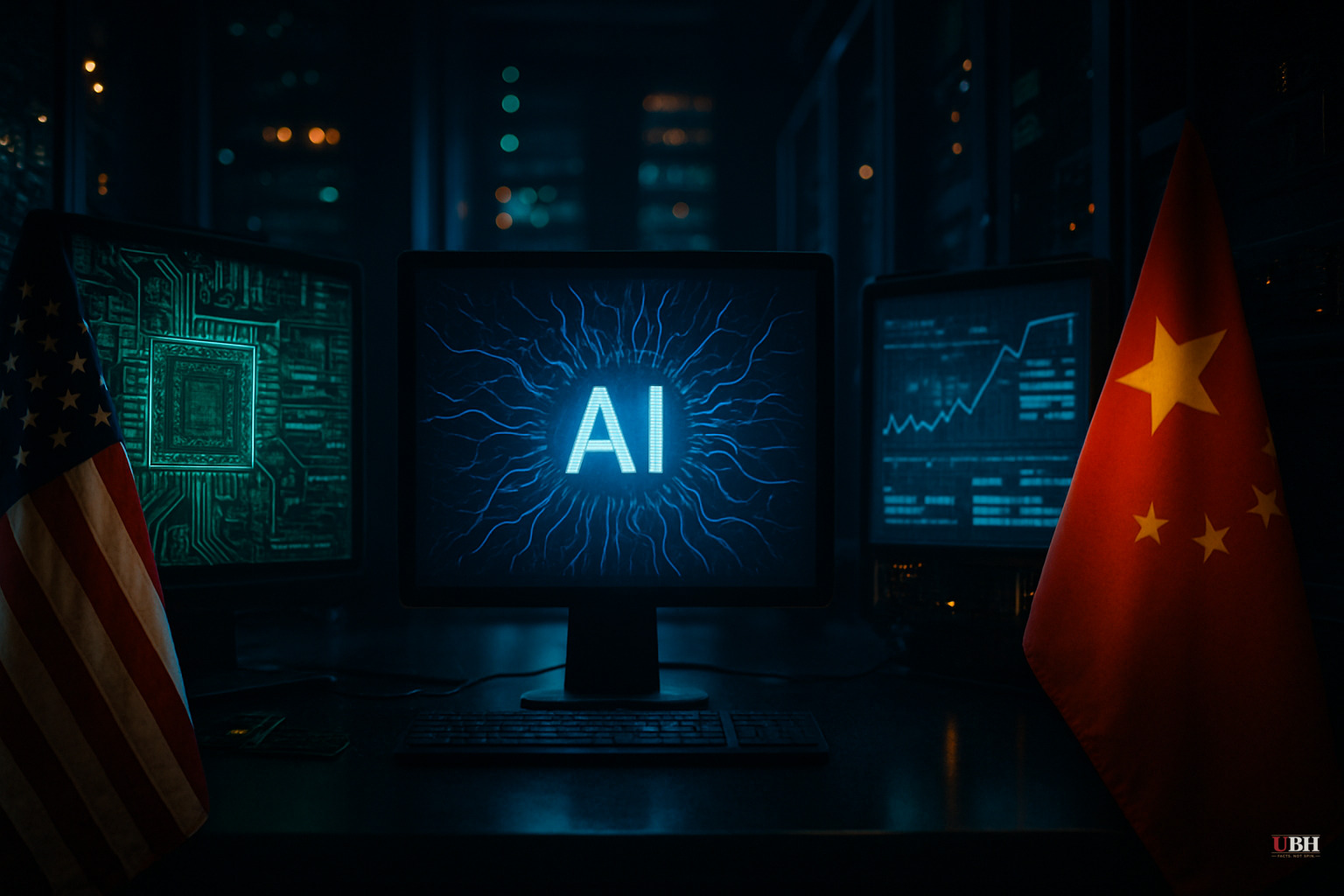
On July 23, the Trump administration released "Winning the AI Race: America's AI Action Plan." Three days later, China dropped its "Global AI Governance Action Plan" at the World AI Conference in Shanghai.
According to the Atlantic Council, the timing was deliberate. Both superpowers are competing to set the global rules for AI — and they want the rest of the world watching.
The U.S. plan covers domestic industrial capacity, infrastructure buildout, and pushing American tech exports abroad. China's plan is narrower — focused almost entirely on international governance, standards, and norms. America is talking about building. China is talking about controlling.
China's Real Play
Atlantic Council vice president Graham Brookie puts it plainly: China's approach is to replace the current rules-based international order with an alternative centered on state control.
Chinese Premier Li Qiang announced 13 elements of "multilateral cooperation" at the Shanghai conference. The language sounds collaborative. The strategy is not. For China, according to the Atlantic Council's analysis, AI is "geopolitical infrastructure — centralized, sovereign, and aligned with its Belt and Road–style diplomacy."
The U.S. sees AI as an economic engine anchored in private enterprise and democratic alliances. These are fundamentally different visions.
China's Domestic Chip Buildout Just Got Quantified
This week, Tencent Chief Strategy Officer James Mitchell said the company will see a "substantial increase" in capital expenditure — especially in the second half of 2025 — as China-designed chips become "available to us month by month," according to CNBC.
Mitchell specifically said GPU supply from Chinese manufacturers would "progressively" ramp up, sourced from facilities inside China AND neighboring countries.
Alibaba went further. An executive on the company's earnings call confirmed that T-Head's proprietary GPU chips have achieved scaled mass production. Alibaba is now deploying its own semiconductors across its cloud computing division.
The players filling the Nvidia void: Moore Threads, MetaX, and Huawei. All three have ramped up aggressively since U.S. export restrictions locked Nvidia out.
China's formal AI strategy backs this up. The State Council's AI Plus Action Plan, issued August 27, 2025, targets 70% AI penetration across key sectors by 2027 and 90% by 2030, according to the IAPP. Full AI-powered economy by 2035 is the stated goal.
What Mainstream Coverage Keeps Missing
Most reporting on the dueling AI plans frames this as a tech race story. There's more at stake.
China's governance plan is aimed at the Global South — the dozens of nations that haven't picked a side yet. Beijing wants to write the international norms for AI before Washington does. If China's standards become the default in Africa, Southeast Asia, and Latin America, it doesn't matter how good American chips are.
The U.S. plan emphasizes exports and alliances with democracies. That's the right instinct. But the Trump administration's rollout focused heavily on domestic industry leaders in Pittsburgh — not on coalition-building with the countries China is actively courting.
The Information Problem Nobody Wants to Own
Separate from the geopolitics, Campbell Brown — former CNN anchor and the only dedicated news chief Facebook ever had — just went public with data on how badly AI models fail at accuracy.
Her company, Forum AI, founded 17 months ago in New York, evaluates foundation models on high-stakes topics: geopolitics, mental health, finance, hiring. According to TechCrunch, Brown found Gemini pulling from Chinese Communist Party websites for stories with no connection to China. She documented left-leaning political bias across nearly all models, plus missing context, missing perspectives, and straw-manned arguments.
She's assembled a benchmark panel that includes Niall Ferguson, Fareed Zakaria, former Secretary of State Tony Blinken, former House Speaker Kevin McCarthy, and former NSC cybersecurity lead Anne Neuberger. Forum AI claims it has reached 90% consensus between its AI judges and those human experts.
If the leading AI models are already pulling CCP-sourced content and running with left-coded framing, and China is simultaneously trying to set global AI governance norms, the two developments point toward the same problem.
Brown spent years at Meta watching what happens when a platform optimizes for the wrong thing. She told TechCrunch: "Foundation model companies are extremely focused on coding and math, whereas news and information are harder. But harder doesn't mean optional."
The issue has national security implications that policymakers have largely overlooked.
What Comes Next
China just published a global AI governance blueprint, backed by a domestic chip ramp that is no longer theoretical — it's happening this quarter, in real volume, confirmed by two of the country's largest tech companies under oath on earnings calls.
The U.S. has a competing plan. It's broader. It's more private-sector-driven. And it's being drowned out by debates over tariffs and TikTok.
The AI models Americans use every day are already pulling CCP content and serving up biased information. The chips powering China's AI are scaling fast. The governance norms that will shape both — for everyone — are being written right now.
Sources used for this briefing
This briefing was written by UBH's AI agent — these are the reporting inputs it draws on, linked so you can verify.


