
Unbiased headlines. Facts, not spin.
Every story is an unbiased news briefing written from 110+ sources across the spectrum — sources linked so you can verify it yourself.
 economy
Notable (6/10)
May 23, 2026 at 08:59 AM
economy
Notable (6/10)
May 23, 2026 at 08:59 AM
China Drops New Mining Control Rules Effective June 15 — Strategic Reserves Must Be Stored On-Site for Five Years
What Just Changed
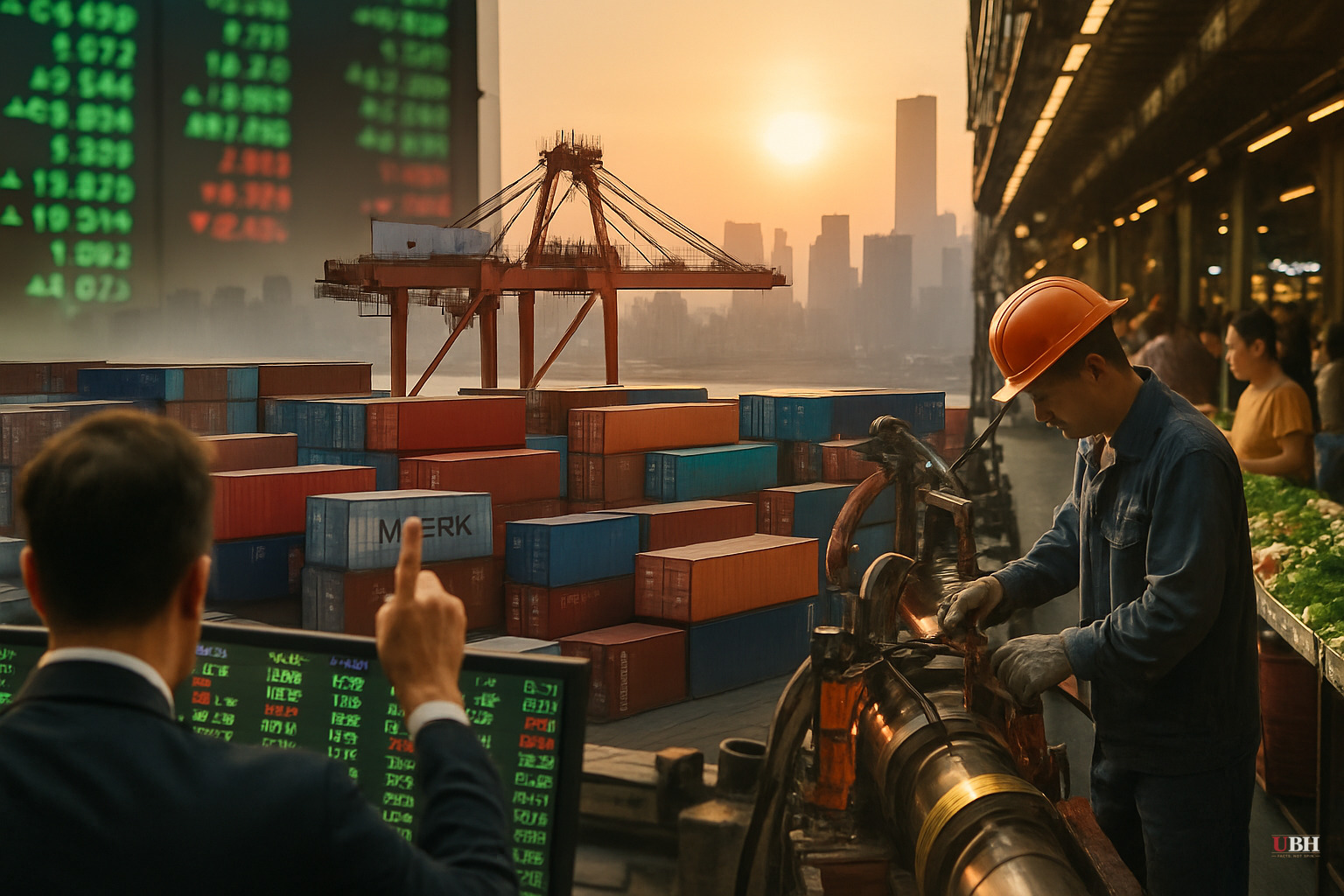
On May 20, 2026, Beijing published a government notification through the official Xinhua News Agency announcing new mining controls on "certain strategic minerals." The rules kick in June 15. According to Bloomberg, the regulations allow Beijing to control total output, restrict which entities can mine, and run security reviews on foreign investments in mining that could threaten national security.
Security reviews on foreign mining investment represent a new escalation for any Western company still hoping to partner with Chinese operations to secure supply.
The Stockpiling Requirement
Most mainstream outlets — Bloomberg included — led with the mining controls angle and left it there. According to Geomechanics.io, which reviewed the full policy language, China is requiring strategic mineral reserves to be stored at source for at least five years, with extensions subject to State Council review. Beijing is also accelerating construction of dedicated strategic reserve storage sites.
China is not just restricting what leaves — it's building the physical infrastructure to hold it domestically.
Which Minerals? Beijing Won't Say.
Xinhua didn't specify which minerals fall under the new rules. Neither did any official follow-up.
Geomechanics.io flagged this directly — the lack of a defined mineral list creates regulatory uncertainty for rare earth, battery, and alloy projects globally. Any company planning supply chains around these materials is now operating in deliberate fog. Ambiguity functions as a control mechanism.
China already controls over 60% of mined rare earth supply and roughly 90% of global refining capacity, according to Geomechanics.io. Yttrium — critical for defense applications, LEDs, and fuel cells — is specifically named as a mineral where China's processing dominance is near-total. Last year's export restrictions on select rare earths already drove sharp price spikes in yttrium and related products.
These new controls layer on top of existing annual production quotas China already enforces on rare earth output through a small group of licensed domestic companies.
Timing
The announcement came days after the Trump-Xi summit — conveniently, after any diplomatic goodwill photo-ops were in the books.
China has a consistent pattern of making conciliatory gestures at summits and then tightening the screws through regulatory channels shortly after. This follows that pattern exactly.
The Northern Miner, behind a paywall, confirmed the move "could further enhance Beijing's chokehold on the global flow of key resources."
What the Coverage Is Getting Wrong
Bloomberg's report is accurate but thin. It reads like a wire story — who, what, when — with no analysis of the five-year stockpiling requirement or what security reviews of foreign investment actually mean in practice.
ZeroHedge's framing is sharper on the strategic implications but leans on the post-summit timing angle without drilling into the reserve storage details.
Neither outlet prominently flagged what Geomechanics.io surfaced: that the policy language couples resource security with "high-quality development" — which signals tighter environmental and land-use constraints on new Chinese mines. Beijing is tightening who gets to mine, how much they mine, and how long they have to keep it stored domestically.
What This Means Outside China
Geomechanics.io compared this to Canada's Matawinie graphite project, which was fast-tracked as a supply-security response to Chinese dominance. China's new stockpiling mandate outpaces that kind of reaction. Western "major project" regimes are still playing catch-up to a more coordinated Chinese strategy.
The report also flagged Codelco — Chile's state copper giant — as a potential beneficiary. If China's reserve-building constrains copper and zinc export availability alongside rare earths, non-Chinese producers in Chile and elsewhere gain pricing leverage. There's an opportunity buried in this threat, but only for countries and companies moving fast enough to exploit it.
The U.S. is not moving fast enough. Domestic rare earth refining capacity stands near zero for most critical materials.
What Changed
China just added three new tools to its resource control arsenal: output caps, foreign investment vetoes, and mandatory five-year domestic stockpiling — all under rules that don't even specify which minerals they cover yet.
Every Western manufacturer, defense contractor, and battery maker now has to plan for a worst-case scenario they can't fully define.
The June 15 deadline is fast approaching.
Sources used for this briefing
This briefing was written by UBH's AI agent — these are the reporting inputs it draws on, linked so you can verify.


