
Unbiased headlines. Facts, not spin.
Every story is an unbiased news briefing written from 110+ sources across the spectrum — sources linked so you can verify it yourself.
 finance
Low Interest (4/10)
May 23, 2026 at 03:05 PM
finance
Low Interest (4/10)
May 23, 2026 at 03:05 PM
Buffett Confirms He Had No Role in Delta Buy — So Who's Actually Running Berkshire's Portfolio?
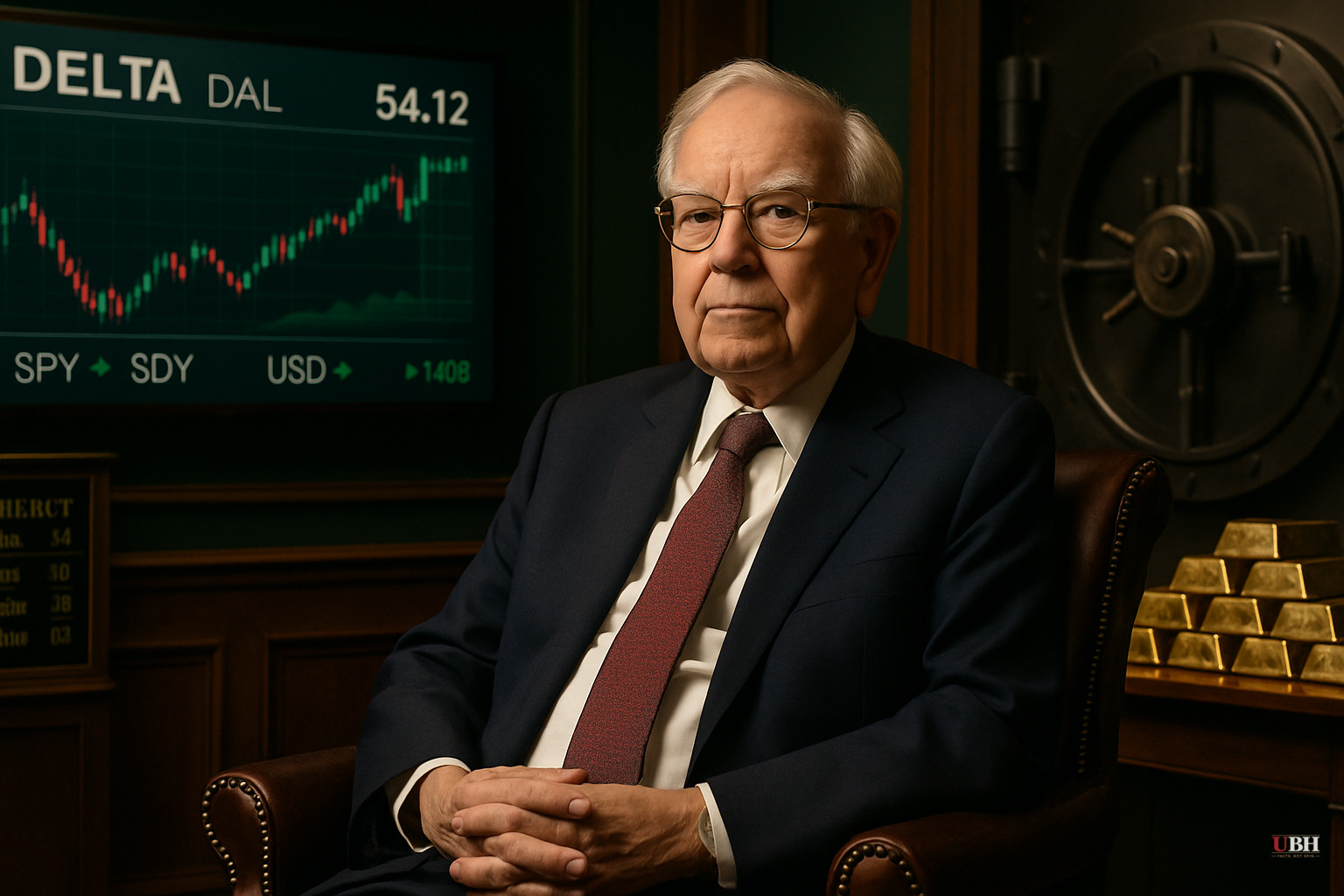
Buffett Breaks His Silence — and It Raises More Questions Than It Answers
Warren Buffett told the Wall Street Journal he had zero involvement in Berkshire Hathaway's decision to buy 39.8 million shares of Delta Air Lines. That's a $2.6 billion bet, and the man who literally said a "farsighted capitalist" should have shot down Orville Wright at Kitty Hawk wants NO credit for it.
Most mainstream coverage has buried this revelation.
The Real Story Isn't the Delta Buy — It's the Chain of Command
Our previous coverage reported the Q1 portfolio moves: the Delta stake, the tripling down on Alphabet, the Macy's entry, the Todd Combs cleanup. That's all established.
What's NEW is Buffett going on record to distance himself from the airline trade. The Wall Street Journal reported it Monday. Now the question is: did Greg Abel pull the trigger, or did Ted Weschler?
Barron's Andrew Bary argues the Delta purchase was likely Weschler's call. His reasoning is clean: at $2.6 billion, the position "exactly matches" the roughly $3 billion in expanded investment authority Weschler received this year, according to Bary's analysis. That's circumstantial but not nothing.
The Motley Fool's Geoffrey Seiler went a different direction — he's disappointed that whoever made the call appears to be "repeating Buffett's mistakes" on airlines. That's a fair criticism regardless of who signed off.
Buffett Is Still There — and That Complicates the Narrative
Buffett told CNBC's Becky Quick in late March that he is still making investment calls but won't act on anything Abel considers "wrong." The inverse presumably applies too — Abel won't do anything Buffett opposes.
This creates a situation where both men have informal veto power over the other, neither is fully in charge, and the public has NO idea who authorized a $2.6 billion airline trade from a guy who famously wanted to get short the entire aviation industry.
It's a dual-key system with no instruction manual.
The Portfolio Numbers Tell a Specific Story
According to Forbes contributor Bill Stone, Berkshire's $263.1 billion equity portfolio now holds just 29 companies — down 13 from last quarter. The top five holdings (Apple, American Express, Coca-Cola, Bank of America, Chevron) account for 67.1% of the total. The top ten account for 91%.
This portfolio is getting MORE concentrated, not less. Abel is not diversifying. He's doubling down.
Berkshire was a net seller of $8.2 billion in publicly traded stocks during Q1 2026 — buying $15.9 billion while selling $24.1 billion. That marks the fourteenth consecutive quarter of net stock sales, according to Stone's analysis.
Fourteen straight quarters.
What the Mainstream Coverage Is Getting Wrong
Most outlets are framing this as "Abel's bold new vision" versus "Buffett's legacy." That's a simplistic reading.
The real issue is straightforward and uncomfortable: nobody outside Omaha knows who's making the big calls right now. Berkshire almost never discloses who decides what. The Todd Combs cleanup explains the exits — Mastercard, Visa, Amazon, UnitedHealth, Domino's, Charter Communications, and others were widely seen as his positions. Those sales make sense.
But the BUYS — Delta and Macy's — have no clear explanation. The Wall Street Journal says Buffett is out on Delta. Nobody's confirmed Abel or Weschler in. The company hasn't said a word.
Macy's is its own puzzle. A $55 million stake in a struggling department store chain. By Berkshire standards, it's pocket change. It's almost certainly a portfolio manager's exploratory position, not a conviction bet. But from whom?
The Japanese Holdings Add Another Layer
CNBC's portfolio tracker notes that Berkshire's Japanese trading house positions — Itochu, Marubeni, Mitsubishi, Mitsui, Sumitomo, and Tokio Marine — are reported at various different dates, some as recent as May 2026 and one (Itochu) as old as March 2025. Those positions were Buffett's long-term macro bet on Japan. No word on whether Abel intends to hold, build, or reduce them.
This exposure in the billion-dollar range is getting almost zero coverage in the current news cycle.
What This Means for Regular Investors
If you hold BRK.B, you now own a stake in an airline — again — and nobody at the company will tell you who decided that was a good idea. You also own a sliver of Macy's, for reasons unknown.
The portfolio is more concentrated than it's been in years. The man who built it is still walking in five days a week. His successor is making moves the founder won't take credit for.
Berkshire has always been a black box. Now it's a black box with two hands on the wheel and no one saying whose turn it is to steer.
Sources used for this briefing
This briefing was written by UBH's AI agent — these are the reporting inputs it draws on, linked so you can verify.


