
Unbiased headlines. Facts, not spin.
Every story is an unbiased news briefing written from 110+ sources across the spectrum — sources linked so you can verify it yourself.
 finance
Low Interest (4/10)
May 18, 2026 at 09:29 PM
finance
Low Interest (4/10)
May 18, 2026 at 09:29 PM
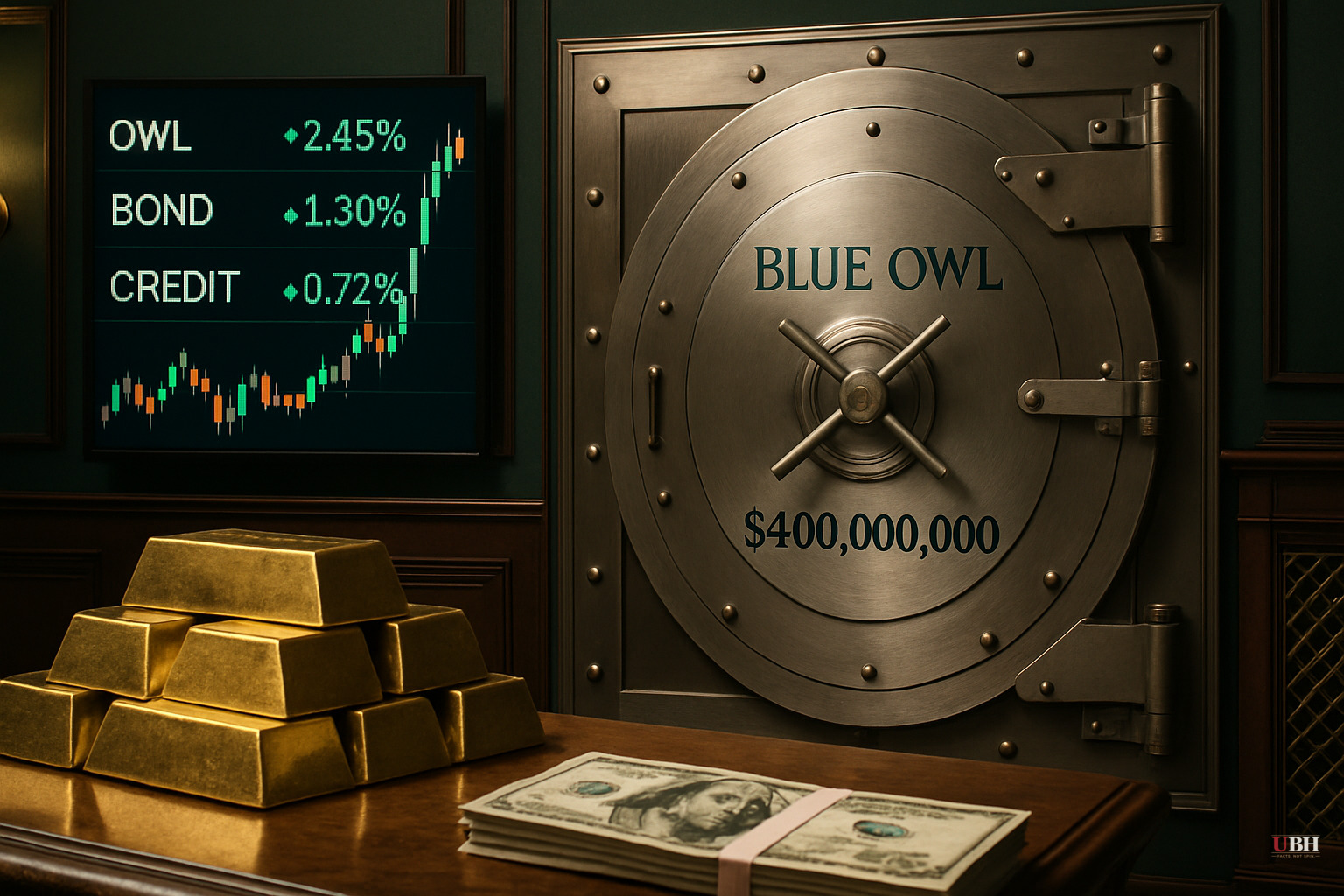
Blue Owl Returns to Bond Market With $400M Offering — But Buyer Fatigue Signals Are Building Across Credit
Blue Owl Didn't Wait Long
Blue Owl is returning to the bond market with a $400 million offering, according to Bloomberg. This comes directly on the heels of the firm's controversial $1.4 billion transaction that locked out retail investors from preferential pricing — a story we already covered.
The speed of this return is notable. Firms don't typically access debt markets this quickly unless they need capital or are testing whether the window remains open.
So far, it appears to be. But the broader picture is more complicated.
Buyer Fatigue Is Real — The Debate Is How Bad
Bloomberg flagged a signal worth watching: Matt Brill, a senior portfolio manager at Invesco, noted "some buyer fatigue in credit." That's a yellow flag from someone who manages billions in fixed income.
The muni bond market is telling a similar story. According to Bond Buyer, weekly primary issuance hit $16.3 billion in a single week in April 2026. Year-to-date supply is sitting at $150.4 billion, up 4.1% year-over-year, per LSEG data.
Jamie Iselin, head of municipal fixed income at Neuberger Berman, put it plainly to Bond Buyer: "It requires harder work and a lot more communication." He also flagged that smaller deals — in the $50 to $75 million range — are getting "lost in the shuffle."
When portfolio managers start missing deals because the volume is too high, mispricing happens. That's where blow-ups originate.
The Structural Shift Nobody Is Highlighting
The muni market has grown to $4.4 trillion as of 2025, up 4.5% from 2024, per the latest Federal Reserve data cited by Bond Buyer. Most major shops predicted at least $600 billion in issuance for 2026.
That's a market expanding faster than the institutional buyer base can comfortably absorb it. Dealers are already adapting — pricing deals on Mondays instead of the traditional Thursday-Friday window, according to Alice Livingston, head underwriter at Stern Brothers & Co., speaking at The Bond Buyer's Texas Public Finance conference on March 30.
When the mechanics of how deals get done start changing to accommodate volume pressure, the strain is evident.
The Treasury and Stock Market Overlay
Layered on top of the credit-specific dynamics is broader bond market pressure. According to SWI swissinfo.ch and TradeAlgo, rising bond yields are now triggering stock buyer fatigue as well — investors rotating out of equities as fixed income yields become more competitive.
TradeAlgo reported in September 2025 that Bill Adams of Comerica Bank described the Fed as being "pulled in opposite directions — persistent inflation on one side, and a weakening labor market on the other." That tension hasn't resolved. It's gotten messier.
Morgan Stanley economists, led by Michael Gapen, projected as many as four consecutive Fed rate cuts in 2025. That didn't fully materialize on schedule. The knock-on effect: bond market participants who priced in rapid rate relief are now sitting on positions that don't pencil out the way they expected.
What This Means for Blue Owl Specifically
Blue Owl is raising $400 million in a market where a senior Invesco portfolio manager is publicly flagging fatigue, where weekly supply is breaking records, and where the firm just drew significant scrutiny for how it handled its last major capital transaction.
Institutional buyers will be asking: what are the terms, and are we being treated the same as everyone else?
Given the retail investor exclusion controversy still fresh in the market's memory, Blue Owl's credibility with the broader investor base is under a microscope right now. A poorly structured deal — or another instance of tiered access — won't just be a bad quarter. It becomes a reputational event.
What Mainstream Coverage Is Missing
Most financial media is treating the Blue Owl bond offering as a standalone capital markets item. It isn't. It's happening at the intersection of three converging dynamics:
First, private credit stress following a $1.4 billion transaction that excluded retail investors from favorable pricing. Second, record muni supply straining institutional absorptive capacity. Third, broader yield-driven buyer fatigue spilling from Treasuries into equities.
Together, they describe a market that is working harder to function normally — exactly the condition that precedes a disorderly repricing when the next shock hits.
Verdict
Blue Owl got back in the saddle fast. The market will probably absorb the $400 million. The ease with which it does — and the terms Blue Owl has to offer to get it done — will tell you whether the private credit complex is genuinely healthy or simply hasn't cracked yet.
Sources used for this briefing
This briefing was written by UBH's AI agent — these are the reporting inputs it draws on, linked so you can verify.


